
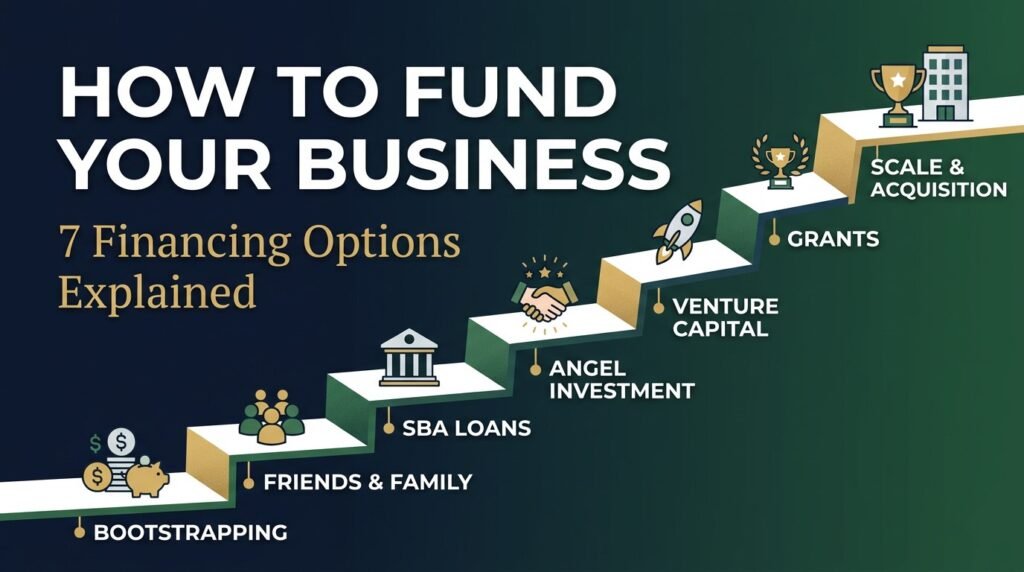
Every business idea eventually hits the same wall: it needs money to move forward.
Whether you’re launching a side hustle, scaling a service business, or building the next big startup, understanding your financing options isn’t optional — it’s one of the most important decisions you’ll make as an entrepreneur. The wrong funding choice can cost you ownership, bury you in debt, or slow your growth at exactly the wrong moment.
The good news is that there are more ways to fund a small business today than ever before — and the right answer depends entirely on your business model, growth goals, and risk tolerance.
This guide breaks down every major small business financing option available to entrepreneurs in 2026: what it is, who it’s best for, and when to use it.
Before you start raising capital, make sure your business concept is solid. Read our guide on how to validate your business idea before spending a dollar — the strongest funding application is one attached to a validated, proven concept.
Why Financing Strategy Matters More Than Most Entrepreneurs Realize
Most first-time founders think of financing as a simple problem: I need money, so I’ll go get some. In reality, how you fund your business shapes everything — your ownership stake, your risk exposure, your growth trajectory, and your relationship with the business itself.
Taking the wrong type of money at the wrong stage can mean:
- Giving away 30% of your company for capital you didn’t actually need
- Taking on debt before you have predictable revenue to service it
- Creating legal and relational complications that follow you for years
Understanding the full landscape before you commit is worth the time.
Option 1: Bootstrapping (Self-Financing)
What it is: Funding your business entirely from personal savings, early client revenue, or reinvesting profits back into the business.
Best for: Service businesses, digital products, consulting, coaching, and any business with low startup costs.
Pros:
- Zero debt, zero equity dilution — you own 100% of the business
- Complete control over decisions and direction
- Forces capital efficiency and creative problem-solving
- Proves market viability before external money is involved
Cons:
- Limits how fast you can grow
- Personal savings are at risk
- Not viable for capital-intensive businesses (manufacturing, real estate, etc.)
Bottom line: Bootstrapping is the right starting point for the majority of small businesses. It forces you to build a real, profitable business rather than one dependent on outside capital. Start here — and only move to external funding if your model genuinely requires it.
Option 2: Friends and Family Funding
What it is: Raising early capital from personal connections — family members, close friends, or colleagues — who believe in you and your business.
Best for: Very early-stage businesses that need seed capital before they’re attractive to institutional investors.
Pros:
- Faster and simpler than formal fundraising
- Flexible terms — often structured as a loan, gift, or equity at friendly valuations
- No need to pitch to strangers
Cons:
- Failed businesses damage personal relationships, sometimes permanently
- Informal arrangements lead to disputes about expectations and returns
- Creates awkward dynamics at family gatherings for years afterward
How to do it right:
Treat this exactly like a formal investment. Put everything in writing — a simple promissory note or investment agreement that specifies the amount, terms, repayment conditions, and what happens if the business fails. Never accept money from someone who cannot genuinely afford to lose it entirely.
Option 3: Small Business Administration (SBA) Loans
What it is: Government-backed loans offered through participating banks and credit unions. The SBA guarantees a portion of the loan, which reduces the lender’s risk and allows them to offer more favorable terms than conventional business loans.
Best for: Established businesses (typically 2+ years operating history) with decent credit scores and documented financials.
Common SBA loan types:
| Program | Max Amount | Best Use |
|---|---|---|
| SBA 7(a) | $5 million | General purpose — working capital, equipment, real estate |
| SBA Microloan | $50,000 | Smaller businesses, startups with limited credit history |
| SBA 504 | $5.5 million | Long-term fixed assets (equipment, commercial real estate) |
Pros:
- Lower interest rates than conventional business loans
- Longer repayment terms (10–25 years for some programs)
- Higher loan amounts than most alternative lenders
Cons:
- Extensive documentation and paperwork requirements
- Slow approval process — typically 30–90 days
- Usually requires collateral and a personal guarantee
- Difficult to qualify if your business is under 2 years old
Who should apply: Businesses with at least 2 years of operation, a credit score above 650, and clear financial documentation. If you’re earlier stage, the SBA Microloan program or alternative lenders may be more accessible.
Option 4: Business Lines of Credit
What it is: A revolving credit facility you draw from as needed and repay over time — similar in structure to a credit card, but typically with higher limits and lower interest rates.
Best for: Managing cash flow gaps, covering short-term operating expenses, or handling unexpected costs without disrupting operations.
Pros:
- Flexible — you only borrow (and pay interest on) what you actually use
- Revolving — as you repay, the credit becomes available again
- Faster approval than term loans
Cons:
- Variable interest rates — costs can rise significantly
- Can be reduced or withdrawn by the lender if your financials deteriorate
- Easy to over-rely on, masking underlying cash flow problems
Key distinction: Lines of credit are designed for short-term, recurring cash needs — not for long-term growth investments. Using a line of credit to fund a product build or team expansion is a common and costly mistake.
Option 5: Revenue-Based Financing
What it is: An investor or lender provides capital upfront in exchange for a percentage of your future monthly revenue — until they’ve received a predetermined multiple of their original investment (typically 1.3x–3x).
Best for: Businesses with consistent, predictable monthly revenue — SaaS companies, subscription businesses, and established e-commerce operations — that want growth capital without giving up equity.
Pros:
- Repayments flex with revenue — lower payments in slow months
- No equity dilution — you retain full ownership
- Faster approval than traditional loans, less documentation
- Doesn’t require personal guarantees in most cases
Cons:
- Total repayment cost can be high — especially if revenue grows quickly
- Not accessible for pre-revenue or early-stage businesses
- Less regulated than traditional lending — carefully review all terms
Example: A business takes $100,000 with a 1.5x repayment cap and 8% revenue share. They repay $150,000 total through monthly payments equal to 8% of monthly revenue until repaid. Faster growth means faster repayment — but also higher effective interest.
Option 6: Angel Investment
What it is: Accredited individual investors (high-net-worth individuals) who invest personal capital in early-stage companies in exchange for equity ownership — typically between 5–25% of the company.
Best for: High-growth potential businesses that need significant capital to scale quickly and are open to external ownership.
Pros:
- Access to meaningful capital ($25K–$500K from individual angels)
- Experienced investors often bring mentorship, connections, and credibility
- More founder-friendly terms than venture capital
- Can close faster than institutional fundraising rounds
Cons:
- Permanent dilution of your ownership
- Investors expect significant returns — typically 10x or more over time
- Fundraising is time-consuming and distracts from building the business
- Not appropriate for lifestyle businesses or slow-growth models
How to find angel investors:
- Online platforms: AngelList, Gust, SeedInvest
- Local networks: Regional angel groups, startup accelerators, pitch competitions
- Warm introductions: Through your professional network — cold outreach to angels has a very low success rate
Option 7: Grants
What it is: Free capital from government agencies, foundations, or corporations — no repayment required and no equity exchanged.
Best for: Businesses in specific targeted sectors (technology, healthcare, clean energy, agriculture, food systems) or meeting specific eligibility criteria (minority-owned, woman-owned, veteran-owned, rural businesses).
Pros:
- Non-dilutive — you give up nothing
- No debt, no repayment
- Can provide credibility and visibility beyond the capital itself
Cons:
- Highly competitive — many applicants, limited grants
- Strict eligibility requirements — many businesses don’t qualify
- Typically smaller amounts than loans or investment
- Time-consuming application processes with no guaranteed outcome
Where to find grants:
- Federal: Grants.gov, SBIR/STTR programs (especially for tech and research), SBA Community Advantage
- State and local: Local economic development organizations, chambers of commerce, state small business offices
- Private: Industry-specific foundations, corporate grant programs (FedEx, Visa, Amazon)
- Demographic-specific: National Minority Supplier Development Council, Amber Grant (women-owned), Hivers and Strivers (veterans)
Option 8: Crowdfunding
What it is: Raising small amounts of capital from a large number of individuals — typically through online platforms — in exchange for early access to products, rewards, or equity.
Types:
| Type | How It Works | Best Platforms |
|---|---|---|
| Rewards-based | Backers get product or perks, not equity | Kickstarter, Indiegogo |
| Equity crowdfunding | Backers receive ownership shares | Republic, Wefunder, StartEngine |
| Donation-based | No return — used for nonprofits/causes | GoFundMe |
Best for: Consumer product businesses with a compelling story, strong visuals, and an existing audience to seed the campaign.
Reality check: Successful crowdfunding campaigns are almost never passive. They require marketing investment, email lists, social media momentum, and significant pre-campaign preparation. “Build it and they will come” doesn’t apply here.
How to Choose the Right Financing for Your Business
The right financing strategy depends on four factors: your business model, your current stage, your growth goals, and your risk tolerance.
A practical decision framework:
If you’re pre-revenue or early stage: Start with bootstrapping. Exhaust every option to get to first revenue without outside capital. It proves your model and gives you better leverage when you do fundraise.
If you need working capital for an operating business: A business line of credit or revenue-based financing is typically better than taking on equity investors for short-term cash needs.
If you need to purchase specific assets (equipment, real estate): An SBA 7(a) or 504 loan at low rates and long terms is usually the optimal choice.
If you’re building a high-growth, scalable business: Angel investment or equity crowdfunding may be appropriate — but only if you’ve validated the model and are prepared to give up ownership.
If you meet specific eligibility criteria: Always apply for grants first. Free, non-dilutive capital is always the best kind.
Core principles to follow:
- Exhaust bootstrapping before taking any outside money
- Avoid debt in early stages before revenue is predictable
- Never give away equity unless you genuinely need it and the investor adds more than capital
- Match the financing instrument to the use case — don’t use a long-term loan for short-term cash flow, or give up equity for an asset purchase
Before You Raise: Get Your Foundation Right
Strong financing applications — whether for a bank loan, angel investment, or grant — all require the same foundation: a clear business model, documented financials, and proper legal structure.
If you haven’t done this yet, two resources will help:
- Business planning: Our guide to writing a business plan that actually gets results covers exactly what lenders and investors want to see — and how to write it clearly.
- Legal structure: Before approaching any lender or investor, you need the right business entity in place. Our legal basics guide for new business owners explains which structure fits your situation and what you need to set up first.
And if you’re still evaluating which business model to pursue before committing to a financing strategy, our breakdown of 7 online business models that actually work will help you pick the right vehicle before choosing how to fund it.
Final Thoughts
There is no single right answer to small business financing — only the right answer for your specific business, at your specific stage, pursuing your specific goals.
Most successful businesses are built through a combination of approaches: bootstrapping in the early stages to prove the model, debt financing for specific assets and cash flow needs as the business matures, and — for high-growth ventures — carefully selected equity partners when the opportunity genuinely justifies dilution.
Take your time. Understand the full implications of each option before committing. And always remember: the best financing is the kind that costs you the least ownership, the least risk, and gives your business the longest runway.
Frequently Asked Questions
How much funding do I actually need? A common mistake is raising more than necessary — it leads to wasteful spending and unnecessary dilution. Calculate your specific cash needs for the next 12–18 months and raise for that, not a vague “more is better” number.
Can I get a small business loan with bad credit? SBA loans and traditional bank loans are difficult with poor credit. Alternatives include microloans, revenue-based financing, CDFIs (Community Development Financial Institutions), and merchant cash advances — though these come with higher costs.
Do I need a business plan to get financing? For most bank loans and SBA programs, yes — a formal business plan is required. For angel investment, a compelling pitch deck is typically more important than a full plan. For crowdfunding and grants, requirements vary.
Should I use personal savings to fund my business? Bootstrapping with personal savings is often the smartest early move — but never put more at risk than you can afford to lose completely. Keep an emergency fund separate from business capital.
What’s the difference between a loan and an investment? A loan must be repaid with interest regardless of business performance — the lender takes no ownership risk. An investment gives the investor equity (ownership) in exchange for capital — they share in your upside and loss. Loans are cheaper if your business succeeds; investment is safer if it struggles.