
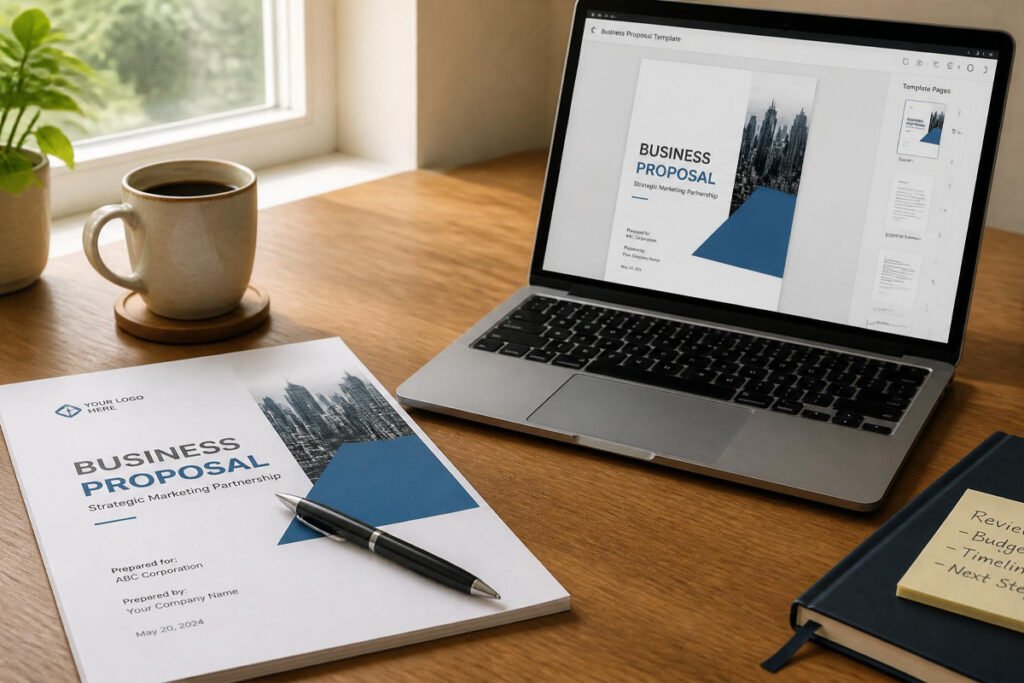
Staring at a blank page while a client deadline gets closer is one of the most common ways a good proposal never gets sent. You know the pitch. You know the pricing. What trips people up is structure — where the problem statement goes, how much detail the timeline needs, whether a one-pager will look thin or a ten-pager will look bloated.
This is usually a template problem, not a writing problem. Most new business owners either build a proposal from scratch every time (slow, inconsistent) or grab a generic template that doesn’t match their industry, then spend an hour stripping out sections that don’t apply.
If you already know how to write a business proposal that wins clients, this guide is the next step: real templates and examples, organized by industry and proposal type, so you’re customizing a structure that already fits instead of building one from zero.
Quick Answer
The best business proposal template depends on what you’re pitching and who’s asking for it. A solicited proposal responding to an RFP needs to mirror the client’s exact requirements section by section. An unsolicited proposal reaching out cold needs a stronger problem statement up front, since the reader isn’t expecting you. A one-page proposal works for small, low-complexity jobs where speed matters more than detail. A full formal proposal with an executive summary, scope, timeline, and pricing table suits larger contracts, agency work, or anything over a few thousand dollars. Whatever the format, every strong proposal shares the same backbone: a clear problem statement, a scoped solution, transparent pricing, and a specific call to action.
Table of Contents
- What Is a Business Proposal Template?
- How to Choose the Right Template
- Best Business Proposal Templates by Type
- Template Comparison Table
- Templates for Different Industries
- How to Customize a Template Correctly
- Common Mistakes
- Expert Tips
- Final Thoughts
- Frequently Asked Questions
What Is a Business Proposal Template? {#what-is-it}
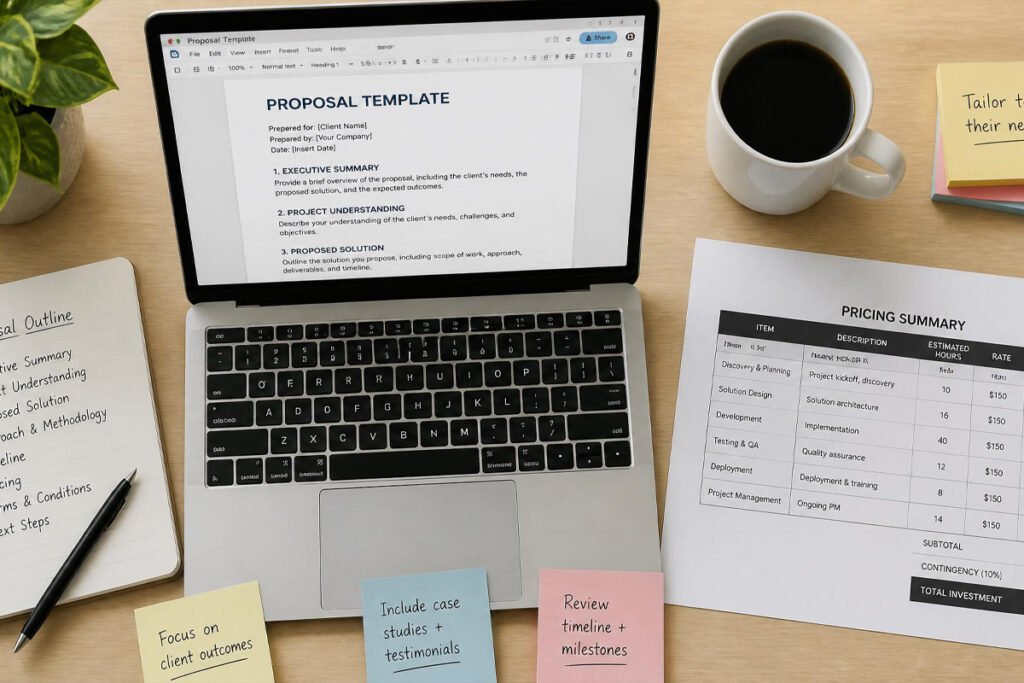
A business proposal template is a pre-built document structure with the standard sections a proposal needs already in place — you’re filling in client-specific details rather than deciding what sections to include from scratch. A good template already answers “what goes where” so your only job is the content itself.
Every solid business proposal template — regardless of industry — includes some version of these core sections: a cover page identifying both parties, a problem statement, a proposed solution or scope of work, a timeline, pricing, and a clear next step or call to action. What changes between industries is depth and emphasis: a construction proposal needs a detailed materials and timeline breakdown; a marketing proposal needs more room for strategy and expected results; a one-page proposal compresses all of this into a tight summary.
Understanding this distinction matters before you pick a template: structure is universal, but weighting is industry-specific. If you haven’t nailed the writing fundamentals yet, it’s worth pairing this with our guide on how to write a business proposal that wins clients, which covers tone, pricing psychology, and follow-up strategy in more depth than a template alone can.
How to Choose the Right Template {#how-to-choose}
Ask yourself three questions before picking a format:
Is this solicited or unsolicited? A solicited proposal — one requested via an RFP or a client’s direct ask — should follow their requested structure almost exactly, since evaluators are often scoring against a checklist. An unsolicited proposal needs a stronger opening hook, since the reader isn’t expecting you and hasn’t already agreed there’s a problem to solve.
How big is the engagement? A $500 one-off job doesn’t need the same ten-page document as a $50,000 annual contract. Match your template’s length to the size of the ask — an oversized proposal for a small job can look like you’re padding it, and an undersized one for a large contract can look under-prepared.
Does the client need to present this internally? If your contact needs to forward your proposal to a boss or committee, they need something that reads clearly without you in the room to explain it — favor a self-contained format with a strong executive summary over anything that leans on live pitch delivery.
Best Business Proposal Templates by Type {#best-templates}
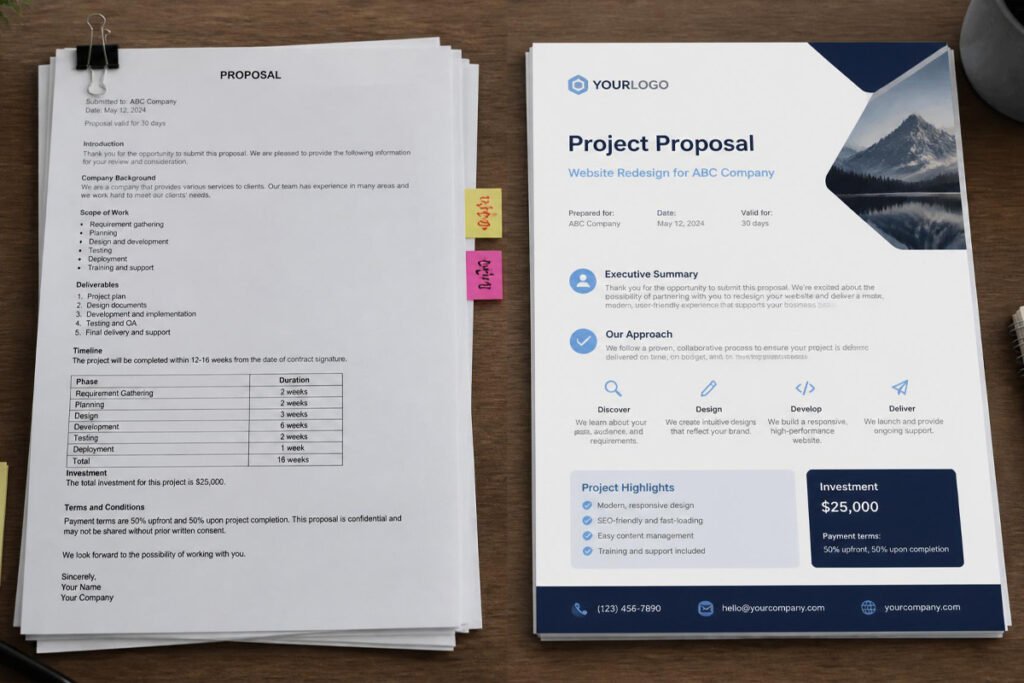
The One-Page Proposal
Overview: Distills the full proposal down to problem, solution, price, and next step, all on a single page. Built for speed, not depth.
Key Features:
- Fits on one printed page or screen without scrolling
- Skips extended company background and case studies
- Best delivered as a PDF for quick client review
Best For: Small jobs, fast-moving sales cycles, and clients who’ve already had a conversation with you and just need the details in writing.
Pros: ✅ Fast to write and fast to read ✅ Hard to lose the reader’s attention ✅ Easy to send from a phone or tablet on-site
Cons: ❌ Too thin for large or highly technical engagements ❌ Leaves little room for social proof or case studies
Our Verdict: A strong default for freelancers and small service businesses — pair it with the pricing psychology tips in our core proposal-writing guide to make sure the single page still lands.
The Formal / Full Business Proposal
Overview: The traditional multi-section document: cover page, executive summary, problem statement, scope of work, timeline, pricing table, terms, and signature block.
Key Features:
- Typically 4–10 pages depending on complexity
- Includes a dedicated executive summary for decision-makers who skim
- Room for case studies, testimonials, and a detailed pricing breakdown
Best For: Larger contracts, agency pitches, government or corporate clients, and anything requiring formal sign-off.
Pros: ✅ Thorough enough to answer objections before they’re raised ✅ Reads well even when forwarded to people who weren’t in the original conversation
Cons: ❌ Takes longer to write and customize per client ❌ Can feel like overkill for smaller, simpler jobs
Our Verdict: The right default whenever the deal size or client formality justifies the extra length — just resist the urge to pad it further than the job requires.
The RFP Response Template
Overview: Built to answer a formal Request for Proposal point by point, mirroring the exact structure and numbering the client specified.
Key Features:
- Follows the client’s requested section order exactly
- Often includes a compliance matrix showing where each requirement is addressed
- Heavier on qualifications and past-performance evidence than a standard pitch
Best For: Government contracts, enterprise procurement, and any formal bidding process with a published RFP document.
Pros: ✅ Reduces risk of disqualification for missing a required section ✅ Signals professionalism to evaluators scoring multiple bids
Cons: ❌ Rigid — little room for creative differentiation ❌ Can be lengthy depending on the RFP’s requirements
Our Verdict: Never freelance the structure here — copy the RFP’s requested outline directly into your template before writing a word of content.
The Executive Summary-Led Template
Overview: Leads with a punchy, one-paragraph summary of the entire proposal before any detail, designed for decision-makers who won’t read past the first page unless something grabs them.
Key Features:
- Summary paragraph states the problem, solution, and price upfront
- Full detail follows for whoever needs to dig deeper
- Works well as a hybrid between the one-pager and the full formal proposal
Best For: Busy executives, investor-facing pitches, or any proposal going to someone with limited time to review it.
Pros: ✅ Respects the reader’s time while still providing full detail for those who want it ✅ Increases the odds your key point gets read even if nothing else does
Cons: ❌ Requires strong summarization skill to avoid sounding vague
Our Verdict: Worth adopting as a habit across every template above — even a one-pager benefits from a tight opening summary sentence.
Template Comparison Table {#comparison-table}
| Template Type | Ideal Length | Best For | Structure Flexibility |
|---|---|---|---|
| One-Page Proposal | 1 page | Small jobs, fast sales cycles | High |
| Formal / Full Proposal | 4–10 pages | Larger contracts, agency pitches | Medium |
| RFP Response | Matches RFP length | Government/enterprise bids | Low (must match RFP) |
| Executive Summary-Led | 2–8 pages | Busy decision-makers, investors | High |
Templates for Different Industries {#industries}
Construction & Trade Services
Construction proposals need the heaviest logistics section of any template type: materials breakdown, phased timeline, permits and inspections, and a clear payment-milestone schedule tied to project phases rather than a single lump sum. If you’re pricing out a related trade business, our guides on starting a party rental business and similar service operations cover how to structure milestone-based pricing that plugs directly into this template style.
Marketing & Creative Agencies
Marketing proposals lean harder on expected outcomes and strategy than on line-item logistics. A strong template here front-loads the target audience and channel strategy, then transitions into a timeline with clearly defined deliverables per phase (e.g., “Month 1: audit and strategy,” “Month 2: campaign launch”). Case studies and past results carry more persuasive weight in this category than in almost any other.
Consulting & Professional Services
Consulting proposals need a detailed methodology section explaining how you’ll solve the problem, not just what the end result will be — clients in this category are often buying your process as much as your outcome. Pair this with clear engagement terms (hourly vs. retainer vs. fixed-fee) since ambiguity here is one of the most common sources of scope disputes later.
How to Customize a Template Correctly {#how-to}
Step 1: Match the Template to the Deal Size
Don’t send a ten-page formal proposal for a $400 job, and don’t send a one-pager for a $40,000 contract. Size the template to the ask before you start filling it in.
Step 2: Replace Boilerplate With Client-Specific Language
Swap generic phrases like “your organization” for the client’s actual name and specific pain points mentioned in your discovery conversation. This is the single biggest signal that separates a templated proposal from a copy-pasted one.
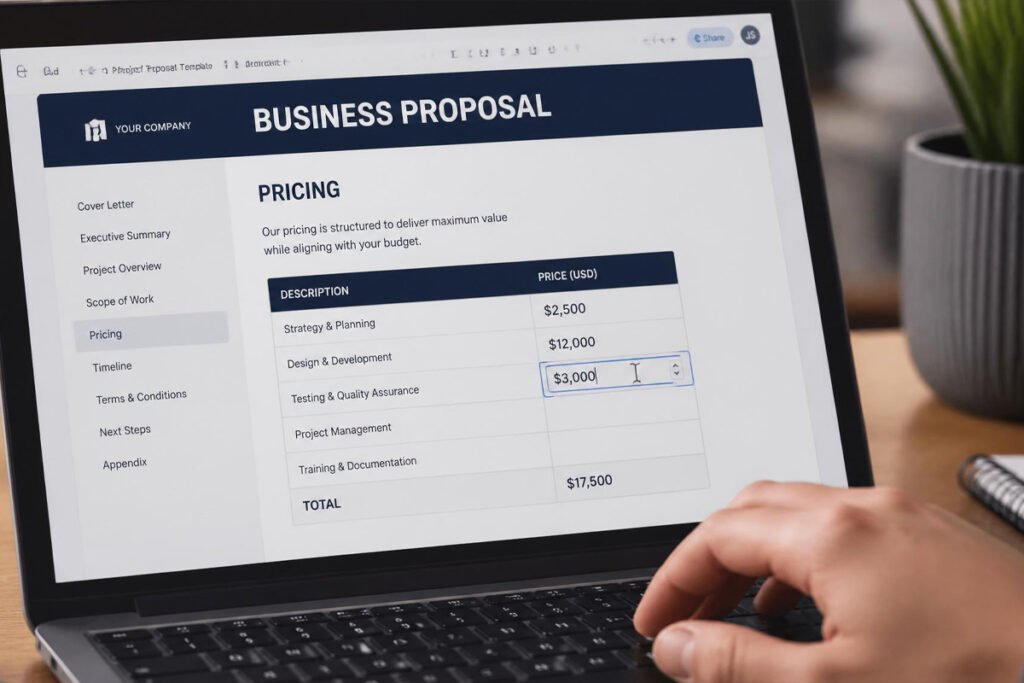
Step 3: Rebuild the Pricing Section for the Actual Scope
Never leave placeholder pricing structures untouched — rebuild the table to reflect the real deliverables, even if the layout stays the same.
Step 4: Cut Any Section That Doesn’t Apply
If a template includes a section irrelevant to this deal (like a maintenance plan for a one-time project), remove it entirely rather than leaving a thin, half-filled section.
Step 5: Proofread the Call to Action
The final section — what happens next, how to sign, and by when — is the most-skipped step when customizing a template quickly. Confirm it still matches this specific deal before sending.
Common Mistakes {#mistakes}
Using the same template regardless of deal size. A one-size-fits-all approach either under-serves large contracts or over-complicates small ones. Match template weight to the size of the engagement, the same way you’d scale a pricing structure to the scope of any service business.
Leaving template placeholder text in the final draft. Bracketed placeholders like “[Client Name]” or “[Insert Value Prop]” that slip through to the sent version are one of the fastest ways to lose credibility with a prospective client.
Ignoring the RFP’s requested structure. When responding to a formal RFP, freelancing your own section order — even a better one — can get a proposal disqualified before it’s evaluated on merit.
Expert Tips {#tips}
Keep three base templates, not one. A one-pager, a formal proposal, and an RFP-response shell cover nearly every deal you’ll encounter. Maintaining three ready-to-customize documents is far faster than building from scratch or over-editing a single generic template each time.
Build your pricing table as a separate reusable module. Since pricing structure often repeats across proposals even when project details change, keeping a clean, separate pricing table you can drop into any template saves significant editing time.
Track which template wins more often. If you’re sending proposals regularly, note which format (one-pager vs. full formal) closes more deals in your specific industry — the data usually points toward a clear house preference within a few months.

Final Thoughts {#final-thoughts}
Best overall: The formal proposal template, since its structure flexes well across most mid-size deals without needing a rebuild each time.
Best for speed: The one-page proposal, ideal when you’re sending several proposals a week and need a fast, repeatable format.
Best for competitive bids: The RFP response template, which protects you from disqualification on formatting grounds alone.
Whichever template you start from, the fundamentals matter more than the format — a clear problem statement, a scoped solution, honest pricing, and a specific next step. If you haven’t already, revisit our full breakdown on how to write a business proposal that wins clients to make sure the content inside whichever template you choose is doing its job.
Frequently Asked Questions {#faq}
Do I need a different template for every industry I work in? Not necessarily — the core structure (problem, solution, timeline, pricing, call to action) stays consistent. What usually changes is emphasis: construction needs more logistics detail, marketing needs more strategy and results framing.
How long should a business proposal be? It depends on deal size. Small jobs suit a one-page format; larger contracts typically run four to ten pages. Length should match complexity, not the other way around.
What’s the difference between a business proposal and a business plan? A business proposal pitches a specific project or engagement to a specific client. A business plan is a broader internal or investor-facing document outlining an entire company’s strategy, market, and financial projections.
Should I use a free template or pay for proposal software? Free templates in Word, Google Docs, or Canva work well for most small businesses. Paid proposal software adds e-signature collection, tracking (seeing when a client opens your proposal), and automated follow-ups — worth it once you’re sending proposals regularly enough that manual tracking becomes a burden.
How do I respond to an RFP using a template? Copy the RFP’s exact requested section order into your document first, then fill in content beneath each heading. Don’t reorganize their structure even if you think your own is clearer — evaluators often score against a checklist matching their original outline.
What should go in the executive summary of a proposal? A single paragraph stating the client’s core problem, your proposed solution, and the price — written so a busy decision-maker understands the entire pitch even if they read nothing else.
Can I reuse the same proposal for multiple clients? You can reuse the structure and boilerplate sections, but the problem statement, client name, and specific details must be customized every time. A proposal that reads as clearly copy-pasted is one of the fastest ways to lose credibility.
Do I need pricing broken into a table, or is a single total enough? A broken-down table (by phase, deliverable, or line item) builds more trust than a single lump sum, since it shows the client exactly what they’re paying for and makes it easier to negotiate individual items if needed.
What file format should I send my proposal in? PDF is the safest default — it preserves formatting across devices and looks more finished than an editable Word or Google Doc link, unless the client specifically requests an editable format for internal markup.
How do I know if my proposal template is actually working? Track your win rate by template type over several proposals. If one format consistently converts better in your industry, standardize on it rather than switching structures for every new pitch.
Author: Morne Winston Last Updated: July 2026