
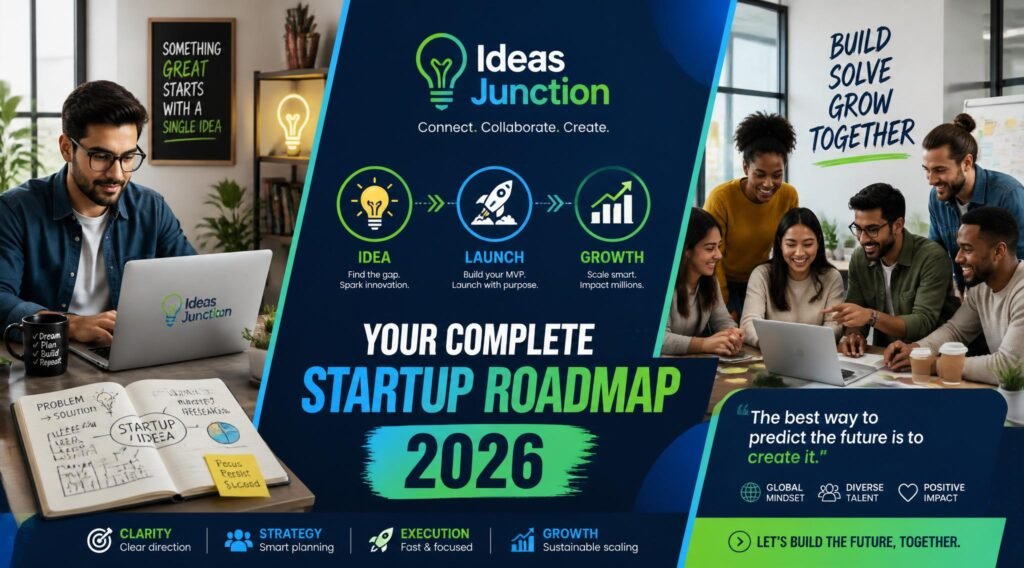
The entrepreneurial landscape has fundamentally transformed. What once required significant capital, physical infrastructure, and years of preparation now can be launched from your home with minimal investment and maximum speed. In 2026, the barriers to entry for starting a successful online business have never been lower, while the opportunities have never been greater.
Yet this accessibility comes with a critical challenge: not all ideas succeed. Without proper validation, strategic planning, and execution, even the most brilliant concepts fail. The difference between successful entrepreneurs and those who struggle isn’t talent or luck—it’s a structured approach to launching, validating, and scaling businesses.
This comprehensive guide synthesizes the essential knowledge every aspiring entrepreneur needs to transform ideas into profitable, scalable businesses. Whether you’re considering your first venture or your fifth, this roadmap provides the strategic framework for success.
Table of Contents
- The Modern Entrepreneur’s Mindset: Foundation for Success
- From Inspiration to Business Validation: Testing Your Ideas
- Choosing Your Business Model: Online Opportunities in 2026
- The Complete Passive Income Strategy Framework
- E-Commerce Excellence: Print on Demand Success
- The Dropshipping Deep Dive: Building Sustainable Profit
- Home-Based Businesses: Location Independence and Scale
- Market Research Mastery: Understanding Your Customers
- Launch Strategy and Customer Acquisition
- Scaling Your Business: Growth Systems and Expansion
1. The Modern Entrepreneur’s Mindset: Foundation for Success
Entrepreneurship has transitioned from a niche career path to a mainstream choice. Millions of people worldwide are building businesses while maintaining employment, studying, or managing other responsibilities. This democratization of entrepreneurship reflects fundamental economic shifts that favor agility, creativity, and self-direction over traditional corporate hierarchies.
Why 2026 Is the Year for Launching Your Business
The convergence of technological advancement, remote work normalization, and platform accessibility creates unprecedented opportunities:
Technology Democratization
- Cloud-based tools eliminate expensive infrastructure requirements
- AI-powered business automation handles complex tasks
- Digital marketing reaches global audiences affordably
- Payment processors accept micro-transactions reliably
Market Maturity and Opportunity
- Proven business models reduce trial-and-error costs
- Established platforms provide built-in customer bases
- Niche markets reward specialized expertise
- Global reach multiplies addressable market size
Workforce Evolution
- Remote work enables location-independent income
- Digital skills command premium compensation
- Portfolio-building becomes career advantage
- Entrepreneurial experience adds significant value
The Entrepreneurial Mindset Blueprint
Success requires specific psychological frameworks that distinguish thriving entrepreneurs from those who struggle:
Embrace Calculated Risk-Taking Successful entrepreneurs don’t avoid risk—they analyze it, quantify it, and accept it strategically. This differs fundamentally from reckless gambling. Every business decision involves risk evaluation.
Develop Resilience and Adaptability Setbacks are inevitable. Whether facing customer rejection, technical problems, or market shifts, resilience determines who perseveres. The most successful entrepreneurs view failures as learning experiences rather than endpoints.
Cultivate Customer Obsession Profitable businesses solve real problems for real customers. This fundamental truth shapes all strategic decisions. Your job isn’t to sell products—it’s to serve customers so well that they enthusiastically recommend you.
2. From Inspiration to Business Validation: Testing Your Ideas
The graveyard of failed businesses is filled with technically sound ideas that nobody wanted. Validation separates viable businesses from interesting concepts.
The Validation Imperative
Business validation transforms assumption into evidence. It answers critical questions: Do customers actually want this solution? Will they pay for it? At what price point? What problems matter most to them?
This essential guide covers:
- Market size assessment methodologies
- Customer interview techniques that reveal truth
- Competitive landscape analysis frameworks
- Positioning strategy development
- Validation metrics and decision-making criteria
Quick Validation Framework: The Lean Approach
Phase 1: Assumption Documentation (Week 1) Write down every assumption your business depends on:
- “Customers will pay $X for this solution”
- “My target market includes professionals aged 25-45”
- “There are 50,000+ potential customers in my niche”
- “Competitors charge $Y but my value justifies premium pricing”
Phase 2: Problem Validation (Weeks 2-3) Interview potential customers about the problem:
- “How do you currently solve this problem?”
- “How much time does this problem cost you weekly?”
- “What would a solution need to do to be valuable?”
- “How much would solving this be worth?”
Never pitch your solution. Focus entirely on understanding their world.
Phase 3: Solution Testing (Weeks 3-4) Create a minimal viable version and gather feedback:
- Build a landing page describing your solution
- Drive targeted traffic to measure interest
- Conduct customer interviews about your proposed solution
- Measure willingness to pay through pre-sales
Phase 4: Market Validation (Ongoing) Make initial sales or secure commitments:
- Achieve 10+ customer commitments from your target market
- Understand which features drive purchasing decisions
- Document pricing acceptance levels
- Identify unexpected customer segments or use cases
3. Choosing Your Business Model: Online Opportunities in 2026
The variety of viable online business models has exploded. Each offers distinct advantages, profit structures, and scaling potential. Choosing the right model dramatically impacts your path to profitability.
The Major Online Business Model Categories
Information and Education-Based Businesses Monetizing specialized knowledge through courses, coaching, consulting, or digital products.
Advantages:
- High profit margins (digital products cost minimal per-unit)
- Scalability through automated distribution
- Builds personal brand and authority
- Leverages existing expertise
Considerations:
- Requires credibility and demonstrated expertise
- Market saturation in popular niches
- Customer education investment needed
- Ongoing content creation demands
Product-Based Businesses Selling physical or digital products, either manufactured or resold.
Advantages:
- Clear revenue model
- Product quality builds brand loyalty
- Intellectual property protection possible
- Multiple distribution channels
Considerations:
- Inventory or manufacturing logistics
- Upfront capital investment often required
- Competitive product markets
- Supply chain dependencies
Service-Based Businesses Providing specialized services to clients.
Advantages:
- Leverage existing skills immediately
- Build deep client relationships
- Often requires minimal startup capital
- Premium pricing for specialized expertise
Considerations:
- Time-traded-for-money model limits scaling
- Personal brand dependency
- Client acquisition costs
- Service delivery logistics
Platform/Marketplace Businesses Creating platforms where others buy and sell.
Advantages:
- Network effects drive exponential growth
- Massive scaling potential
- Multiple revenue streams
- Defensible competitive advantages
Considerations:
- Chicken-and-egg problem (need supply and demand)
- Complex platform management
- Significant capital often required
- Complex regulatory considerations
4. The Complete Passive Income Strategy Framework
“Passive income” has become entrepreneurship’s most misunderstood term. True passive income requires significant upfront effort, careful planning, and continued optimization. However, the reality—earning while you sleep—remains compelling.
Understanding Income Leverage
Passive income works by decoupling effort from payment. Traditional employment trades time for money at a 1:1 ratio. Business ownership creates leverage where single efforts generate multiple income streams.
Passive Income Models for 2026
This detailed guide covers:
- Investment-based passive income streams
- Content and digital asset monetization
- Automated business models
- Royalty and licensing opportunities
- Realistic income expectations by model
- Time-to-profitability analysis
Building Your Passive Income Strategy
Layer 1: Content Production Create valuable content that solves problems or entertains:
- Blog posts optimized for search ranking
- YouTube videos building audience loyalty
- Social media content establishing authority
- Podcasts or audio content for niche audiences
Layer 2: Monetization Mechanisms Apply multiple revenue models to audience:
- Advertising (Google AdSense, sponsorships)
- Affiliate marketing (commission on recommendations)
- Digital products (e-books, courses, templates)
- Premium memberships or subscriptions
Layer 3: Automation and Delegation Remove yourself from operational tasks:
- Email automation for customer nurturing
- Social media scheduling and automation
- Customer service chatbots
- Affiliate network management
Layer 4: Optimization and Growth Continuously improve margins and reach:
- Analyze which content drives highest monetization
- Expand successful revenue streams
- Reduce traffic acquisition costs
- Build strategic partnerships
5. E-Commerce Excellence: Print on Demand Success
Print-on-demand represents a revolutionary e-commerce model: profitable product businesses without inventory, manufacturing, or fulfillment logistics. This eliminates the traditional barriers to physical product entrepreneurship.
The Print-on-Demand Advantage
Print-on-demand platforms handle manufacturing, quality control, and shipping. You control design, marketing, and customer experience. This division of labor enables entrepreneurs without manufacturing expertise or capital to build profitable product businesses.
Comprehensive Print-on-Demand Implementation
This extensive guide provides:
- Platform selection and comparison
- Design creation and sourcing strategies
- Product selection for market demand
- Marketing and customer acquisition tactics
- Pricing strategy for profitability
- Scaling successful designs and products
Building Your Print-on-Demand Business
Step 1: Niche Selection and Validation Choose a target market with demonstrated demand:
- Identify underserved design or message niches
- Research existing competitor offerings
- Survey potential customers about design preferences
- Validate market size and willingness to pay
Step 2: Design and Product Strategy Create designs that appeal to your target market:
- Study successful designs in your niche
- Create original designs or commission designers
- Test designs through landing pages
- Iterate based on customer feedback
Step 3: Platform and Store Setup Establish your storefront:
- Select print-on-demand platform (Printful, Merch by Amazon, etc.)
- Configure product listings and pricing
- Optimize product descriptions for search
- Set up payment processing and customer service
Step 4: Marketing and Customer Acquisition Build audience and drive traffic:
- Target design-related keywords for organic search
- Build social media presence around design style
- Leverage TikTok and Instagram for visual content
- Consider paid advertising for validated designs
Step 5: Scaling and Optimization Grow revenue through expansion:
- Expand product lines (shirts, hoodies, mugs, etc.)
- Create design variations appealing to broader audiences
- Develop seasonal or trending designs
- Build email list for repeat customer marketing
6. The Dropshipping Deep Dive: Building Sustainable Profit
Dropshipping presents another inventory-free e-commerce model: reselling products manufactured by others, shipping directly to customers. This model requires less upfront investment than traditional retail but demands strong marketing and customer service.
Dropshipping Reality Check
Dropshipping success requires understanding both its advantages and its challenges. Unlike influencer marketing’s glamorous portrayal, real dropshipping profitability depends on operational excellence and customer focus.
Building Profitable Dropshipping Ventures
This detailed guide covers:
- Supplier vetting and verification
- Product selection methodologies
- Store setup and optimization
- Customer acquisition strategy
- Profitability mechanics and margin analysis
- Scaling successful product categories
Critical Success Factors in Dropshipping
Supplier Relationships Your suppliers determine product quality, shipping times, and profitability. Cultivate relationships with reliable partners:
- Verify supplier credentials and customer reviews
- Understand their quality control processes
- Negotiate favorable payment terms
- Establish communication protocols for issues
Customer Service Excellence Products drop shipped from factories are indistinguishable from competitors. Superior service creates competitive advantage:
- Respond to inquiries within 24 hours
- Provide accurate shipping estimates
- Address problems proactively
- Build repeat customer relationships
Marketing Efficiency Dropshipping’s thin margins demand efficient customer acquisition:
- Master one marketing channel deeply
- Optimize conversion funnels continuously
- Build email lists for repeat customers
- Leverage customer testimonials and social proof
7. Home-Based Businesses: Location Independence and Scale
The revolution in remote work has normalized home-based businesses. Beyond convenience, remote work enables entrepreneurs to dramatically reduce overhead costs while accessing global markets.
The Home-Based Business Advantage
Starting from home eliminates rent, commute costs, and infrastructure expenses. This dramatically accelerates profitability timelines while reducing financial risk.
Building Scalable Home-Based Enterprises
This detailed guide covers:
- Legal and licensing requirements by jurisdiction
- Home office setup for productivity and professionalism
- Time management and work-life balance strategies
- Customer service delivery from home
- Marketing and professional brand building
- Scaling beyond home-based constraints
Home-Based Business Success Framework
Zone 1: Professional Space Create dedicated workspace separate from living areas:
- Physical separation maintains professional mindset
- Dedicated office supports work-life boundaries
- Professional background enhances video calls
- Reduces distractions and improves productivity
Zone 2: Operations Management Establish efficient business systems:
- Client management and scheduling software
- Project tracking and deadline management
- Financial tracking and accounting systems
- Customer communication protocols
Zone 3: Scaling Strategy Build systems enabling growth beyond personal capacity:
- Document all processes for delegation
- Hire virtual assistants for administrative tasks
- Build teams in different time zones
- Create products or services reducing personal involvement
8. Market Research Mastery: Understanding Your Customers
Successful businesses are built on intimate customer understanding. Market research transforms vague assumptions into detailed customer knowledge that shapes every strategic decision.
The Strategic Importance of Market Research
Market research answers critical business questions:
- Is there sufficient market demand?
- What problems do customers prioritize?
- Who are the primary decision makers?
- What drives purchasing decisions?
- How much will customers pay?
- What language resonates with your market?
Without market research, you’re operating on hope rather than evidence.
Comprehensive Market Research Methodology
This comprehensive resource provides:
- Qualitative research methodologies
- Quantitative data collection techniques
- Competitive analysis frameworks
- Market sizing methodologies
- Customer segmentation strategies
- Data analysis and insight extraction
- Research-driven decision making
Practical Research Implementation
Primary Research: Direct Customer Insights Gather information directly from potential customers:
- Surveys measuring market size and willingness to pay
- Interviews exploring customer problems and needs
- Focus groups testing potential solutions
- Observation studying customer behavior
Secondary Research: Leveraging Existing Data Analyze information already compiled by others:
- Industry reports providing market size and trends
- Competitor analysis revealing market positioning
- Academic research on customer behavior
- Government data on market demographics
Tertiary Research: Expert Perspectives Consult with people holding specialized knowledge:
- Industry experts sharing insider perspectives
- Influencers understanding audience preferences
- Journalists covering market trends
- Consultants with specialized expertise
9. Launch Strategy and Customer Acquisition
Market validation and strategic planning matter little without execution. Launch strategy determines whether your business gains traction or disappears unnoticed.
The Critical Launch Window
Your launch represents the moment you transform from planning to testing. This window determines whether you gain initial momentum or struggle to recover.
Launch Strategy Components
Pre-Launch Phase (8-12 weeks before) Build anticipation and prepare infrastructure:
- Develop your product or service offering
- Create marketing assets and website
- Build email list through landing page
- Establish social media presence
- Test systems and processes thoroughly
Launch Phase (1-2 weeks) Generate awareness and initial customers:
- Maximize network reach through personal connections
- Leverage media and journalist relationships
- Offer launch incentives or bonuses
- Create urgency through limited-time offers
- Monitor systems and respond to issues immediately
Post-Launch Phase (Weeks 3-12) Stabilize operations and build momentum:
- Gather customer feedback and iterate quickly
- Document success stories and testimonials
- Expand customer acquisition channels
- Optimize conversion and retention
- Plan next phase of growth
Customer Acquisition Strategies
Organic Marketing Build sustainable traffic requiring minimal spending:
- Search engine optimization for long-term visibility
- Content marketing establishing authority
- Social media building community
- Word-of-mouth leveraging customer enthusiasm
Paid Marketing Accelerate customer acquisition with budget:
- Search advertising capturing high-intent customers
- Social media advertising targeting specific demographics
- Display advertising building brand awareness
- Influencer partnerships reaching engaged audiences
Partnerships Leverage complementary businesses for mutual benefit:
- Joint ventures sharing customers and resources
- Affiliate partnerships incentivizing recommendations
- Strategic alliances expanding market reach
- Channel partnerships accessing new customer segments
10. Scaling Your Business: Growth Systems and Expansion
Early-stage businesses prioritize product-market fit and initial profitability. Scaling businesses prioritize systems, teams, and market expansion that multiply results exponentially.
The Scaling Challenge
Growing from personal business to business system requires fundamental shifts:
- Documenting processes that were previously intuitive
- Hiring teams and building culture
- Automating repetitive tasks
- Expanding product lines or services
- Entering new geographic or customer markets
Scaling Strategy Components
Process Documentation and Standardization Create systems enabling consistent execution without you:
- Document every repeatable process
- Create playbooks for common scenarios
- Establish quality control checkpoints
- Build feedback loops for continuous improvement
Strategic Hiring Build teams multiplying your impact:
- Identify roles requiring filling
- Recruit for cultural fit and values alignment
- Invest in training and development
- Create clear advancement and growth paths
Product Line Expansion Leverage existing customer base for growth:
- Identify customer needs you’re not meeting
- Develop complementary products or services
- Create product tiers serving different customer segments
- Bundle offerings for higher customer value
Market Expansion Extend reach into new customer segments:
- Geographic expansion to new regions or countries
- Demographic expansion to different customer types
- Channel expansion through new distribution methods
- Vertical market expansion serving industry-specific needs
Sustainable Growth Mindset
Profitable scaling balances aggressive growth with sustainable operations:
- Growth without profitability is unsustainable
- Premature scaling creates inefficiency
- Sustainable growth builds lasting competitive advantages
- Customer-focused growth ensures retention and referrals
The Entrepreneurial Journey: From Ideas to Impact
Entrepreneurship transforms ordinary people into creators of value, builders of wealth, and catalysts for economic progress. The journey from idea to scaled business demands courage, persistence, and strategic thinking.
Your advantage in 2026 is unprecedented: technology has democratized the tools, validated business models have reduced trial-and-error, and global markets have expanded addressable opportunities.
The resources available through Ideas Junction—from market research guidance to home-based business strategies, from passive income frameworks to e-commerce excellence, and dropshipping success strategies—provide the comprehensive foundation for entrepreneurial success.
Your business begins with a single decision: to transform ideas into action. The complete roadmap exists. The question now is: What will you build?
Related Resources on Ideas Junction
- Complete Market Research Guide for Startups: Step-by-Step Process (2026)
- How to Start a Small Business from Home in 2026: Complete Step-by-Step Guide
- 15 Best Passive Income Ideas That Actually Work in 2026 (Beginner’s Guide)
- How to Start a Print on Demand Business in 2026: The Complete Beginner’s Guide
- How to Start Dropshipping in 2026: Complete Beginner’s Guide