
How to Start a Print on Demand Business in 2026: The Complete Beginner’s Guide
By Morne Winston | Online Business Ideas | Updated June 2026
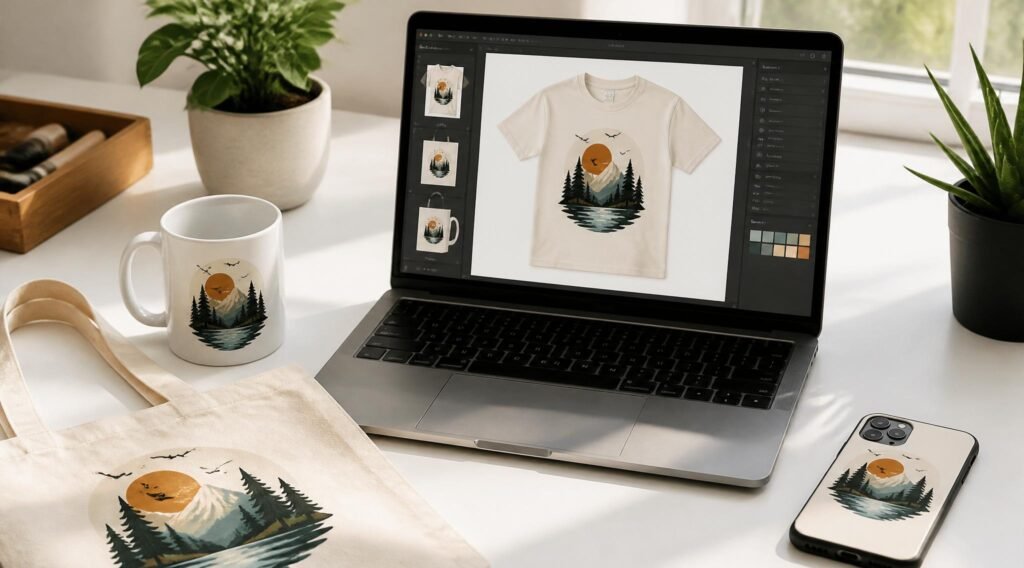
What if you could sell custom-designed products online — t-shirts, mugs, phone cases, tote bags, hoodies, notebooks — without ever touching inventory, packing a single box, or spending money upfront on stock?
That is exactly what print on demand (POD) makes possible.
Print on demand is one of the most beginner-friendly, low-risk online business models available today. You create the designs, choose the products, list them in your store, and when a customer places an order, a third-party supplier prints and ships the product directly to them. You pay for the product only after a sale is made. There is no minimum order, no warehouse, no upfront investment in stock.
In 2026, the print on demand market has matured enormously. There are more reliable platforms, better product quality, faster shipping times, and more powerful design tools than ever before. The result is a business model that is genuinely accessible to anyone — whether you are a designer, a side-hustler, a stay-at-home parent, or a complete beginner with no prior business experience.
This complete guide walks you through every step: how print on demand works, which platforms to choose, how to pick a profitable niche, where to get designs, how to set up your store, how to make your first sale, and how to scale toward meaningful monthly income.
What Is Print on Demand and How Does It Work?
Print on demand is a fulfilment model where custom products are manufactured only after an order is placed. Unlike traditional retail — where you buy stock in bulk, store it, and hope it sells — POD eliminates inventory risk entirely.
Here is the basic workflow:
- You create a design (your own artwork, a quote, a graphic, a logo, or anything else).
- You upload it to a POD platform and apply it to products — t-shirts, hoodies, mugs, phone cases, posters, notebooks, pillows, tote bags, and dozens more.
- You list those products in your store — on Etsy, Shopify, Amazon, or another selling channel, with your own pricing and branding.
- A customer finds your product and places an order.
- The POD platform prints the product and ships it directly to the customer. You never touch the item.
- You keep the profit — the difference between your retail price and the POD platform’s base cost.
You handle the creative side and the marketing. The platform handles printing, quality control, packaging, and shipping. It is one of the most streamlined business models available to solopreneurs.
Is Print on Demand Still Worth It in 2026?
Yes — and arguably more so than ever.
Competition has increased since the POD boom of the early 2020s, but so has the overall market size. Global e-commerce continues to grow, the demand for personalised and custom products is at an all-time high, and tools for creating professional designs have become dramatically more accessible (including AI design tools that require zero prior artistic skill).
The businesses that succeed in 2026 POD are those that find a specific niche, create genuinely compelling designs, build a recognisable brand identity, and market consistently. Generic designs on saturated products rarely succeed. Niche-focused, well-designed stores consistently generate real income.
The model rewards creativity and persistence above all else.
Print on Demand vs. Dropshipping: What Is the Difference?
If you have read our guide on how to start dropshipping in 2026, you may be wondering how POD compares.
Both models involve selling products without holding inventory, and both use third-party suppliers to fulfil orders. The key difference is customisation:
- Dropshipping involves selling existing, finished products that already exist in a supplier’s catalogue. You are reselling someone else’s product as-is.
- Print on demand involves selling custom-designed products that are created specifically for each order with your artwork applied to them.
This means POD gives you a genuinely unique product — nobody else has your exact design on that exact product. It is harder to compete on price alone, but easier to build a distinctive brand and a loyal customer base.
POD typically has higher profit margins than dropshipping for well-designed products because customers pay a premium for custom, unique items. It also has better long-term brand-building potential.
How Much Money Can You Make with Print on Demand?
Income ranges widely based on niche, design quality, platform, and marketing effort.
Realistic expectations:
| Stage | Monthly Revenue Range |
|---|---|
| Getting started (0–3 months) | $0–$300 |
| Building momentum (3–6 months) | $300–$1,500 |
| Established store (6–12 months) | $1,500–$5,000 |
| Scaled operation (12+ months) | $5,000–$20,000+ |
These are estimates — some people make their first sale in their first week, others take three months. The variables that matter most are niche selection, design quality, and how aggressively you market your store.
The passive income potential is real but slow-building. A well-established POD store with 50–100 well-optimised listings can generate consistent sales with minimal daily effort. Getting to that point requires consistent work upfront.
If you are looking for faster income while building your POD store, see our guide on 15 passive income ideas that actually work in 2026 for complementary strategies.
Step 1: Choose Your Print on Demand Platform
Your POD platform is your production and fulfilment partner. It handles printing, quality control, packaging, and shipping. Choosing the right one matters enormously.
Here are the leading platforms in 2026:
Printful
Printful is widely considered the premium option in print on demand. It offers excellent print quality, reliable fulfilment, a wide product catalogue, and seamless integrations with Shopify, Etsy, WooCommerce, Amazon, and other selling channels.
Pros: Best print quality, strong branding options (custom labels, packaging inserts), global fulfilment centres (USA, Europe, Mexico), consistent reliability.
Cons: Higher base prices than competitors, which means either lower margins or higher retail prices. Can be challenging to compete on price-sensitive platforms.
Best for: Entrepreneurs who prioritise quality and brand-building, especially those using Shopify as their primary store.
Printify
Printify works differently from Printful — instead of printing products itself, it acts as a marketplace connecting you to a network of print providers worldwide. This means you can often find lower base prices than Printful, though quality varies by provider.
Pros: Competitive pricing, large product catalogue, wide range of providers in different regions, useful for keeping costs low.
Cons: Quality can be inconsistent across providers — always order samples before listing. Shipping times vary depending on which provider you select.
Best for: Cost-conscious sellers, high-volume stores, and those selling on Etsy where lower base costs help maintain competitive pricing.
Redbubble and Society6
These platforms are marketplaces where you upload designs and they handle everything — selling, printing, shipping, and customer service. You simply earn a royalty on each sale.
Pros: Zero setup required, built-in audience, completely passive once designs are uploaded.
Cons: Very low profit margins (typically 10–20% of base price), no ability to build your own brand, highly competitive marketplace, no customer data or email list.
Best for: Designers who want a zero-effort passive income stream without building a standalone store.
Merch by Amazon
Amazon’s own POD platform allows approved sellers to list custom apparel directly on Amazon. Access is by invitation or application, and getting approved can take time — but the platform’s reach is enormous.
Pros: Access to Amazon’s 300+ million customers, no upfront costs, Amazon handles everything.
Cons: Application process, limited product types, lower royalties, highly competitive, no brand control.
Best for: Sellers who want maximum marketplace reach and are willing to work within Amazon’s constraints.
Which Platform Should You Start With?
For most beginners in 2026, the recommended starting combination is Printify + Etsy (for lower cost and built-in traffic) or Printful + Shopify (for better quality and brand control). Starting with Etsy gives you access to an existing audience while you learn — you can always build a standalone Shopify store later as you scale.
Step 2: Find Your Niche
Niche selection is the single most important decision in print on demand. Generic designs like “coffee lover” or “cat mom” compete against thousands of existing listings. A well-defined niche with passionate, underserved buyers gives you a genuine competitive advantage.
What Makes a Good POD Niche?
A strong niche has three qualities:
- Passionate buyers — people who identify strongly with the niche and wear it as part of their identity (not just mild interest — genuine passion)
- Buying intent — people who actively spend money on products related to their interest
- Underserved or differentiable — not so saturated that standing out is impossible, or saturated but approachable with genuinely better designs
Niche Examples Across Categories
Professions and occupations: Nurses, teachers, electricians, vets, librarians, firefighters, paramedics. These are passionate communities with strong occupational identity. “This Is What An Awesome Nurse Looks Like” sells. Generic designs sell less.
Pets and animals: Dog breeds (golden retriever owners versus generic “dog mom”), specific cat breeds, exotic pets. Specific beats generic — a dachshund owner is more likely to buy a dachshund-specific design than a generic dog product.
Hobbies and interests: Rock climbing, beekeeping, kayaking, embroidery, amateur radio, bonsai, urban gardening, tabletop gaming, disc golf. The more specific, the better.
Lifestyle and values: Veganism, minimalism, homesteading, van life, homeschooling, zero-waste living. Buyers in these communities actively signal their values through what they wear and use.
Humour within niches: Funny designs within a specific niche consistently outperform generic humour. “Dentists” + funny = excellent niche combination.
Events and milestones: Class reunions, retirement gifts, family reunion products, baby shower, wedding party gifts.
How to Research Niches
- Browse Etsy’s best-seller lists in apparel and accessories — look for patterns in what sells, not just what is popular
- Use tools like Alura, EverBee, or Erank to see Etsy search volumes and competition data
- Browse Reddit communities for underserved niches with passionate members
- Look at what sells well on Redbubble and Society6 in specific categories
- Use Google Trends to assess whether interest in a niche is growing or declining
Step 3: Create Your Designs
Design quality is the core value you bring to the print on demand model. Great designs sell. Generic designs sit unseen.
The good news: you do not need to be a professional designer to create successful POD designs in 2026.
Design Tools for Beginners
Canva Pro is the most accessible design tool for beginners. It has an enormous template library, easy text and graphic manipulation, and built-in print-ready export options. Many successful POD stores are built entirely using Canva. The Pro version (approximately $13/month) unlocks templates, premium graphics, and background removal — all essential for POD work.
Adobe Illustrator is the industry-standard professional tool for vector design. Steep learning curve, but creates infinitely scalable artwork that looks sharp at any print size. Worth learning if you plan to build a serious long-term POD business.
Kittl has become one of the most popular POD-specific design tools. It offers vintage, retro, and professional templates specifically designed for apparel and merchandise, with a style quality that is difficult to achieve in Canva.
AI design tools (including Midjourney, Adobe Firefly, and others) have transformed POD design in 2025–2026. You can use AI to generate unique illustrations, backgrounds, and artistic elements, then refine them in Canva or Illustrator. This dramatically reduces the design skill barrier — though you still need to understand what makes a commercially appealing design.
Design Specifications
Every POD platform has specific requirements for design files. General standards:
- File format: PNG with transparent background (for most products)
- Resolution: Minimum 150 DPI at print size, ideally 300 DPI
- Colour mode: RGB (most platforms convert to CMYK for printing)
- Size: Check each product’s template — t-shirts typically need designs at 4500 x 5400 pixels for front placement
Always download and use the platform’s official product templates to ensure correct sizing and placement.
What Makes a Design Sell?
Observe what consistently sells on Etsy and you will notice common patterns:
- Bold, readable typography — especially for humour and quote-based designs
- Clean, simple compositions — clutter-free designs print better and look better on products
- Niche specificity — a design that speaks directly to one type of person outperforms a design that tries to appeal to everyone
- High contrast — designs need to be legible on the product colour; always check your design on both light and dark mockups
- Trend awareness — seasonal designs (holiday, sports seasons, awareness months) sell well if listed in advance
Order physical samples of your products before listing them publicly. What looks good on screen often prints differently than expected. Samples are a business investment, not an unnecessary cost.
Step 4: Set Up Your Store
With a niche chosen and designs ready, it is time to build your selling channel.
Selling on Etsy
Etsy is the recommended starting platform for most POD beginners because it already has millions of buyers searching for custom and handmade products daily. You do not need to drive all your own traffic from day one.
Setting up an Etsy shop:
- Create an Etsy account and open a shop (etsy.com/sell)
- Choose a shop name that reflects your niche or brand — make it memorable and searchable
- Connect your Printify or Printful account to Etsy (both have direct integrations)
- Create your product listings (see listing optimisation below)
- Set up payment and billing details
- Open your shop
Etsy charges a $0.20 listing fee per product, a 6.5% transaction fee on each sale, and a payment processing fee. Factor these into your pricing.
Selling on Shopify
Shopify gives you your own branded store, full control over customer data, and no marketplace competition on your own pages. The trade-off is that you are responsible for driving all your own traffic.
Shopify costs $39/month (Basic plan as of 2026) plus transaction fees. It integrates seamlessly with both Printful and Printify.
For most beginners, start with Etsy, validate your designs and niche, then add a Shopify store as you scale. This is consistent with the broader approach in our guide to how to start a profitable online business in 2026.
Product Listing Optimisation
How you write and structure your listings determines whether buyers find your products in search. SEO on Etsy and other platforms works similarly to Google SEO — keywords matter enormously.
Title: Lead with your most important keywords. “Funny Nurse Gift T-Shirt — Nurse Life Shirt — Gift for RN — Nurse Appreciation Gift” hits multiple search terms while describing the product clearly.
Tags: Use all available tags (Etsy allows 13). Include variations of your main keywords: different phrasings, related terms, occasion-based tags (“gift for nurse”, “nurse birthday gift”, “nursing school graduation gift”).
Description: Write a thorough product description that includes your keywords naturally. Describe the product (material, fit, sizing), the design (what it says or shows), and the occasion or person it is suitable for. Include a sizing guide.
Photos and mockups: Use realistic, high-quality mockups that show the product on a person or in a lifestyle setting — not just a flat product image. Both Printful and Printify provide free mockup generators. Canva and Placeit also offer mockup templates. Use 5–8 photos per listing.
Pricing: Research competitor pricing for similar products in your niche. POD products on Etsy typically sell for $22–$45 for t-shirts, $18–$28 for mugs, and $15–$30 for tote bags. Price to cover your base cost, Etsy fees, and leave a profit margin of at least $8–$15 per item.
Step 5: Market Your Store and Make Your First Sale
Having great products listed is necessary but not sufficient. You need to actively drive traffic, especially in the early months before your Etsy SEO builds momentum.
Etsy SEO (Long-Term Traffic)
Etsy’s search algorithm rewards listings that get clicks, convert to sales, and generate positive reviews. In the early days, focus on:
- Using highly specific, accurate keywords in titles and tags
- Taking excellent mockup photos (the thumbnail is what gets the click)
- Pricing competitively without underselling your work
- Running Etsy Ads with a small daily budget ($1–$5/day) to get initial visibility and data on which listings perform
Pinterest Marketing (Free and Highly Effective for POD)
Pinterest is one of the most underrated marketing channels for print on demand. It is a visual search engine where product images are naturally shareable, and pins have long lifespans (months or even years, unlike social media posts that disappear in hours).
Create a business Pinterest account, pin your product mockups with keyword-rich descriptions, link directly to your Etsy listings, and pin consistently (10–15 pins per day is a common recommendation). Results take 2–4 months to build but become increasingly passive over time.
Instagram and TikTok (Brand Building)
Social media works best for POD when you show the story behind your brand — the design process, product reveals, behind-the-scenes content — rather than just posting product images.
TikTok in particular has driven enormous traffic to Etsy shops through viral videos. A single video showing your design process or a product unboxing can generate hundreds of shop visits overnight.
Email Marketing
Build an email list from your first sale. Offer a small discount on a future order in exchange for an email address. Even a list of 100 genuine customers is enormously valuable — they have already bought from you and are your most likely repeat customers.
Email marketing is one of the highest-ROI marketing channels available. Our guide on how to write a marketing plan in 2026 covers how to build a simple, effective marketing system around your store.
Step 6: Scale Your Print on Demand Business
Once you have validated your niche and made your first consistent sales, the path to scaling is relatively straightforward.
Add More Listings Consistently
Volume matters on Etsy and similar platforms. More listings mean more opportunities to appear in search. Successful Etsy POD sellers typically have 50–200+ active listings. Aim to add 3–5 new listings per week consistently for the first 6 months.
Expand Your Product Range
Once a design proves it sells on one product (say, a t-shirt), apply it to complementary products: a matching hoodie, a mug, a tote bag, a phone case. Customers who love a design often want it on multiple products. This multiplies your revenue from proven winners without requiring new design work.
Build a Shopify Store Alongside Your Etsy Shop
As your brand grows, having your own storefront becomes increasingly valuable. A Shopify store lets you collect customer emails, run your own promotions, and avoid marketplace fees on direct traffic. It also significantly enhances the professionalism of your brand.
Outsource Design Work
Once you have validated which design styles sell in your niche, you can hire freelance designers on Fiverr or Upwork to produce designs at scale. Many successful POD operators do not design their own products — they understand what sells and direct designers to create it.
Explore Additional Selling Channels
Expand beyond Etsy to Amazon Merch, Redbubble, Walmart Marketplace, and your own Shopify store. Each additional channel multiplies your reach and revenue without proportional increases in workload.
This multi-channel approach mirrors the scaling strategies in our guide on starting an online business: 7 models that actually work in 2026.
Legal and Business Basics for Print on Demand
Running a POD business means running an actual business, with associated legal and tax responsibilities. Many beginners ignore this until it becomes a problem — do not make that mistake.
Business Structure
If your POD store starts generating meaningful income, consider forming an LLC to separate your personal and business finances and limit personal liability. Our guide on how to start an LLC in 2026 walks you through the process step by step.
Taxes
In most countries, online selling income is taxable. Keep accurate records of revenue, platform fees, design tool subscriptions, and any other business expenses. In the US, Etsy will issue a 1099-K form if your sales exceed $600 in a year. Set aside approximately 25–30% of profit for taxes.
Intellectual Property
Never use copyrighted designs, characters, logos, brand names, sports team names, or celebrity likenesses in your POD products without explicit licensing. This is one of the most common and serious mistakes new POD sellers make. Etsy, Amazon, and other platforms enforce intellectual property rights aggressively and will shut down shops that infringe.
Creating your own original designs — or using genuinely royalty-free design elements from licensed sources — is the only safe approach. For a broader overview of the legal basics every online entrepreneur needs to understand, see our guide on legal basics every new business owner must know.
Common Print on Demand Mistakes to Avoid
Skipping samples. Never list a product without ordering a physical sample first. Print quality, colour accuracy, sizing, and material feel can all differ from what mockups suggest.
Choosing too broad a niche. “Cat lover” is not a niche. “Ragdoll cat owners who are also nurses” is closer to a niche. The more specific, the better your conversion rate.
Listing only a few products and waiting. POD is a volume game, especially on Etsy. You need a significant number of listings to generate consistent traffic. Ten listings will rarely produce consistent sales; a hundred listings dramatically improves your odds.
Ignoring SEO. Listings with poorly researched titles and tags will not appear in search. Research keywords carefully for every single listing.
Giving up too soon. Most POD stores take 3–6 months to generate consistent sales. The first 60–90 days are often slow, discouraging, and filled with learning. Those who persist through the early phase are those who eventually build successful stores.
Violating intellectual property. As mentioned above — using copyrighted material is a business-ending mistake. Create original work.
Print on Demand in 2026: Trends to Know
AI-generated design elements are now a standard part of the POD toolkit. Sellers use AI image generators to create unique illustrations, textures, and backgrounds that would previously have required professional design skills. The key is refining AI outputs with design tools rather than using raw AI images — quality and originality still matter.
Personalised and customisable products are growing fastest. Products that customers can personalise with their name, pet’s name, or custom text command higher prices and convert better than static designs. Both Printful and Printify offer personalisation options.
Eco-friendly and sustainable products are increasingly in demand. Organic cotton t-shirts, recycled tote bags, and sustainably sourced products carry a premium that customers are willing to pay — and provide a differentiating angle for your brand.
Niche micro-brands are outperforming generic shops. The most successful POD businesses in 2026 look and feel like real brands built for a specific community — with cohesive visual identity, brand voice, and product ranges that feel curated rather than random.
Your 30-Day Print on Demand Launch Plan
Days 1–3: Choose your platform combination (Printify + Etsy recommended). Research and select your niche. Create accounts on your chosen platform and selling channel.
Days 4–7: Research keywords for your niche using Etsy search, Erank, or similar tools. Create your first 5 designs using Canva, Kittl, or your preferred tool.
Days 8–10: Apply designs to products, generate mockups, write optimised listings with keyword-rich titles, descriptions, and all tags used. List your first 5 products.
Days 11–14: Order samples of your key products. While waiting, create 5 more designs and list them.
Days 15–21: Receive samples, assess quality, adjust any listings based on what you observe. Start a Pinterest business account and begin pinning product images. Create your first social post about your store.
Days 22–28: List additional products (aim for 20+ total). Launch Etsy Ads with $3–$5/day on your best listings to gather data.
Days 29–30: Review data — which listings have the most views? Which keywords are driving traffic? Double down on what is working. Refine or unpublish what is not.
By the end of 30 days, you should have a live store with 20+ listings, initial traffic data, and a clear sense of which products and designs resonate with buyers.
Final Thoughts: Print on Demand Is a Real Business
Print on demand is not a get-rich-quick scheme. It is a legitimate business model that rewards creativity, persistence, and strategic thinking. The early months are a period of learning, testing, and building — not instant income.
But the upside is genuinely compelling. A well-built POD store generates income with minimal ongoing work once established. It is a business you can run from anywhere with no employees, no inventory risk, and extremely low fixed costs.
The barrier to entry is low. The ceiling is high. And in 2026, the tools and platforms available make it more achievable than ever.
Pick your niche. Create your designs. List your products. Market consistently. Iterate on what works.
Your first sale is closer than you think.
Ready to build your online business? Explore more strategies at Ideas Junction — from starting a freelancing business to building a personal brand that attracts clients.