

New personal trainers usually assume the hard part is passing a certification exam — and then they hit a second, more confusing question: do I actually need a business license to train clients for money? The honest answer isn’t a simple yes or no, and that ambiguity is exactly what trips people up.
Unlike food trucks or drone photography, personal training doesn’t have one clear federal rule to point to. Instead, it sits in a gray zone: certification bodies set the professional standards, while business licensing depends entirely on how you structure your work and where you do it. Conflicting answers online — some sites say “no license needed,” others say “yes, always” — often come down to people describing different situations without saying so.
This guide untangles the actual requirements: what’s genuinely optional, what’s not, and how the answer changes depending on whether you’re training out of a gym, running your own studio, or coaching clients independently.
Quick Answer
There is no dedicated “personal trainer license” issued by any government body — that’s the most common misconception. What you actually need depends on your setup: a personal training certification (from an organization like NASM, ACE, ISSA, or NSCA) proves your professional competency and is effectively required to get hired or insured, but it isn’t a government license. A general business license from your city or county is typically required if you’re operating as your own business — training clients independently, running a studio, or working under your own brand — but not if you’re simply employed by a gym as staff. Liability insurance isn’t legally mandated in most places but is functionally required by nearly every gym, studio, or serious client relationship.
Table of Contents
- License vs. Certification: What’s the Real Difference?
- How to Figure Out What You Actually Need
- The Core Requirements Explained
- Requirements Comparison Table
- Requirements for Different Training Setups
- How to Get Set Up Legally: Step by Step
- Common Mistakes
- Expert Tips
- Final Thoughts
- Frequently Asked Questions
License vs. Certification: What’s the Real Difference? {#what-is-it}
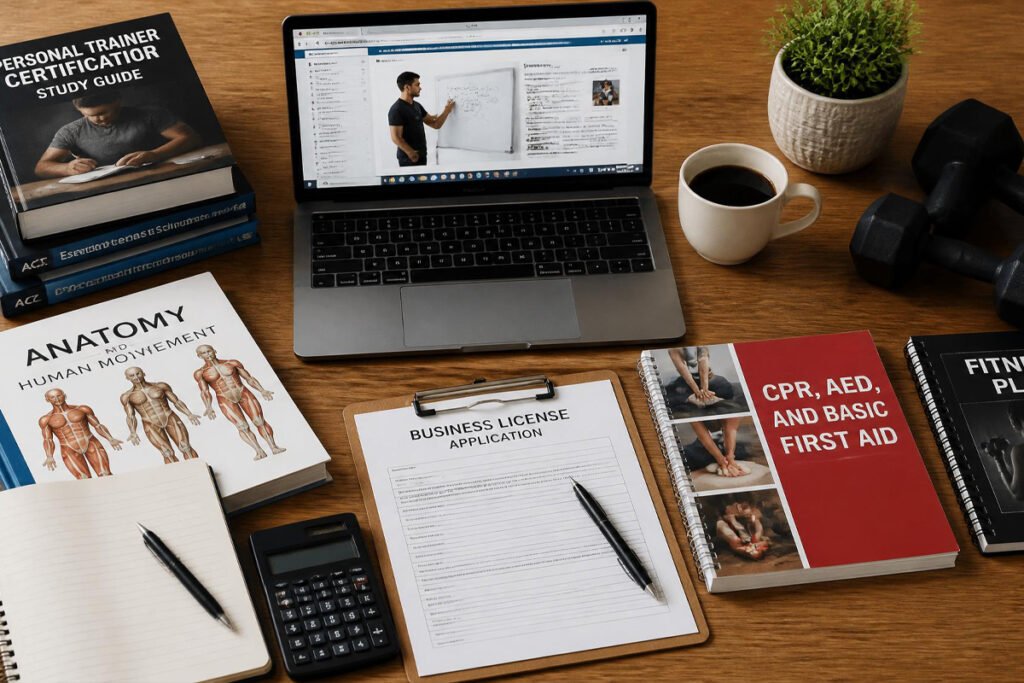
A certification is a professional credential issued by a private organization (NASM, ACE, ISSA, NSCA, and others) that proves you understand exercise science, safe coaching practices, and program design. It’s not issued by any government agency, and there’s no legal requirement in the U.S. mandating a specific certification to call yourself a personal trainer — but in practice, gyms won’t hire you and insurers won’t cover you without one.
A business license is entirely separate — it’s a government registration (city or county, sometimes state) that authorizes you to legally operate a business in that jurisdiction. It has nothing to do with fitness expertise; it’s the same type of registration any small service business needs.
The confusion happens because both feel like “permission to work,” but they’re issued by completely different types of authorities for completely different reasons. If you’re still deciding how to structure your business entity, it’s worth reviewing general small business startup requirements alongside the fitness-specific rules below, since entity formation typically needs to happen before a business license application.
How to Figure Out What You Actually Need {#how-to-choose}
Three questions determine your actual requirements:
Are you an employee, or running your own business? If a gym hires you as staff and pays you a wage, the gym typically handles business-level compliance — you mainly need your certification. If you’re independently contracting, freelancing, or running your own studio under your own name, you’re the business, and licensing requirements shift onto you.
Where are you physically training clients? Training inside an existing gym or studio usually means that facility’s business license and insurance already cover the location. Training clients in their homes, outdoors, or in a space you rent yourself puts more of the compliance burden on you directly.
Is training your primary income, or a side activity? Even occasional paid sessions can technically require basic business registration in many cities, though enforcement and thresholds vary. If you’re earning meaningful income independently, don’t assume a casual setup exempts you from local rules — check with your city or county directly.
The Core Requirements Explained {#core-requirements}
Personal Trainer Certification
Overview: The credential that actually matters most to your career — not legally mandatory everywhere, but functionally required by nearly every employer and insurer.
Key Features:
- Issued by organizations like NASM, ACE, ISSA, and NSCA
- Requires passing an exam covering exercise science, program design, and safety
- Continuing education required to maintain most certifications
Best For: Every personal trainer, regardless of employment setup.
Pros: ✅ Opens the door to gym employment and most insurance coverage ✅ Builds legitimate client trust and marketability
Cons: ❌ Costs range widely ($500–$2,000+) depending on the organization and level ❌ Requires ongoing continuing education to stay current
Our Verdict: Treat this as the non-negotiable first step — nothing else on this list matters much without it.
General Business License
Overview: Required for independent trainers operating their own business, not typically required for trainers employed directly by a gym.
Key Features:
- Filed with your city or county
- Often bundled with a DBA filing if operating under a business name
- Renewed annually in most jurisdictions
Best For: Independent trainers, studio owners, and anyone training clients under their own brand rather than as gym staff.
Pros: ✅ Relatively inexpensive ($50–$400 depending on location) ✅ Establishes legal legitimacy for contracts and invoicing
Cons: ❌ Easy to overlook since there’s no single national standard reminding you it’s required
Our Verdict: If you’re training independently and not sure whether you need one, call your city clerk’s office directly — this is one area where local rules genuinely vary too much to generalize safely.
Liability Insurance
Overview: Not government-mandated in most places, but functionally required by virtually every gym, studio, and increasingly by clients themselves.
Key Features:
- Typically bundled with certification memberships (NASM, ACE, and others offer discounted policies)
- Covers claims related to training-related injury
- Often a prerequisite for gym employment contracts
Best For: Every trainer taking on paid client work, employed or independent.
Pros: ✅ Protects personal assets if a client claims injury ✅ Often required before a gym will let you train on their premises
Cons: ❌ Ongoing annual cost even in slow months
Our Verdict: Get this immediately after certification — most professional organizations make it easy to bundle at a discount.

Requirements Comparison Table {#comparison-table}
| Requirement | Legally Mandatory? | Issued By | Who Needs It |
|---|---|---|---|
| Personal Trainer Certification | No federal mandate, but functionally required | NASM, ACE, ISSA, NSCA, etc. | Every trainer |
| General Business License | Only for independent operators | City/County | Independent trainers, studio owners |
| Liability Insurance | Not government-mandated | Private insurer | Every trainer taking paid clients |
| CPR/AED Certification | Often required by employers/certifying bodies | Red Cross, AHA | Every trainer |
| DBA Filing | Only if using a business name | City/County | Trainers operating under a brand name |
Requirements for Different Training Setups {#setups}
Employed at a Gym or Studio
If you’re hired as staff, the facility typically holds the business license and insurance covering the location. Your personal responsibility is largely limited to maintaining your certification and any CPR/AED requirements the employer sets.
Independent / Freelance Training
This is where licensing responsibility shifts fully onto you. You’ll typically need a business license, your own liability insurance, and a clear business structure (sole proprietorship or LLC). If you’re weighing entity types, general small business setup guidance applies directly here — the legal structure decision isn’t fitness-specific.
In-Home or Outdoor Training
Training clients in their homes or public outdoor spaces adds an extra layer of consideration: some cities have permit requirements for using public parks commercially, and in-home liability coverage may differ from studio-based policies. Confirm both with your city and your insurer before booking your first outdoor or in-home session.
How to Get Set Up Legally: Step by Step {#how-to}
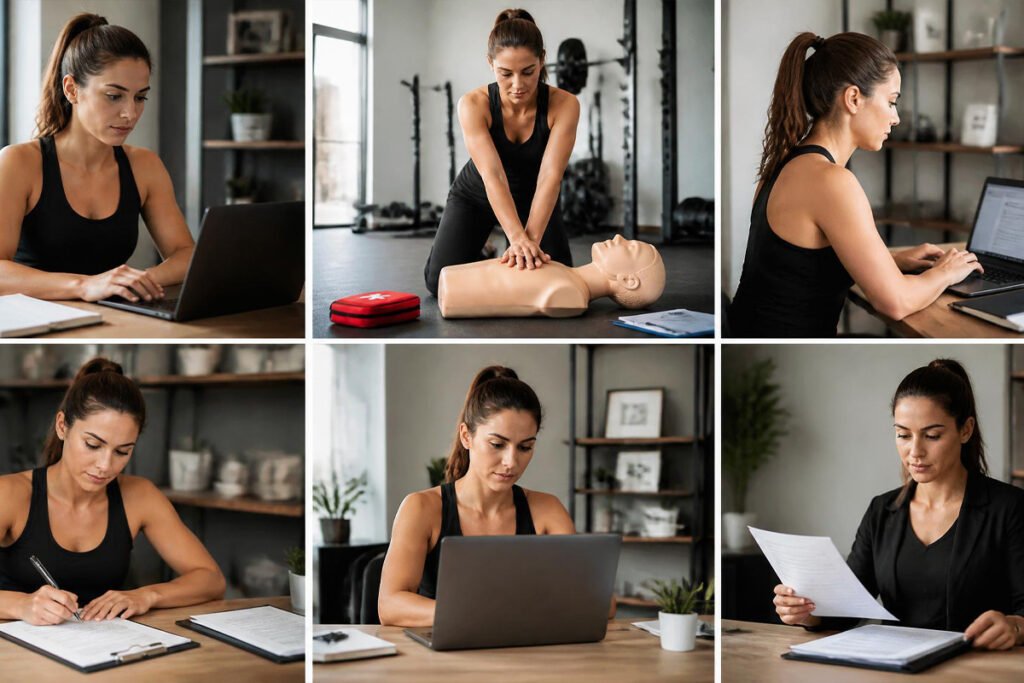
Step 1: Complete Your Certification
Choose an NCCA-accredited program (NASM, ACE, ISSA, or NSCA are the most widely recognized) and pass the required exam before pursuing anything else on this list.
Step 2: Get CPR/AED Certified
Most certifying bodies and employers require current CPR/AED certification alongside your primary credential — schedule this early since it’s often needed to activate your certification.
Step 3: Decide Your Business Structure
If training independently, choose between operating as a sole proprietor or forming an LLC, based on your liability tolerance and income level.
Step 4: Apply for a Business License (If Independent)
File with your city or county if you’re not working as gym staff — this step doesn’t apply if you’re purely employed by a facility.
Step 5: Secure Liability Insurance
Many certifying organizations offer discounted policies bundled with membership — this is usually the fastest and most affordable route.
Step 6: Set Up Contracts and Waivers
Have every client sign a liability waiver and service agreement before your first session, regardless of your employment setup.
Common Mistakes {#mistakes}
Assuming certification alone covers everything. Certification proves competency; it doesn’t authorize you to legally operate an independent business. Independent trainers who skip business licensing are operating with a real, avoidable compliance gap.
Not checking local rules before training in public spaces. Some cities specifically regulate commercial fitness activity in parks and outdoor public areas — a certification and insurance policy don’t automatically clear you for every location.
Skipping insurance because “nothing’s happened yet.” A single injury claim without coverage can be financially devastating for an independent trainer — treat this the same way you’d treat any small business’s compliance basics, not as an optional extra.
Expert Tips {#tips}
Bundle your certification and insurance purchase. Most major certifying organizations offer discounted liability coverage to members — buying both together is typically cheaper than sourcing insurance separately later.
Call your city clerk’s office before assuming you’re exempt. Business license thresholds and enforcement vary so significantly by city that generic online guidance (including this one) can’t substitute for a five-minute local phone call.
Keep your CPR/AED certification renewal on a calendar reminder. This lapses faster than most trainers expect (commonly every 1–2 years), and letting it expire can jeopardize both your primary certification status and your insurance coverage.

Final Thoughts {#final-thoughts}
Best for trainers employed at a gym: Focus your energy on certification and CPR/AED renewal — your employer typically handles business-level licensing for the facility.
Best for independent trainers: Treat business licensing and liability insurance as non-negotiable startup steps, not optional extras to figure out later.
Best for in-home or outdoor trainers: Double-check local permit rules for public spaces specifically — this is the requirement most likely to catch independent trainers off guard.
Getting the legal side sorted isn’t the exciting part of building a training career, but it’s what protects the business you’re building. Once it’s handled, the growth side — covered in our broader guides on starting a small business and business compliance basics — is where the real momentum builds.
Frequently Asked Questions {#faq}
Do personal trainers need a license to legally train clients? Not a dedicated “personal trainer license” — there isn’t one issued by any government body. What matters is a recognized certification (like NASM or ACE) plus, if you’re operating independently, a general business license from your city or county.
Can I train clients without any certification at all? Legally, in most places, there’s no government mandate requiring a specific certification. Practically, virtually no gym will hire you and no insurer will cover you without one, so it’s effectively required for a real career.
Do I need a business license if I only train a few clients occasionally? It depends on your city’s specific threshold and enforcement, which varies significantly. If you’re earning meaningful, ongoing income independently, it’s safest to check directly with your local city or county rather than assume a casual setup is exempt.
What’s the difference between NASM, ACE, ISSA, and NSCA? These are all NCCA-accredited certifying organizations with slightly different focuses and exam formats. Most are broadly recognized by gyms and insurers; the right choice often comes down to cost, study format preference, and any specialty tracks (like senior fitness or sports performance) you want to pursue.
Do I need liability insurance if my gym already has a policy? Many gyms’ policies cover the facility but not necessarily your individual actions as a trainer, especially if you’re an independent contractor rather than a direct employee. Confirm exactly what your gym’s policy covers before assuming you’re included.
Do online or virtual personal trainers need the same licensing? Requirements can get more complex, since you may be operating across multiple states or client locations. Business licensing generally follows where your business is legally based, but insurance and liability considerations may need special attention for virtual training — check with your insurer directly.
How much does it cost to get fully set up as an independent trainer? Budget roughly $500–$2,000+ for certification, $50–$400 for a local business license, and a few hundred dollars annually for liability insurance, depending on your certifying body and location.
Do I need an LLC to be a personal trainer? Not necessarily — many independent trainers operate as sole proprietors. An LLC adds liability protection separating personal and business assets, which becomes more valuable as your client base and income grow.
What happens if I operate independently without a business license? You risk fines and potential forced closure if your city’s licensing office becomes aware, in addition to lacking the legal legitimacy a license provides for contracts and business banking.
Does my certification transfer if I move to a different state? Yes — certifications from NCCA-accredited bodies are nationally recognized and don’t need to be reissued state to state. However, any business license you hold is tied to your previous city or county and won’t transfer; you’ll need to reapply locally after a move.
Author: Morne Winston Last Updated: July 2026