
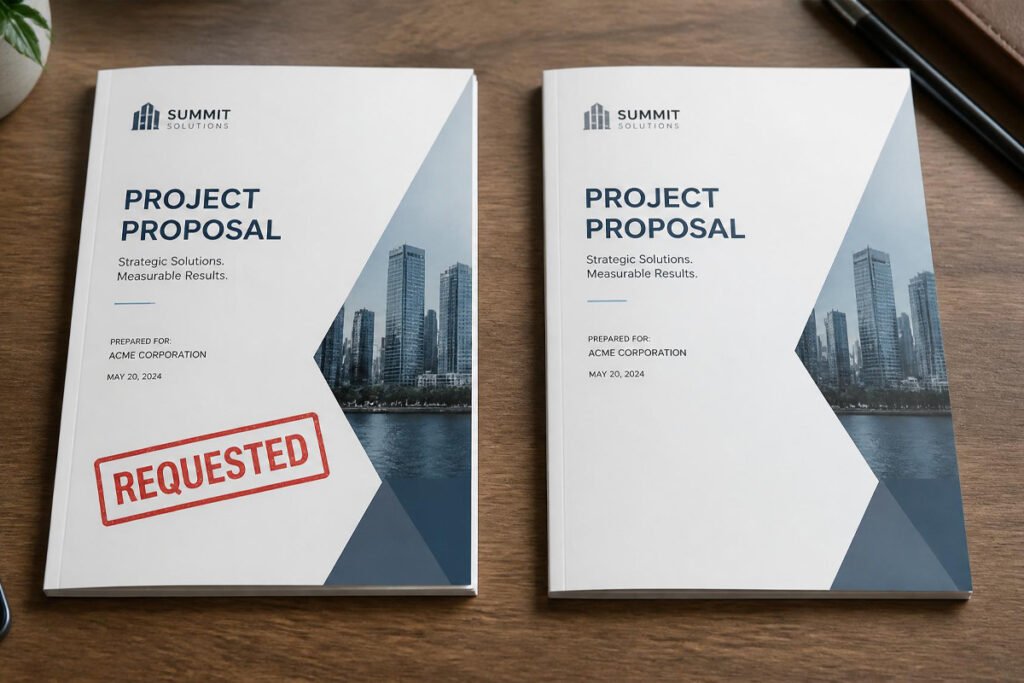
Two proposals can look identical on the page — same sections, same pricing table, same polished formatting — and still fail for completely different reasons. One gets ignored because the client never asked for it and doesn’t feel the urgency. The other gets disqualified because it didn’t follow the exact structure the client requested. Understanding which type of proposal you’re actually writing changes almost everything about how you approach it.
This is the distinction between solicited and unsolicited proposals, and it’s one new business owners and freelancers often blur together without realizing it. Treating an unsolicited pitch like a formal RFP response — or treating a client’s specific request like a generic sales brochure — is one of the most common, avoidable reasons proposals underperform.
If you already know how to write a business proposal that wins clients, this guide fills in the piece that comes before the writing: knowing which type of proposal you’re sending, and adjusting your entire approach accordingly.
Quick Answer
A solicited proposal is written in response to a specific request from a client — whether that’s a formal RFP (Request for Proposal), a verbal ask after a sales call, or an informal “send me something in writing.” A unsolicited proposal is sent to a client who never asked for it, meaning you have to first convince them a problem exists before you can pitch the solution. Solicited proposals should closely follow whatever structure or criteria the client specifies, since they’re often being scored against other responses. Unsolicited proposals need a stronger, more attention-grabbing opening, since there’s no guarantee the reader will keep reading past the first paragraph. Neither type is inherently better — they’re suited to different situations, and using the wrong approach for the wrong scenario is one of the fastest ways to lose a deal.
Table of Contents
- What’s the Real Difference?
- How to Tell Which Type You’re Writing
- Solicited Proposals: The Three Main Types
- Comparison Table
- Writing Each Type for Different Situations
- How to Write a Winning Version of Each
- Common Mistakes
- Expert Tips
- Final Thoughts
- Frequently Asked Questions
What’s the Real Difference? {#what-is-it}
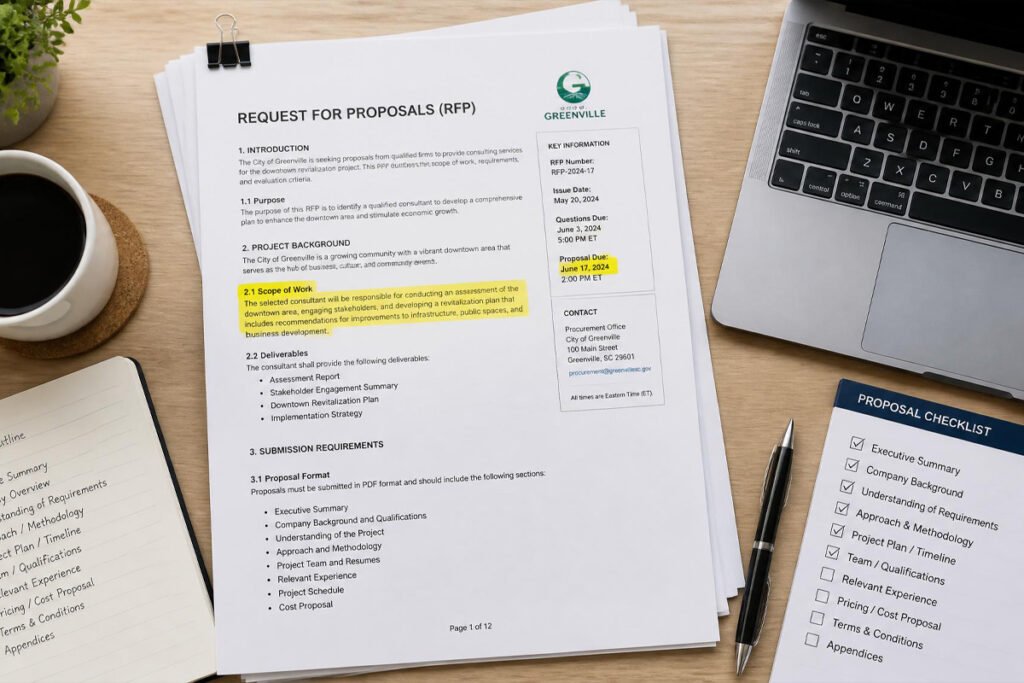
A solicited proposal exists because someone asked for it — whether through a formal written Request for Proposal, a verbal “can you send me a quote,” or an informal follow-up after a sales conversation. The client already knows they have a need, and your job is to convince them you’re the right one to meet it.
An unsolicited proposal exists because you decided to reach out — the client hasn’t expressed a need, hasn’t budgeted for a solution, and may not even realize they have a problem worth solving. Your job here is fundamentally different: you have to create the sense of need before you can sell the solution to it.
This distinction changes nearly everything about how a proposal should be written — tone, structure, length, and especially the opening. If you haven’t already, it’s worth reviewing business proposal templates and examples by industry alongside this guide, since choosing the right template structure often depends on which of these two categories you’re working in.
How to Tell Which Type You’re Writing {#how-to-choose}
Ask yourself these questions before you start writing:
Did the client ask for this, in any form? Even an informal “yeah, send me something” after a conversation counts as solicited — the bar isn’t a formal RFP, it’s simply whether the client is expecting to receive it.
Is there already a budget or timeline attached? Solicited proposals usually come with at least a rough sense of budget or urgency on the client’s side. Unsolicited proposals almost never do, which is why they need to build the case for both from scratch.
Are you competing against other responses? If the client issued a public or semi-public request, assume you’re one of several proposals landing on their desk — this pushes you toward the more rigid, criteria-matching structure of a solicited response.
Solicited Proposals: The Three Main Types {#solicited-types}
Request for Proposal (RFP) Response
Overview: The most formal type of solicited proposal, typically issued by larger organizations, government agencies, or enterprise clients running a structured procurement process.
Key Features:
- Client provides detailed specifications and evaluation criteria upfront
- Often requires matching the RFP’s exact section order and numbering
- Usually involves competing against multiple other vendors
Best For: Government contracts, enterprise procurement, and any formal bidding process.
Pros: ✅ Clear expectations — you know exactly what the client wants ✅ Serious buying intent, since issuing an RFP takes real effort on the client’s side
Cons: ❌ Highly competitive, often scored against a strict rubric ❌ Little room for creative differentiation in structure
Our Verdict: Never freelance the structure on an RFP response — mirror the client’s requested outline precisely before adding your own content.
Request for Quotation (RFQ) Response
Overview: A more streamlined version of a solicited proposal, used when the client already knows exactly what they want and mainly needs pricing.
Key Features:
- Minimal narrative content required
- Primarily focused on price, delivery timeline, and specifications
- Common for commodity products or well-defined, repeatable services
Best For: Situations where the “what” is already fully defined, and the client is comparing vendors mainly on cost and terms.
Pros: ✅ Fast to prepare compared to a full narrative proposal ✅ Decision often comes down to clear, comparable numbers
Cons: ❌ Little opportunity to differentiate on value or approach
Our Verdict: Keep it tight — padding an RFQ response with unnecessary narrative can actually work against you here.
Informal Solicited Proposal
Overview: The most common type for freelancers and small service businesses — a proposal requested verbally or in a casual email after a sales conversation, with no formal RFP process attached.
Key Features:
- No fixed structure required by the client
- Often follows directly from a discovery call or consultation
- Gives you more flexibility than a formal RFP response
Best For: Freelancers, consultants, and small businesses pitching directly to a single decision-maker.
Pros: ✅ Flexible format — you can lead with whatever makes the strongest case ✅ Usually a warmer, more relationship-driven sales process
Cons: ❌ Less clarity than a formal RFP on exactly what the client wants — you may need to fill gaps with judgment
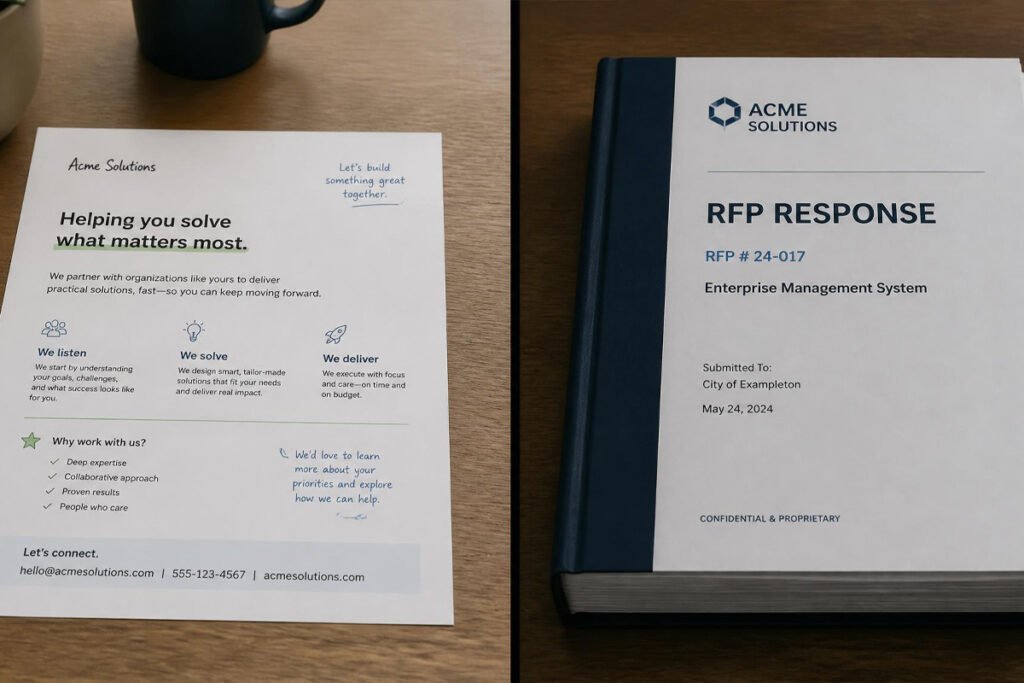
Our Verdict: This is the type most small business owners write most often — pair it with the pricing and follow-up strategies in our core proposal guide for the best results.
Comparison Table {#comparison-table}
| Factor | Solicited Proposal | Unsolicited Proposal |
|---|---|---|
| Client Expectation | Expecting to receive it | Not expecting it at all |
| Opening Focus | Directly address stated need | Establish that a problem exists |
| Structure Flexibility | Often rigid (especially RFPs) | Highly flexible |
| Competition Level | Often competing against others | Usually no direct competition |
| Budget Awareness | Client often has one in mind | Client hasn’t budgeted for it |
| Best Use Case | Formal bids, requested quotes | Cold outreach, new offerings |
Writing Each Type for Different Situations {#situations}
When You’re Responding to an RFP
Treat the RFP document as your outline. Copy its section headers directly into your draft before writing a single sentence of content, and build a simple compliance checklist to confirm every requirement is addressed somewhere in your response. Evaluators are frequently scoring against a checklist, and a beautifully written proposal that’s missing a required section can be disqualified before anyone reads your pricing.
When You’re Sending a Cold, Unsolicited Pitch
Lead with the problem, not your company. The single biggest mistake in unsolicited proposals is opening with “We are a company that…” instead of naming a specific, credible problem the reader is likely facing. If you’re pitching a niche service — say, a mobile car detailing offering to a corporate fleet manager — your opening line should identify a cost or time problem they’re likely already experiencing, not a description of your services.
When a Conversation Leads to “Send Me a Proposal”
This is technically solicited, but treat it with some of the flexibility of an unsolicited pitch. There’s no formal structure to follow, but you should still open by briefly restating the problem you discussed, since the person may have had several conversations since you last spoke and won’t remember every detail.
How to Write a Winning Version of Each {#how-to}
Step 1: Confirm Which Type You’re Writing
Before drafting anything, reread any communication from the client to confirm whether this is truly solicited or unsolicited — the answer shapes every decision after this point.
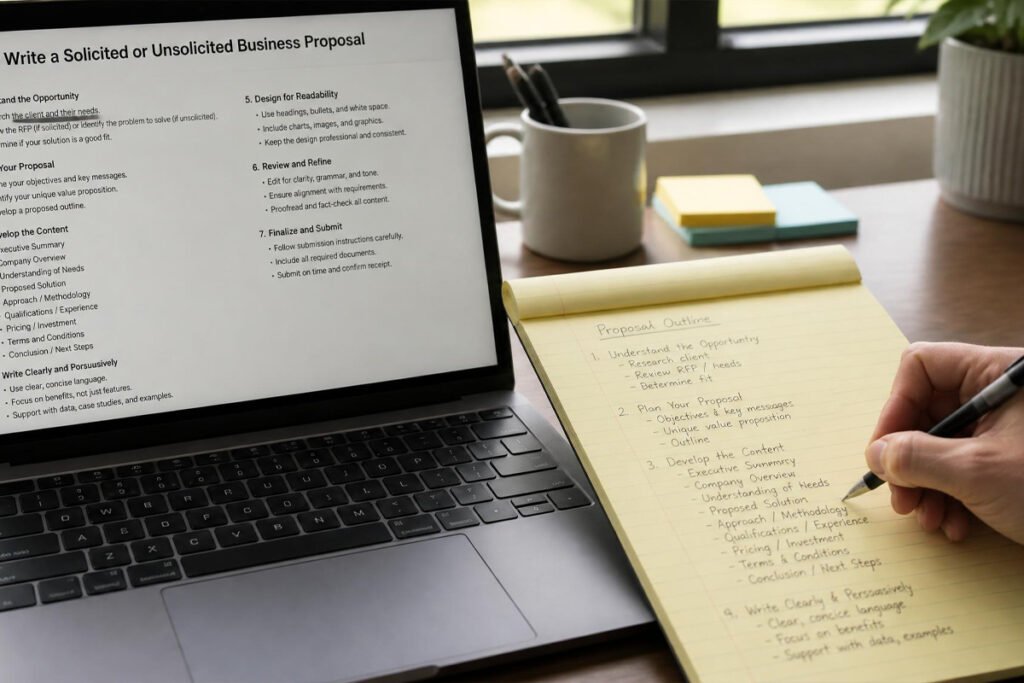
Step 2: Build Your Outline Accordingly
For solicited RFPs, copy the client’s structure exactly. For unsolicited or informal proposals, build your own outline starting with the problem statement, not your company background.
Step 3: Write the Opening to Match the Context
Solicited proposals can open by directly referencing the request (“As requested, here is our proposal for…”). Unsolicited proposals need to open by establishing the problem first, since the reader isn’t expecting the pitch.
Step 4: Adjust Your Pricing Presentation
Solicited proposals, especially RFP responses, often require pricing in a specific format the client has requested. Unsolicited proposals have more freedom — consider offering a smaller, lower-risk starting engagement to reduce the reader’s hesitation.
Step 5: Close With the Right Call to Action
Solicited proposals can close with a straightforward next step, since the client is already expecting a decision process. Unsolicited proposals should close with a lower-commitment ask — a short call rather than an immediate signature — since you’re asking the reader to act on something they didn’t plan for.
Common Mistakes {#mistakes}
Sending an unsolicited proposal that reads like an RFP response. Overly formal structure and rigid section headers can feel cold and impersonal when the reader wasn’t expecting anything — this mismatch is one of the fastest ways an unsolicited pitch gets ignored.
Freelancing the structure of a formal RFP response. Reorganizing a client’s requested outline — even if you think your version reads better — risks disqualification before your content is even evaluated on merit.
Treating every proposal as generic. Sending the same unsolicited proposal to multiple prospects without customization is really a brochure, not a proposal, and reads as such to the recipient — similar to the mistake of using the same proposal template regardless of deal size.
Expert Tips {#tips}
Keep separate opening paragraphs on file for each type. Since the opening is where solicited and unsolicited proposals diverge most, maintaining a ready-to-customize opening for each situation saves significant time without sacrificing the tailored feel each type needs.
For unsolicited proposals, lead with a specific number, not a vague claim. “Companies like yours typically lose 10-15 hours a month to X” lands harder than “we can help you save time,” and works especially well when the reader has never considered the problem before.
For RFP responses, build a simple compliance matrix before writing. A one-page table mapping each RFP requirement to the section of your proposal that addresses it takes 15 minutes to build and meaningfully reduces the risk of a disqualifying omission.

Final Thoughts {#final-thoughts}
Best for high-stakes formal bids: Treat every RFP response as a compliance exercise first and a persuasion exercise second — matching structure precisely protects you from disqualification before your content even gets read.
Best for freelancers and small businesses: Most of your proposals will be informal solicited proposals following a sales conversation — keep these flexible, but always open by restating the problem you discussed.
Best for growing your pipeline: Well-targeted unsolicited proposals can open doors formal bidding processes never will, but only when the opening genuinely earns the reader’s attention with a specific, credible problem statement.
Knowing which type of proposal you’re writing is the step that happens before the writing — and it shapes nearly every decision that follows. Pair this with our guides on how to write a business proposal that wins clients and business proposal templates and examples by industry for the complete picture, from strategy through final formatting.
Frequently Asked Questions {#faq}
Is an unsolicited proposal the same as a cold email? Not quite — a cold email is typically a short outreach message trying to start a conversation, while an unsolicited proposal is a fuller document proposing a specific solution, usually sent after some initial contact or research into the prospect.
Which type of proposal has a higher success rate? Solicited proposals generally convert at a higher rate, since the client has already expressed a need and is actively evaluating solutions. Unsolicited proposals face more resistance but typically have less direct competition once they do land.
Do I need to follow a strict format for an informal solicited proposal? Not as strictly as a formal RFP, but it should still be organized and professional. A quick, unstructured email may feel too casual for the size of the ask, depending on the deal value.
What’s the difference between an RFP and an RFQ? An RFP (Request for Proposal) typically requires a fuller narrative explaining your approach and qualifications, while an RFQ (Request for Quotation) is more streamlined and focused mainly on price and specifications for a clearly defined need.
Can an unsolicited proposal become a solicited one? Yes — if a prospect responds positively to an initial unsolicited pitch and asks for more detail or a formal follow-up proposal, that follow-up document effectively becomes solicited, even though the relationship started unsolicited.
How long should an unsolicited proposal be compared to a solicited one? Unsolicited proposals are often shorter, since you’re asking for the reader’s attention without them expecting it. Solicited proposals, especially formal RFP responses, tend to run longer since the client has requested comprehensive detail.
Should I follow up differently depending on the proposal type? Yes — follow-up on a solicited proposal can reference the original request directly and ask about timeline. Follow-up on an unsolicited proposal should be gentler, since the recipient never asked for the pitch in the first place and may need more time to consider it.
Is it disrespectful to send an unsolicited proposal? Not inherently — many legitimate business relationships start this way, particularly in B2B sales and consulting. The key is making sure the pitch is genuinely relevant and well-researched, rather than a generic mass-sent template.
Do government contracts always require a formal RFP process? Most larger government contracts go through a formal solicitation process, though smaller purchases sometimes use simplified acquisition procedures with less formal requirements. Always check the specific agency’s procurement rules.
What should I do if I’m not sure whether a request counts as solicited? When in doubt, treat it as solicited — even a vague “let me see what you’ve got” from a prospect means they’re expecting something, so a proposal that acknowledges the prior conversation will land better than one written as a cold pitch.
Author: Morne Winston Last Updated: July 2026