
Your first sale felt like a milestone. Your fiftieth sale felt like a part-time job you didn’t apply for — hand-writing addresses, digging through a junk drawer for tape, and repackaging a fragile item twice because the box was two sizes too big. Somewhere between order twenty and order two hundred, packaging stops being an afterthought and starts being the thing eating your evenings.
This is one of the most predictable growing pains for anyone starting a dropshipping business, running an Etsy shop, or shipping physical print-on-demand products — the packaging setup that worked fine for five orders a week falls apart completely once you’re shipping daily. The fix isn’t working faster with the same messy setup; it’s swapping in a handful of purpose-built supplies that cut packing time dramatically and make your unboxing experience look like a real business instead of a garage operation.
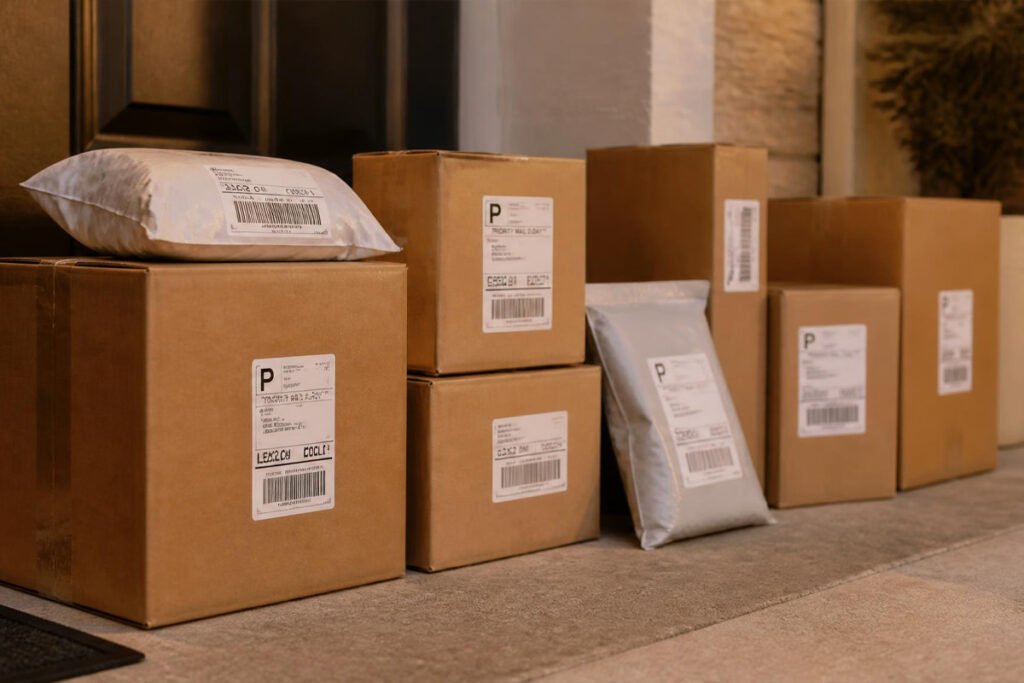
Packaging also isn’t just about protecting the product — it’s often the very first physical touchpoint a customer has with your brand, which matters just as much as the online business plan behind it.
In this guide, we break down the five shipping and packaging supplies worth investing in first, what problem each one solves, and how to prioritize your budget as your order volume grows.
Quick Answer
The best shipping and packaging setup depends on what’s slowing you down right now. If addressing labels by hand is your biggest time sink, a thermal label printer pays for itself within weeks. If you’re shipping lightweight, non-fragile items like clothing or soft goods, poly mailers cut both packing time and shipping cost compared to boxes. If you sell anything breakable — jewelry, electronics, ceramics — bubble mailers or padded envelopes are worth the extra cost to avoid damage claims and refunds. Every seller needs reliable packing tape, since a weak seal is one of the most common causes of in-transit damage. And once you’re shipping heavier or multi-item orders, a stock of corrugated shipping boxes in a few standard sizes rounds out a complete setup. The right principle: match your packaging to what you actually ship most, not to what looks impressive in a photo.
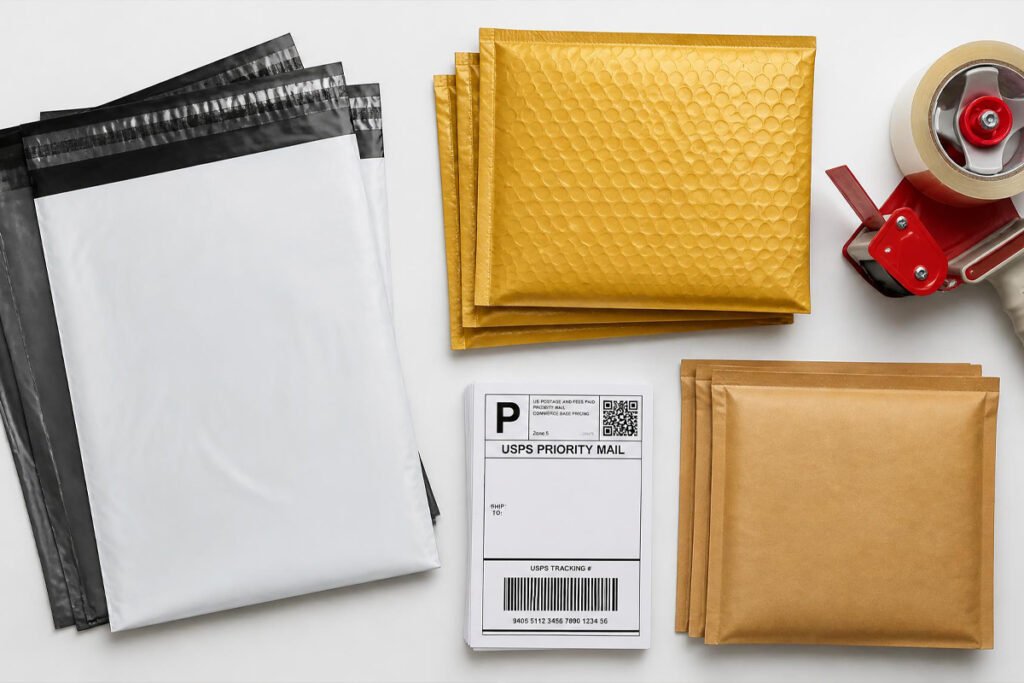
Table of Contents
- What Makes a Good Packaging Setup?
- How to Choose the Right Supplies for Your Products
- Best Shipping & Packaging Supplies Available
- Comparison Table
- Best Setup for Different Types of Online Sellers
- How to Build Your Packing Station Step by Step
- Common Mistakes
- Expert Tips
- Final Thoughts
- Frequently Asked Questions
What Makes a Good Packaging Setup? {#what-is}
A good packaging setup solves three problems at once: it protects the product well enough to avoid damage claims, it keeps your per-order cost as low as possible without hurting quality, and it makes the actual packing process fast enough that shipping doesn’t eat your whole evening. Most sellers only think about the first problem and end up overpaying, or ignore the second and third entirely until order volume forces the issue.
The core categories every online seller eventually needs are:
- Mailers or boxes sized correctly for what you actually sell, since oversized packaging wastes money on both materials and shipping weight
- A reliable sealing method, whether that’s a self-adhesive mailer or proper packing tape, since a weak seal is one of the most common causes of damaged or lost shipments
- A fast labeling method, since hand-addressing or reprinting labels one at a time is one of the biggest hidden time costs as order volume grows
- Protective cushioning for anything fragile, since damage claims and replacement shipments quietly erase your margin faster than almost any other cost
According to the U.S. Postal Service’s packaging guidelines, properly sized and sealed packaging is one of the most reliable ways to reduce shipping damage and delivery issues — which directly affects both your costs and your customer reviews.
How to Choose the Right Supplies for Your Products {#how-to-choose}
Before stocking up, ask yourself three questions:
Is what you sell fragile, or reasonably durable? Soft goods like clothing or accessories ship fine in a poly mailer. Anything breakable — ceramics, electronics, glass — needs padded protection, and skipping it usually costs more in damage claims than the padding ever would have.
How many orders are you shipping per week? If you’re shipping fewer than ten packages a week, buying in bulk ties up cash unnecessarily. Past that volume, bulk pricing on mailers, boxes, and labels drops meaningfully and starts paying for itself fast.
Does your packaging need to reinforce your brand, or just function? If you’re building a dropshipping side operation, plain functional packaging is fine. If you’re building a direct brand relationship with repeat customers on Etsy, unboxing experience genuinely affects repeat purchase rate and word-of-mouth.
Best Shipping & Packaging Supplies Available {#best-options}
1. Thermal Label Printer
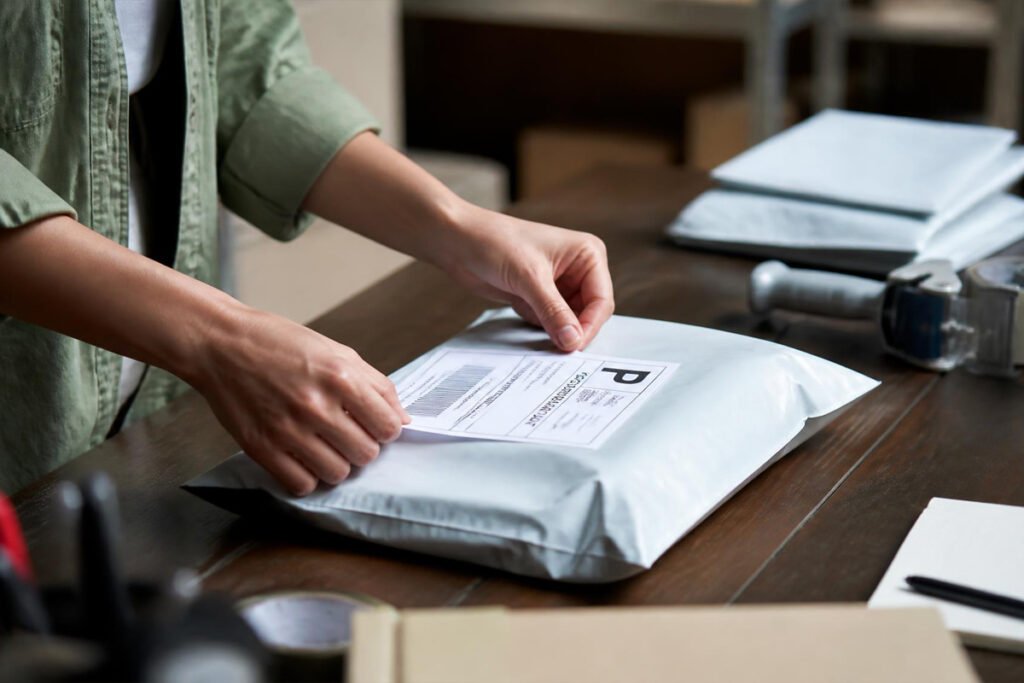
Overview: A thermal label printer prints shipping labels directly from your marketplace or shipping software without ink, toner, or a separate label sheet — you print, peel, and stick. For anyone shipping more than a handful of orders a week, this is consistently the single biggest time-saver in a packing station.
Key Features:
- Direct thermal printing with no ink or toner cartridges to replace
- Compatible with major marketplaces and shipping platforms (Etsy, Shopify, eBay, Amazon)
- Standard 4×6 label size compatible with most carrier requirements
- Fast print speed built for batch-printing multiple labels at once
Best For: Anyone shipping more than roughly ten orders a week who is still hand-writing addresses or printing labels on a regular inkjet printer.
Pros: ✅ Dramatically faster than printing and cutting labels from a sheet ✅ No ongoing ink or toner cost — only label rolls ✅ Pays for itself quickly once order volume increases
Cons: ❌ The highest upfront cost on this list ❌ Requires compatible label rolls, which is an ongoing supply cost
Our Verdict: If shipping is starting to feel like a second job, this is the first upgrade to make — especially relevant for anyone scaling a print-on-demand business where order volume can grow quickly.
2. Poly Mailers
Overview: Poly mailers are lightweight, self-sealing plastic shipping bags built for non-fragile items like clothing, soft goods, and small accessories. They weigh a fraction of what a comparable box weighs, which directly lowers your shipping cost on every single order.
Key Features:
- Self-sealing adhesive strip for fast, tape-free closing
- Tear-resistant and water-resistant material that protects contents from moisture
- Available in multiple sizes to match different product dimensions
- Significantly lighter than boxes, reducing dimensional and actual shipping weight
Best For: Sellers shipping clothing, soft goods, or any non-fragile item where box-level protection isn’t necessary.
Pros: ✅ One of the cheapest packaging options per order at scale ✅ Fast to pack — no tape needed thanks to the self-seal strip ✅ Meaningfully reduces shipping cost due to lower weight
Cons: ❌ Not suitable for anything fragile or rigid ❌ Per-unit cost rises quickly if bought in small quantities instead of bulk
Our Verdict: For Etsy sellers shipping soft goods or apparel, poly mailers are usually the fastest win for both cost and pack time — buy a mid-size bulk pack once you’re shipping consistently to unlock the biggest per-unit savings.
3. Padded / Bubble Mailers
Overview: Padded mailers add a layer of bubble cushioning inside a poly or paper mailer, giving you box-level protection at a fraction of the weight and cost. They’re the middle ground between a plain poly mailer and a full corrugated box, built specifically for items that need protection but don’t require rigid support.
Key Features:
- Built-in bubble cushioning layer for impact protection
- Self-sealing adhesive strip, same as standard poly mailers
- Lighter than boxes while still protecting against drops and rough handling
- Available in multiple sizes for electronics, jewelry, and small breakables
Best For: Sellers shipping small fragile or semi-fragile items — jewelry, electronics accessories, cosmetics, or ceramics.
Pros: ✅ Meaningfully reduces damage claims compared to plain poly mailers ✅ Still lighter than a box with void fill, keeping shipping costs down ✅ Fast to pack, same as standard mailers
Cons: ❌ More expensive per unit than plain poly mailers ❌ Still not a substitute for a rigid box on genuinely fragile or heavy items
Our Verdict: If damage claims or replacement shipments have been quietly cutting into your margin, upgrading fragile-item orders to padded mailers is one of the fastest ways to fix it without switching to boxes entirely.
4. Heavy-Duty Packing Tape (with Dispenser)
Overview: Packing tape is easy to overlook, but a weak or narrow tape is one of the most common causes of boxes opening in transit. A proper heavy-duty tape paired with a handheld dispenser also speeds up packing meaningfully compared to tearing tape off a bare roll by hand.
Key Features:
- Reinforced adhesive built for corrugated cardboard, not household use
- Standard 1.88-inch width for full seal coverage on standard box seams
- Handheld dispenser for one-handed application and clean, consistent cuts
- Available in refillable multi-roll packs for high-volume sellers
Best For: Every seller shipping boxes, regardless of volume — this is a non-negotiable baseline supply, not an optional upgrade.
Pros: ✅ Inexpensive relative to the damage and returns it prevents ✅ A dispenser noticeably speeds up the packing process ✅ Widely available in bulk, keeping cost per box low
Cons: ❌ Cheap or thin tape is a false economy — it fails exactly when you need it most ❌ Dispensers can jam if the tape roll isn’t loaded correctly
Our Verdict: This is the cheapest item on this list and arguably the most important — skimping here is one of the most common (and easily avoidable) causes of shipping damage complaints.
5. Corrugated Shipping Boxes (Multi-Size Pack)
Overview: Once you’re shipping anything rigid, heavier, or multi-item, corrugated boxes are simply non-negotiable. Stocking two or three standard sizes instead of one oversized box keeps both your packaging costs and your dimensional shipping weight under control.
Key Features:
- Multiple standard sizes to match different order types instead of one-size-fits-all
- Corrugated construction for stacking strength and crush resistance
- Compatible with standard void-fill materials (paper, air pillows, tissue)
- Flat-shipped and easy to store before assembly
Best For: Sellers shipping multi-item orders, anything rigid, or products too heavy for a mailer.
Pros: ✅ Necessary baseline for anything that can’t safely ship in a mailer ✅ Buying multiple sizes prevents overpaying for oversized shipping ✅ Widely available with fast bulk reorder options
Cons: ❌ Heavier than mailers, which increases shipping cost per order ❌ Takes up more physical storage space than flat mailers
Our Verdict: Keep your box inventory to two or three sizes that actually match your product range — over-stocking sizes you rarely use ties up both cash and shelf space unnecessarily.
Comparison Table {#comparison-table}
| Supply | Best For | Relative Cost | Ships Fragile Items | Impact on Pack Time |
|---|---|---|---|---|
| Thermal Label Printer | High-volume sellers | High (one-time) | N/A | Highest |
| Poly Mailers | Clothing, soft goods | Very Low per unit | ❌ No | High |
| Padded/Bubble Mailers | Small fragile items | Low–Moderate per unit | ✅ Yes (light) | High |
| Heavy-Duty Tape + Dispenser | Every seller shipping boxes | Very Low | N/A | Moderate |
| Corrugated Boxes | Multi-item, rigid, heavier orders | Low–Moderate per unit | ✅ Yes (with cushioning) | Moderate |
Bulk pricing drops significantly at higher order quantities — compare per-unit cost at your actual monthly order volume before buying.
Best Setup for Different Types of Online Sellers {#use-cases}
Dropshippers and Print-on-Demand Sellers
If you’re running a dropshipping business or fulfilling print-on-demand orders yourself, prioritize the thermal label printer first — order volume in this model tends to scale quickly, and manual labeling becomes a real bottleneck faster than most sellers expect.
Etsy and Handmade Sellers
If you’re running an Etsy shop, padded mailers and a bit of extra care in presentation pay off disproportionately — handmade buyers notice packaging quality, and it directly affects reviews and repeat purchases in a way that matters more here than in commodity dropshipping.
Sellers Shipping a Mix of Product Types
If your catalog spans soft goods and fragile or multi-item products, don’t standardize on one packaging type — stock both poly mailers and a couple of box sizes, and match the packaging to the specific order rather than defaulting to whichever is more convenient to grab.
How to Build Your Packing Station Step by Step {#how-to}
Step 1: Audit Your Last 20 Orders
Look at what you actually shipped recently — sizes, weights, fragility — and let that data decide your supply mix instead of guessing.
Step 2: Start With Tape and One Mailer Size
Get reliable tape and one mailer size that fits your most common product first. Add sizes and box options only once you see a clear, repeated need.
Step 3: Add a Thermal Label Printer Once Volume Justifies It
Once you’re shipping consistently — generally more than ten orders a week — the time saved on labeling starts to outweigh the upfront printer cost quickly.
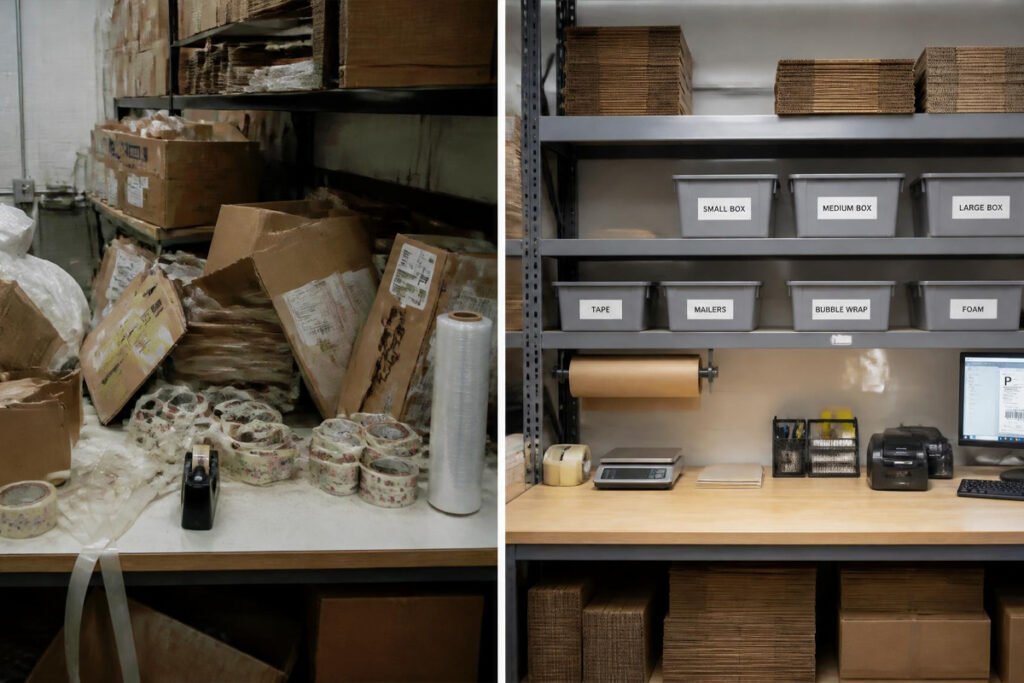
Step 4: Set Up a Dedicated Packing Area
Keep mailers, boxes, tape, and your label printer in one fixed spot rather than scattered around your home — this alone cuts meaningful time off every single order.
Step 5: Reorder Before You Run Out, Not After
Track your usage and reorder supplies at a set threshold rather than waiting until you’re out — running out mid-order is one of the most common causes of shipping delays for small sellers.
Common Mistakes {#mistakes}
Buying one box size for everything. Shipping a small item in an oversized box wastes money on both the box itself and the dimensional shipping weight carriers charge for — a mistake that compounds with every order once volume grows.
Skimping on tape to save a few dollars. Thin or narrow tape is one of the most common causes of in-transit damage claims, which cost far more in refunds and replacement shipping than proper tape would have.
Not reordering supplies until you’re already out. Running out of mailers or labels mid-shipping-day causes delays that directly hurt your marketplace metrics — a problem worth planning around the same way you’d plan around any other operational gap in your business.
Expert Tips {#tips}
Buy your most-used mailer size in bulk, and everything else in smaller quantities. Bulk pricing drops meaningfully at higher quantities, but only for the sizes you actually use often enough to avoid tying up cash in slow-moving inventory.
Weigh a fully packed order before setting your default shipping price. Sellers frequently underestimate packaging weight, which quietly eats margin on every single sale until it’s corrected.
Keep a small stock of both plain and padded mailers, and pick per order. Defaulting every order to the more expensive padded option wastes money on items that never needed it in the first place.
Final Thoughts {#final-thoughts}
There’s no single “best” shipping setup — only the right combination of supplies for what you actually sell and how fast you’re growing. If time is your biggest constraint, the thermal label printer delivers the fastest return. If cost per order matters most and your products are durable, poly mailers are the clear starting point. And if damage claims have been quietly cutting into your margin, padded mailers and proper tape are the cheapest fixes available.
Whichever supplies you start with, remember that packaging is part of the customer experience, not just a shipping cost — a detail worth as much attention as the business idea itself.
Frequently Asked Questions {#faq}
Do I really need a thermal label printer, or can I keep using a regular printer? A regular printer works fine at low volume, but once you’re shipping more than roughly ten orders a week, the time saved by a thermal printer — plus the eliminated ink cost — typically pays for the printer within a few months.
How much should I budget for packaging supplies as a new seller? Start small and buy your most-used mailer size and tape in a mid-size pack rather than committing to bulk pricing immediately. Bulk buying becomes worth it once your order volume is consistent enough to use the supplies before they take up unnecessary storage space.
Poly mailers vs. boxes — which should I use? Poly mailers are the better choice for non-fragile, soft-good items where weight and cost matter most. Boxes are necessary for anything rigid, heavier, or multi-item, where the extra protection outweighs the added weight and cost.
Do padded mailers actually reduce damage claims? Yes — the added cushioning layer meaningfully reduces damage from drops and rough handling compared to plain poly mailers, which is why many sellers reserve them specifically for fragile or higher-value items.
What size shipping labels do most carriers require? Most major carriers and thermal printers use a standard 4×6 label size, which is compatible with USPS, UPS, and most third-party shipping software.
Is it worth using custom-branded packaging as a small seller? It depends on your business model. For direct-to-customer brands like handmade or subscription products, branded packaging can meaningfully improve repeat purchases. For dropshipping or thin-margin resale, plain functional packaging is usually the more practical choice.
How do I reduce shipping costs without sacrificing protection? Match your packaging weight and size to the actual product rather than defaulting to a larger box “just in case” — both box weight and dimensional weight directly affect what carriers charge per shipment.
What’s the most common cause of shipping damage complaints? Underpacked or poorly sealed packages are consistently the most common cause — usually from tape that’s too thin or void fill that’s missing entirely, rather than a completely wrong packaging type.
Can I switch suppliers for packaging without disrupting my process? Yes — as long as you keep your standard sizes and specifications consistent, switching where you buy mailers, tape, or boxes typically requires no other changes to your packing process.
How often should I reassess my packaging setup? Revisit it any time your order volume shifts significantly, you add a new product category, or you notice a pattern in damage claims or returns — those are the clearest signals your current supplies no longer match what you’re actually shipping.
Author: Morne Winston Last Updated: July 2026