

You’ve written a strong proposal using the framework in our guide on how to write a business proposal that wins clients, and maybe you’re already sending it through proposal software. But there’s one section that stalls more freelancers and small business owners than any other: the price.
Price it too high with no justification, and a client quietly moves to the next name on their shortlist. Price it too low, and you win the job but resent the work by week two — or worse, you can’t actually afford to deliver what you promised. Most pricing mistakes aren’t about the number itself; they’re about picking the wrong pricing model for the job in front of you.
This guide walks through the main proposal pricing models, how to choose between them, and the specific mistakes that quietly cost small businesses money on every deal they win.
Quick Answer
The right way to price a business proposal depends on the type of work and how well-defined the scope is. Well-defined, one-time projects price best as a flat fee. Ongoing work — like marketing retainers or consulting — usually fits a monthly retainer. Work with unclear or shifting scope is safest priced hourly, with a not-to-exceed cap. High-value outcomes, like a project that will directly generate revenue for the client, are strong candidates for value-based pricing, where price ties to the result rather than your time. The core principle across all of them: price the outcome you’re delivering, not just the hours it takes you.
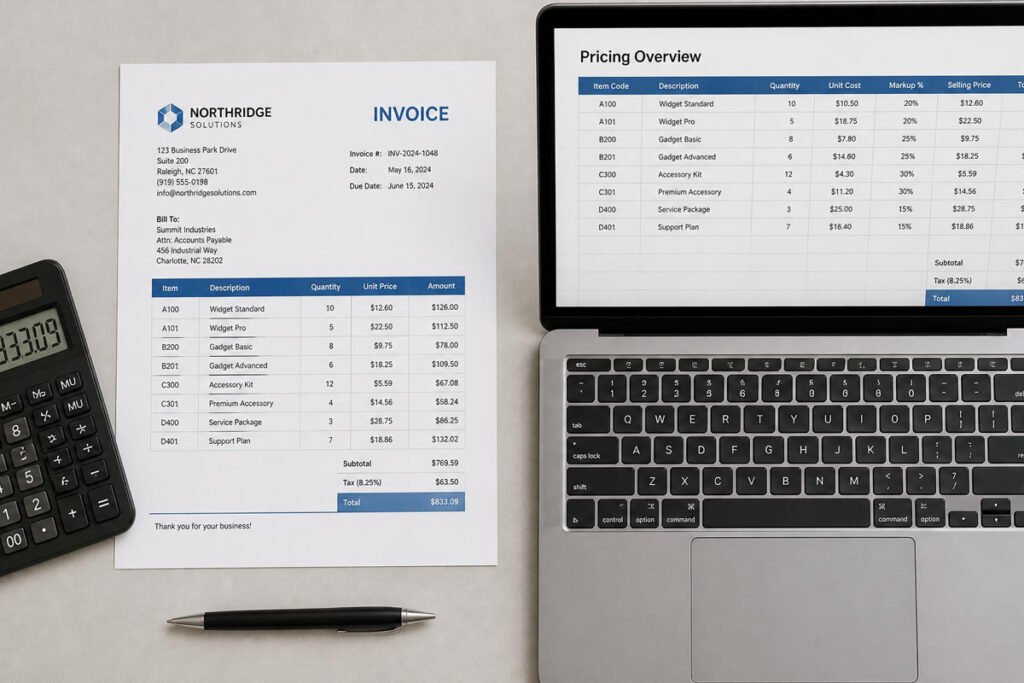
Table of Contents
- Why Pricing Is the Hardest Part of a Proposal
- How to Choose the Right Pricing Model
- The Main Proposal Pricing Models
- Pricing Model Comparison Table
- How to Price Different Types of Proposals
- How to Present Pricing in Your Proposal
- Common Pricing Mistakes
- Expert Tips
- Final Thoughts
- Frequently Asked Questions
Why Pricing Is the Hardest Part of a Proposal {#why-hard}
Pricing feels harder than writing the proposal itself because it’s the one part of the document where you’re putting a number on your own judgment, not just describing a process. Most new freelancers and small business owners default to hourly pricing because it feels the safest — but hourly pricing quietly punishes you for getting faster and better at your work, since a more efficient result earns you less money, not more.
The businesses that price with confidence have usually done one thing differently: they picked a pricing model that matches the type of work, instead of using the same approach for every proposal regardless of scope. This matters just as much once you’ve nailed down your first 10 customers as it does years into running the business — pricing habits set early tend to stick.
How to Choose the Right Pricing Model {#how-to-choose}
Before you write a number into a proposal, answer three questions:
Is the scope fully defined, or likely to shift? A tightly scoped project supports a flat fee. A project where requirements are still being worked out is safer priced hourly or with a defined discovery phase first.
Is this a one-time project or ongoing work? Ongoing work — like monthly marketing, bookkeeping, or maintenance — fits a retainer model far better than repeatedly quoting one-off flat fees.
Can you tie your work to a measurable result for the client? If your work directly and measurably increases revenue or cuts costs, value-based pricing usually earns more than time-based pricing — and it shifts the client’s focus from your hourly rate to their return.
According to the U.S. Small Business Administration, small businesses that price around the value delivered to the customer — rather than simply marking up their costs — are generally better positioned to compete on more than price alone, which is exactly the shift value-based pricing is built around.
The Main Proposal Pricing Models {#pricing-models}
1. Flat Fee (Fixed Price)
Overview: You quote one total price for a clearly defined scope of work, regardless of how many hours it actually takes you to deliver it.
Key Features:
- One clear number the client can budget against
- Requires a tightly defined scope document to protect both sides
- Rewards efficiency — the faster you work, the better your effective rate
- Easiest model for clients to say yes to quickly
Best For: Website builds, logo design, single reports, one-off consulting projects — anything with a clear beginning, middle, and end.
Pros: ✅ Simple for clients to understand and approve ✅ Rewards you for getting faster over time ✅ No time-tracking required
Cons: ❌ Risky if scope isn’t locked down first ❌ You absorb the cost of underestimating the work
Our Verdict: Flat fee is the strongest default for most service businesses once you’ve done similar work enough times to estimate it accurately. Pair it with a clearly scoped business proposal so both sides agree on exactly what’s included.
2. Hourly Rate
Overview: You bill for actual time worked, typically with an estimated range so the client isn’t blindsided by the final invoice.
Key Features:
- Fair when scope is genuinely unpredictable
- Usually paired with a “not-to-exceed” cap for client comfort
- Requires reliable time tracking
- Easy to adjust if the project grows mid-way
Best For: Ongoing troubleshooting, legal or advisory work, and any project where the client themselves isn’t sure what they need yet.
Pros: ✅ Fair when scope is unclear ✅ Easy to adjust as work evolves ✅ Lower risk of being underpaid for scope creep
Cons: ❌ Punishes efficiency ❌ Clients often find open-ended hourly quotes harder to approve
Our Verdict: Use hourly pricing as a starting point for new or unclear types of work, then transition to flat-fee pricing once you’ve delivered the same service enough times to estimate it confidently.
3. Monthly Retainer
Overview: The client pays a set monthly fee for ongoing access to your work or availability — common in marketing, bookkeeping, IT support, and consulting relationships.
Key Features:
- Predictable, recurring revenue for your business
- Usually includes a defined scope of monthly deliverables or hours
- Easier long-term financial planning for both sides
- Often includes a minimum commitment period
Best For: Ongoing services like social media management, accounting, or maintenance and support contracts.
Pros: ✅ Predictable monthly income ✅ Builds a longer-term client relationship ✅ Reduces repeated proposal-writing for the same client
Cons: ❌ Requires very clear scope boundaries to avoid resentment on either side ❌ Harder to raise pricing mid-contract
Our Verdict: Retainers are one of the best ways to stabilize income once you’re past the early stage of finding your first clients and want more predictable monthly revenue.
4. Value-Based Pricing
Overview: Instead of pricing your time, you price the outcome — tying your fee to the measurable value the client receives, such as revenue generated or costs saved.
Key Features:
- Price is anchored to client outcomes, not your hours
- Often the highest-earning model when done correctly
- Requires clear data or a strong case for the expected impact
- Works best for experienced providers with a track record
Best For: Consultants, marketers, and specialists whose work has a clear, measurable financial impact on the client’s business.
Pros: ✅ Highest earning potential of any model ✅ Shifts the conversation away from your rate entirely ✅ Rewards expertise, not just time spent
Cons: ❌ Harder to justify without past results or case studies ❌ Requires real confidence in your ability to deliver the outcome
Our Verdict: Value-based pricing is worth working toward as you build a track record — it’s the natural next step after you’ve built a personal brand backed by real results.
5. Milestone-Based Pricing
Overview: The total project fee is split into payments tied to specific deliverables or phases, rather than paid all at once or purely by the hour.
Key Features:
- Breaks a larger flat fee into smaller, scheduled payments
- Improves cash flow for longer projects
- Gives the client checkpoints to review progress
- Reduces risk of doing a large amount of unpaid work upfront
Best For: Larger projects — website builds, product launches, multi-phase consulting engagements — where the full project spans weeks or months.
Pros: ✅ Better cash flow than a single final payment ✅ Natural checkpoints reduce scope-creep risk ✅ Easier for clients to approve internally in stages
Cons: ❌ More complex to set up than a single flat fee ❌ Requires clearly defined milestones to avoid disputes
Our Verdict: For any project running longer than a few weeks, milestone pricing protects your cash flow better than waiting for one lump-sum payment at the very end.
[IMAGE 3B — Comparison | Alt text: “business proposal pricing models comparison table”]
Pricing Model Comparison Table {#comparison}
| Model | Best For | Client Predictability | Your Earning Potential | Complexity |
|---|---|---|---|---|
| Flat Fee | Defined, one-off projects | High | Medium–High | Low |
| Hourly Rate | Unclear or evolving scope | Medium | Low–Medium | Low |
| Monthly Retainer | Ongoing services | High | Medium | Medium |
| Value-Based | Measurable-outcome work | Low | High | High |
| Milestone-Based | Longer, multi-phase projects | High | Medium–High | Medium |
How to Price Different Types of Proposals {#by-type}
Freelancers and Solo Consultants
If you’re early in your freelancing business, start with hourly or flat-fee pricing until you have enough completed projects to estimate accurately. Track your actual hours against your quotes for at least ten projects — that data becomes the foundation for more confident flat-fee pricing later.
Small Agencies and Service Teams
Once you have a team and predictable service packages, retainers and milestone pricing reduce the amount of new proposal-writing needed for every client, and support the kind of financing and cash-flow planning that becomes more important as you grow.
High-Value Consulting and Strategy Work
If your work has a direct, measurable financial impact — increasing sales, cutting costs, improving conversion — value-based pricing is worth the extra effort to justify. This is also the stage where your pitch deck and case studies matter as much as the proposal itself, since both are selling the same track record.

How to Present Pricing in Your Proposal {#how-to-present}
According to guidance from SCORE, a nonprofit resource partner of the U.S. Small Business Administration, proposals that present pricing options rather than a single take-it-or-leave-it number tend to convert better, since clients are choosing between tiers instead of deciding whether to say yes or no at all.
Step 1: Lead With the Outcome, Not the Number
Before the client sees a price, make sure the proposal has already made the case for the value they’re getting — pricing lands very differently after a strong problem-and-solution section than it does cold.
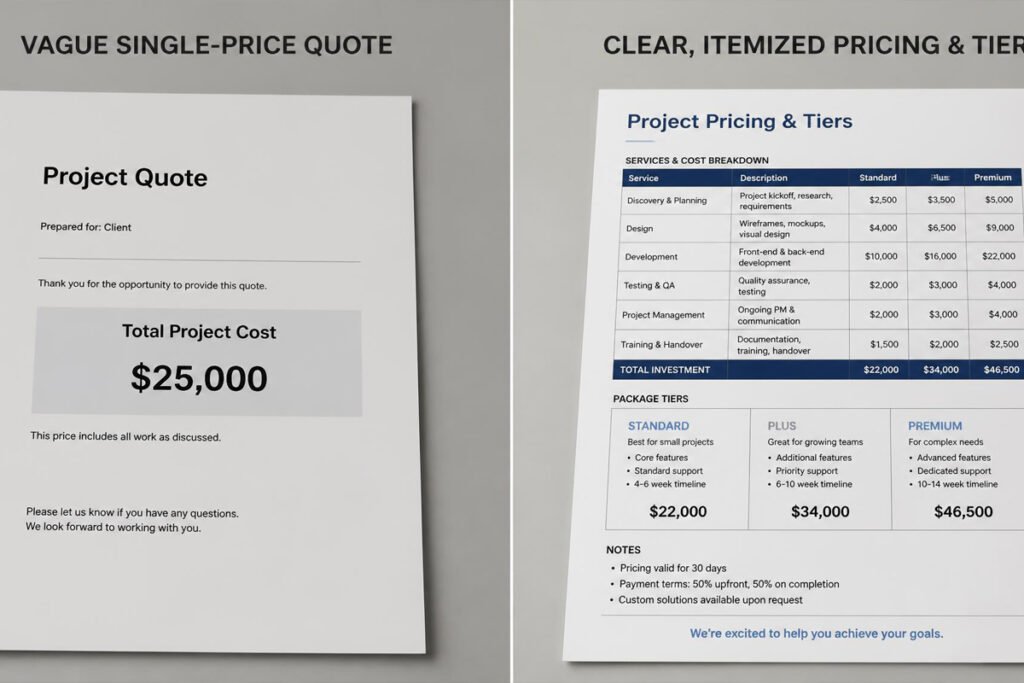
Step 2: Offer Two or Three Pricing Tiers
Presenting a “Good / Better / Best” structure shifts the client’s decision from yes-or-no to which option, which meaningfully increases close rates in most service businesses.
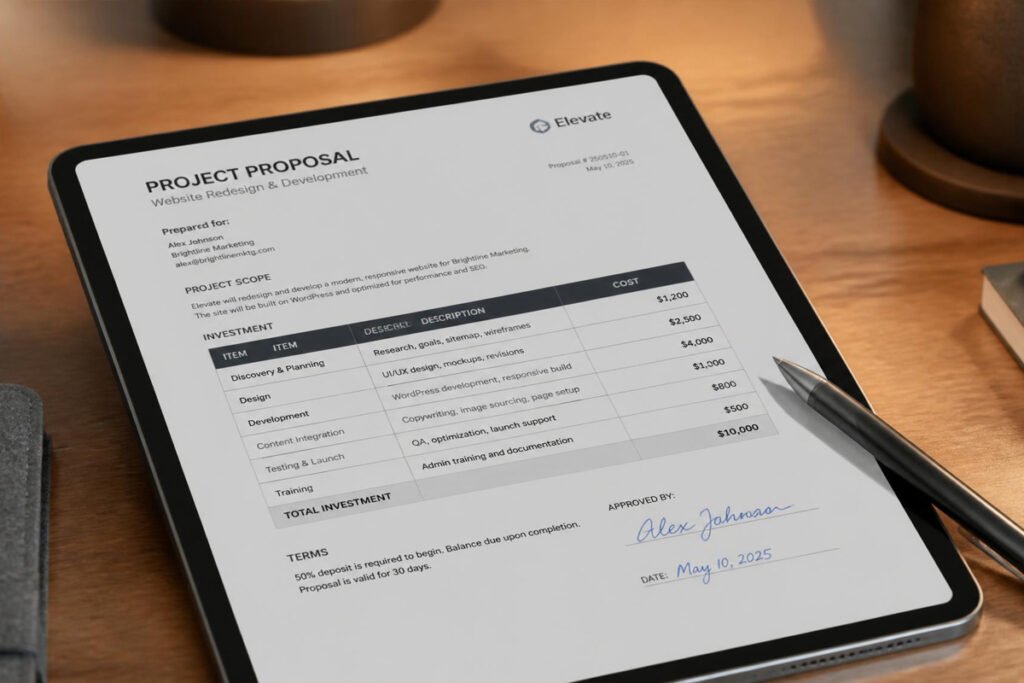
Step 3: Itemize What’s Included
List exactly what each price covers — deliverables, revisions, timeline — so there’s no ambiguity that leads to scope-creep disputes later.
Step 4: State Your Payment Terms Clearly
Specify deposit requirements, payment schedule, and what happens if a milestone is delayed, so there are no surprises for either side once work begins.
Step 5: Set an Expiration Date on the Quote
Give your pricing a clear validity window — typically 15 to 30 days — so you’re not locked into old pricing if a client sits on a proposal for months.
Common Pricing Mistakes {#mistakes}
Quoting a single flat number with no breakdown. Clients trust itemized pricing more than a single lump sum, and a breakdown gives them room to trim scope instead of rejecting the whole proposal outright.
Pricing purely off what competitors charge. Competitor pricing is useful context, but pricing based only on undercutting others usually means underpricing your own business plan’s actual costs and profit targets.
Leaving scope open-ended in a flat-fee proposal. Without a clear scope boundary, “quick tweaks” pile up fast, and you end up doing far more work than the quoted price ever accounted for.
Expert Tips {#tips}
Build a rate floor before you ever write a proposal. Calculate the minimum hourly-equivalent rate you need to hit your income goals before factoring in taxes, software costs, and non-billable admin time — then never quote below it, even under pressure.
Re-quote recurring project types after ten jobs. Once you’ve delivered the same type of project ten times, you have enough real data to move confidently from hourly to flat-fee pricing, usually at a higher effective rate.
Anchor high, then offer a lower tier. Presenting your premium package first makes your mid-tier option look more reasonable by comparison — a well-documented pricing psychology effect worth using deliberately in your proposal layout.
Final Thoughts / Final Verdict {#final-thoughts}
Best overall starting point: Flat-fee pricing for clearly scoped, one-off projects. Best for unpredictable work: Hourly pricing with a not-to-exceed cap. Best for long-term income stability: Monthly retainers once you have repeat clients. Best for maximizing earnings: Value-based pricing, once you have the track record to back it up.
Pricing confidently comes down to matching the model to the work, not defaulting to the same approach every time. Combine the right pricing model with the structure in our business proposal writing guide and delivery through proposal software, and pricing stops being the part of the proposal you dread.
Frequently Asked Questions {#faq}
Should I show my hourly rate in a flat-fee proposal? Generally no. Showing an hourly rate alongside a flat fee invites the client to do their own math and second-guess the total, which undermines the value-based framing you’re going for.
How much should I charge as a beginner freelancer? Research typical rates for your skill and region, then price slightly below the mid-market rate rather than the lowest — using proposal software and a professional presentation helps justify a fair starting rate even without years of experience.
What’s the difference between a quote, an estimate, and a proposal? A quote is a fixed price commitment, an estimate is an approximate figure that may change, and a proposal is the full document — including pricing — that also covers scope, timeline, and terms.
How do I handle a client who says my price is too high? Ask what specifically feels out of range before discounting — often the concern is about a specific deliverable, and you can adjust scope rather than simply lowering your rate.
Should I ever offer a discount in a proposal? Sparingly, and always tied to a reason — a longer contract term, upfront payment, or reduced scope — rather than a blanket discount that trains clients to expect one on every future proposal.
How often should I raise my prices? Most service businesses review pricing annually, or after a clear jump in demand, skill level, or a portfolio backed by a stronger personal brand.
Is value-based pricing realistic for a new business? It’s harder without a track record, but not impossible — start by estimating value conservatively and building in case studies from your first few projects to support higher value-based pricing later.
What should I do if a project runs over the quoted flat fee? This is exactly why scope needs to be itemized upfront — if new work is requested beyond the original scope, treat it as a separate add-on with its own price rather than absorbing it for free.
Do I need different pricing for retainer clients versus one-off clients? Yes — retainer pricing should reflect the value of guaranteed monthly income and priority access, which is usually different (and often lower per-hour) than one-off project pricing.
How does taxes and business structure affect how I price? Make sure your pricing accounts for self-employment or business taxes, not just your take-home target — this is one more reason to have your EIN and business licensing in order early, so tax obligations aren’t a surprise once revenue grows.
Author: Morne Winston Last Updated: August 2026
Pingback: Best Webcams for Virtual Client Meetings: Top 5 Proven Picks | Ideas Junction – Your Hub for Startups, Business Growth & Innovation
Pingback: Best CRM Software for Small Business: Top 6 Proven Picks | Ideas Junction – Your Hub for Startups, Business Growth & Innovation
Pingback: 10 Business Proposal Mistakes That Cost You the Deal | Ideas Junction – Your Hub for Startups, Business Growth & Innovation