
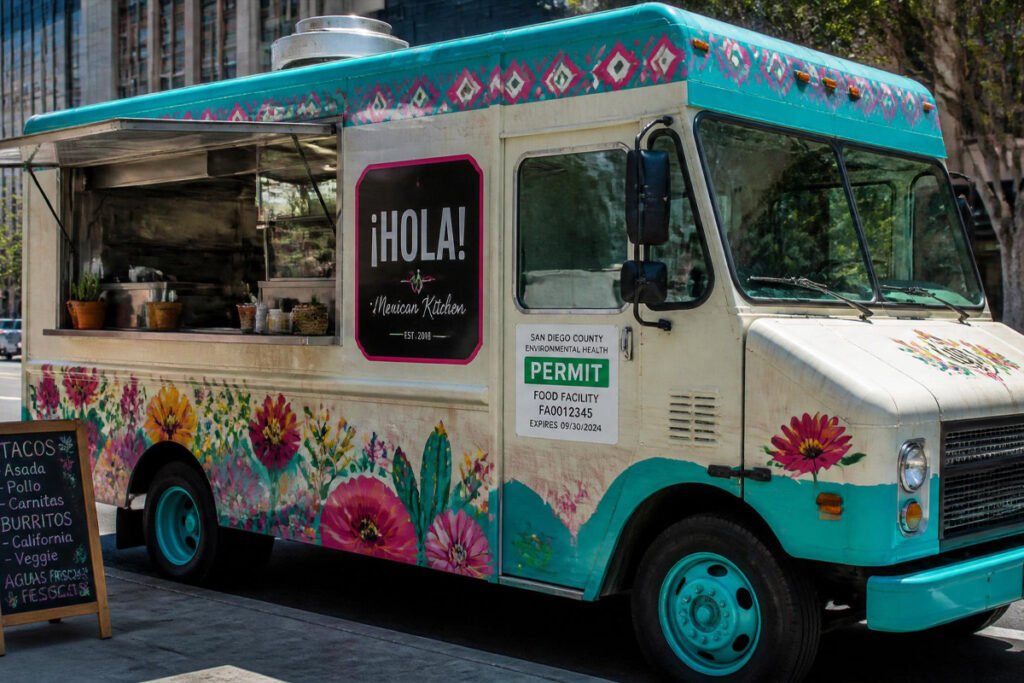
Nothing stalls a food truck launch faster than realizing there isn’t one single “food truck license” to apply for. New operators often start building their food truck business around the menu, the branding, and the truck itself — only to discover the licensing side is a stack of separate approvals from different agencies, each with its own fee, inspection, and timeline.
The confusion is understandable. Rules vary by city and county, not just by state, and a permit that’s optional in one town can be mandatory two towns over. Even the terminology shifts — what one health department calls a “mobile food facility permit,” another calls a “mobile food vendor license.“
This guide breaks down exactly what you need, in what order, and what it actually costs — plus a genuinely new development for 2026: Texas just passed a law consolidating what used to be a fully city-by-city licensing patchwork into one statewide system, which is worth knowing about even if you’re not launching there, since other states may follow the same path.
Quick Answer
Yes — a food truck business needs multiple licenses and permits, not one. At minimum, you’ll need: a general business license from your city or county, a health department permit (sometimes called a mobile food facility or mobile food unit permit), a food handler’s certificate for staff and a food manager certification for at least one supervisor, a seller’s permit to collect sales tax, and usually a commissary kitchen agreement proving you have an approved place to prep and store food. Fire department inspection and a separate parking or vending permit are common additional requirements depending on where you operate. Total costs typically range from a few hundred dollars to around $2,000 depending on your city, with most of that variation coming from health department fees and inspection costs.
Table of Contents
- What Licenses Does a Food Truck Actually Need?
- How to Choose Your Licensing Path
- The Core Permits & Licenses Explained
- Permit Comparison Table
- How Requirements Differ by State
- How to Get Licensed: Step by Step
- Common Licensing Mistakes
- Expert Tips
- Final Thoughts
- Frequently Asked Questions
What Licenses Does a Food Truck Actually Need? {#what-is-it}
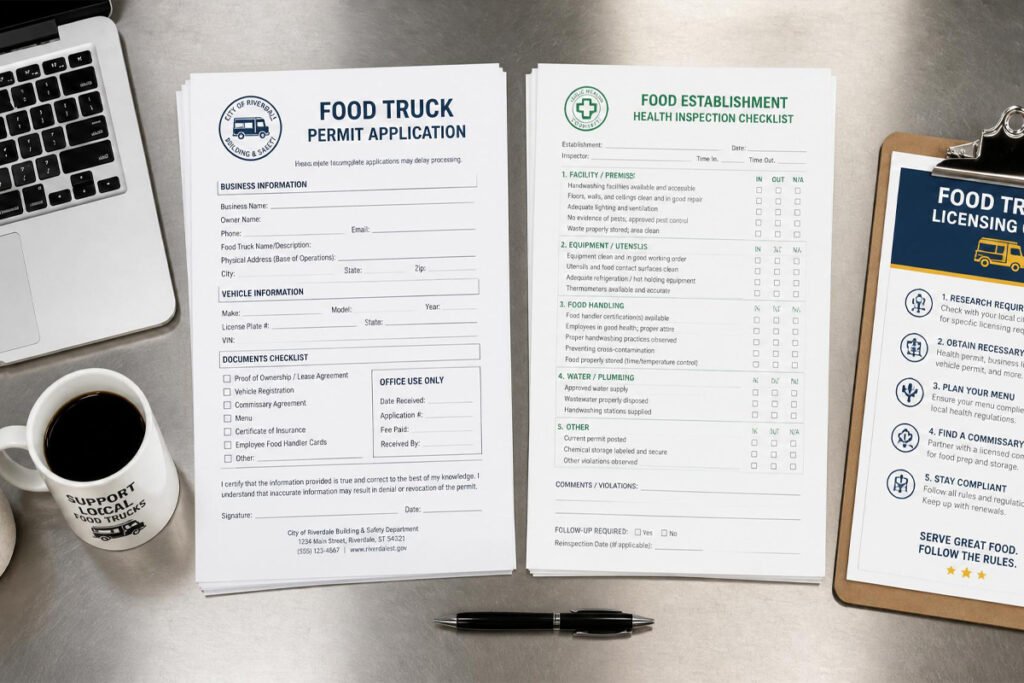
A food truck sits at the intersection of three different regulatory categories at once — it’s a food service business, a vehicle, and often a street-level vendor — which is exactly why the licensing list is longer than a typical small business. Depending on where you operate, the core requirements usually include a business license, a health department permit, food handler and manager certifications, a seller’s permit, a commissary kitchen agreement, and sometimes a separate mobile vending or parking permit.
Unlike a fixed restaurant, a food truck also has to satisfy zoning and parking rules that shift depending on where you park each day — some cities restrict how close you can operate to brick-and-mortar restaurants or schools, and permits for public street vending are often issued separately from your core health permit.
If you’re still finalizing your business structure, it’s worth reviewing our broader guide on starting a small business alongside the food-truck-specific rules below, since entity formation (LLC vs. sole proprietorship) typically has to happen before you can apply for most of these permits.
How to Choose Your Licensing Path {#how-to-choose}
Three questions shape your specific licensing checklist:
What are you serving? Selling only prepackaged food is typically cheaper and lower-risk to license than preparing raw meat or hot food on board, since health departments scale inspection intensity to food safety risk.
Where will you primarily operate? Street vending, private events, breweries, and festival circuits each carry different permit requirements. A truck that only serves private catering events may need fewer public vending permits than one parking on city streets daily.
Does your state license mobile food vendors directly, or leave it to local health departments? Most states leave licensing to county or city health departments, but this is actively changing — Texas, for example, is shifting to a centralized state system in 2026, and it’s worth checking your state’s health department site directly for the current structure before assuming the old city-by-city model still applies.
The Core Permits & Licenses Explained {#core-permits}
General Business License
Overview: The baseline registration any business needs to legally operate within a city or county, separate from anything food-related.
Key Features:
- Filed with your city or county, sometimes alongside a DBA (doing business as) registration
- Usually required before you can apply for health or vending permits
- Renewed annually in most jurisdictions
Best For: Every food truck operator, regardless of city or menu.
Pros: ✅ Straightforward, well-established process ✅ Relatively inexpensive compared to health permits
Cons: ❌ Doesn’t cover food safety or vending — just one piece of the puzzle
Our Verdict: Get this first — most other permits require proof of an active business license before they’ll even accept your application.
Health Department / Mobile Food Facility Permit
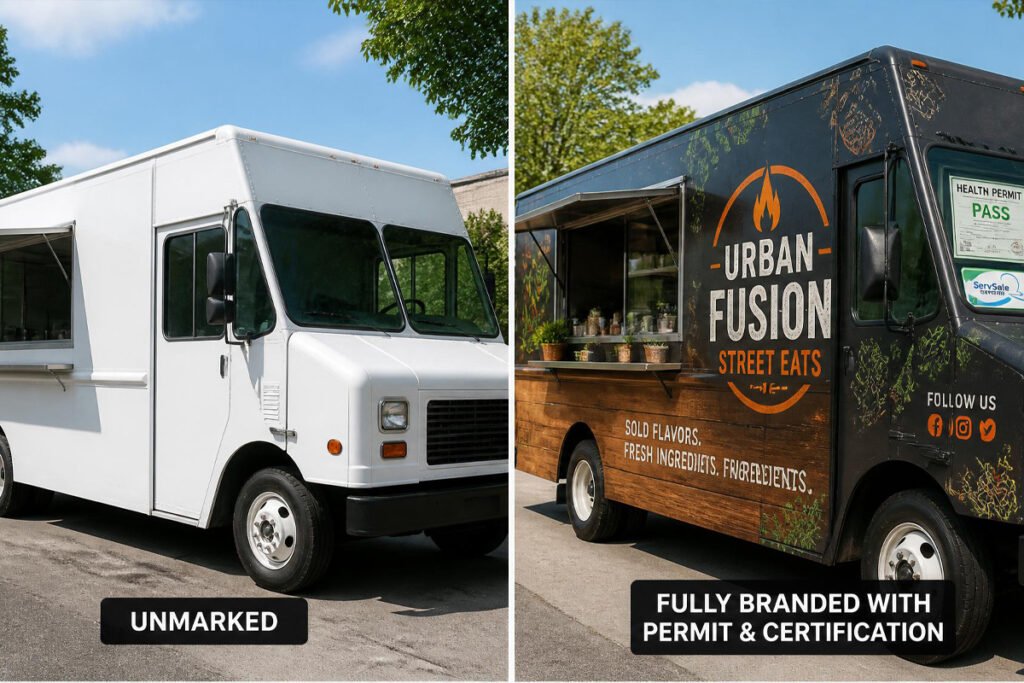
Overview: Confirms your truck meets food safety standards — equipment, storage, sanitation, and water systems all get inspected before this is issued.
Key Features:
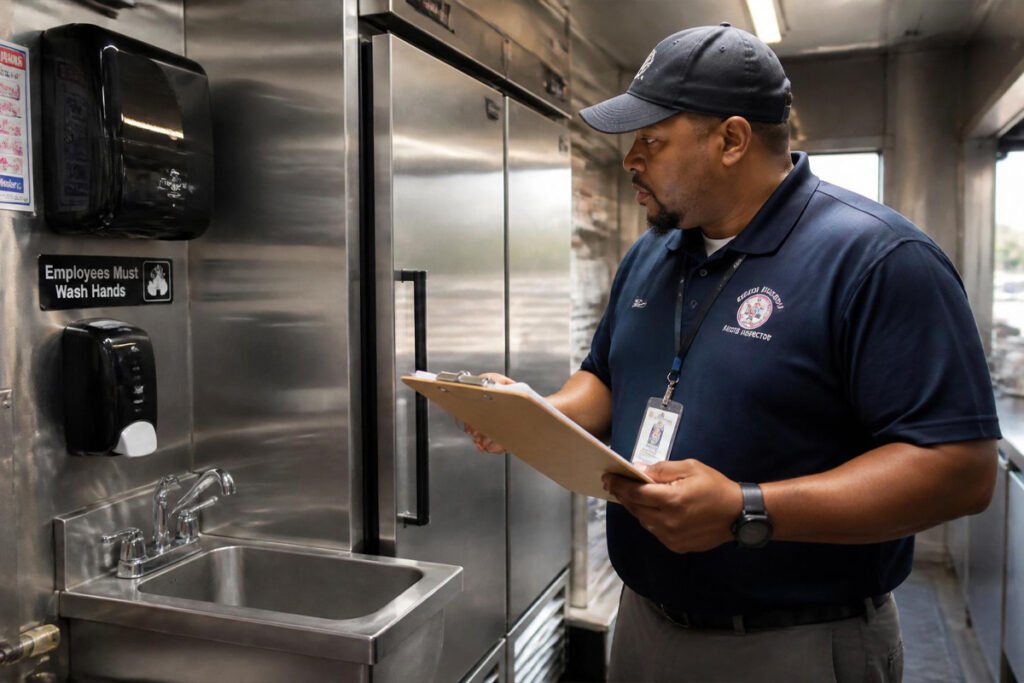
- Requires a physical inspection of the truck itself, not just paperwork
- Checks handwashing stations, three-compartment sinks, refrigeration, and ventilation
- Often tied to a required grade or pass/fail rating, similar to restaurant health scores
Best For: Every food truck without exception — this is the permit most closely associated with “can I legally serve food.”
Pros: ✅ Builds real customer trust once displayed ✅ Establishes a clear compliance baseline for renewals
Cons: ❌ Costs vary widely — commonly $100 to over $1,000 depending on location and risk category ❌ Requires a physical inspection appointment, which can add wait time
Our Verdict: Budget both time and money for this one generously — it’s the permit most likely to delay a launch if your truck isn’t inspection-ready on the first attempt.
Food Handler & Food Manager Certifications
Overview: Confirms that staff handling food have completed basic food-safety training, with at least one certified manager typically required on-site.
Key Features:
- Usually completed via a short online course and exam
- Food handler certifications commonly valid for around three years
- At least one Food Protection Manager certification (such as ServSafe) often required per truck
Best For: You and any staff directly handling or preparing food.
Pros: ✅ Inexpensive and fast to complete online ✅ Transfers with the individual, not tied to a specific truck or business
Cons: ❌ Easy to overlook for part-time or seasonal staff
Our Verdict: Get every team member certified before opening day, not after — inspectors commonly check for this during health permit inspections.
Seller’s Permit (Sales Tax Permit)
Overview: Authorizes you to collect and remit sales tax on the food and drinks you sell, since prepared food is a taxable good in most states.
Key Features:
- Issued by your state’s department of revenue or tax authority
- Free to apply for in most states
- Requires ongoing sales tax filing, typically monthly or quarterly
Best For: Every food truck selling food or beverages directly to customers.
Pros: ✅ Usually free to obtain ✅ Simple online application in most states
Cons: ❌ Adds an ongoing filing obligation, not a one-time task
Our Verdict: Apply for this alongside your EIN early on — many other permit applications ask for your seller’s permit number.
Commissary Kitchen Agreement
Overview: A signed agreement with an approved commercial kitchen where you prep, store, and sometimes clean equipment between shifts — required in many (though not all) jurisdictions.
Key Features:
- Often required as a supporting document for your health permit application
- Costs typically run $200–$1,500 per month as an ongoing operating expense, not a one-time fee
- Shared commissary spaces are common in cities with many food truck operators
Best For: Trucks operating in cities that mandate a home base for food storage and prep — check your local health department, since this requirement is not universal.
Pros: ✅ Solves the “where do I restock and clean” logistics problem ✅ Often required for permit approval, so it doubles as compliance and operations
Cons: ❌ Recurring monthly cost that needs to be factored into your budget from day one
Our Verdict: Shop around — commissary costs and availability vary significantly even within the same city, so get quotes from a few options before committing.
Permit Comparison Table {#comparison-table}
| Permit/License | Issued By | Typical Cost | Renewal |
|---|---|---|---|
| General Business License | City/County | $50–$400 | Annual |
| Health Department / Mobile Food Facility Permit | County Health Dept. | $100–$1,200+ | Annual (with inspection) |
| Food Handler Certification | State/Approved Provider | $10–$30 per person | Every ~3 years |
| Food Manager Certification | Accredited Program (e.g., ServSafe) | $100–$200 | Every ~3–5 years |
| Seller’s Permit | State Dept. of Revenue | Free in most states | Ongoing filing |
| Commissary Kitchen Agreement | Private Commissary | $200–$1,500/month | Ongoing |
| Fire Department Permit | Local Fire Dept. | Varies | Annual |
| Vending/Parking Permit | City | $50–$500/year | Annual |
How Requirements Differ by State {#by-state}
California
California requires a Mobile Food Facility (MFF) permit from your county health department alongside a business license from your city, plus a CDTFA seller’s permit for sales tax. Most counties also require a commissary agreement, and California does not issue a single statewide food truck license — county health departments remain the primary authority.
Texas — What’s Changing in 2026
Texas has historically regulated mobile food vendors at the city and county level, but that’s shifting. <cite index=”30-1″>Beginning July 1, 2026, all mobile food vending vehicles must be licensed through the Texas Department of State Health Services rather than through local health departments alone</cite>. If you already hold a local Texas license, <cite index=”30-1″>you can generally keep operating by providing proof of that existing license when you apply through the new state system</cite>. This is a meaningful shift worth monitoring even outside Texas, since it signals a broader move toward state-level consolidation that other states may eventually follow.
New York
New York also regulates primarily at the health department and city level, and cities like New York City have historically capped the number of mobile food vending permits issued — creating waitlists that can stretch for years in the most competitive markets. If you’re launching in a high-demand city, factor permit availability into your timeline as early as possible, since it can be the longest lead-time item in your entire launch checklist.
How to Get Licensed: Step by Step {#how-to}
Step 1: Form Your Business Entity and Get an EIN
Register your business structure (LLC is common for food trucks) and apply for a free EIN from the IRS — most other permit applications require this first.
Step 2: Apply for Your General Business License
File with your city or county before moving on to health or vending permits, since many applications require an active business license number.
Step 3: Secure a Commissary Agreement (If Required)
Check with your local health department on whether a commissary is mandatory, and line up an agreement before your health inspection, since it’s often a required supporting document.
Step 4: Apply for Your Health Department Permit and Pass Inspection
Submit your application along with proof of your business license and commissary agreement, then prepare your truck for a physical inspection covering equipment, sanitation, and food storage.
Step 5: Get Food Handler and Manager Certifications
Complete online food safety training for yourself and any staff, and ensure at least one certified food manager is designated for the truck.
Step 6: Apply for Your Seller’s Permit and Any Local Vending Permits
Register for sales tax collection through your state’s tax authority, and check whether your city requires a separate permit for parking or vending in public spaces.
Common Mistakes {#mistakes}
Assuming one permit covers everything. New operators often budget for a single “food truck license” and get blindsided by the number of separate approvals actually required — treat the general business license as just the first of several steps, not the whole checklist.
Skipping the commissary requirement because it wasn’t mentioned online. Requirements vary so much by county that generic online guides (including this one) can’t substitute for a direct call to your local health department to confirm what’s mandatory in your specific area.
Not budgeting the commissary as a recurring cost. Unlike most one-time licensing fees, commissary agreements are an ongoing monthly expense — leaving it out of your operating budget is one of the more common cash-flow surprises new food truck owners run into.
Expert Tips {#tips}
Call your local health department before applying anywhere else. Since requirements vary meaningfully even within the same state, a direct conversation with your specific county’s health department early on can save weeks of misdirected paperwork.
Apply for your EIN and seller’s permit in the same week. Both are typically free and fast, and several other permit applications will ask for one or both — getting them out of the way early removes a common bottleneck.
Build in extra time for your health inspection, not just the application. The health permit is consistently the longest-lead item on this list — schedule your truck build-out and equipment installation with the inspection date in mind, not just the application submission date.

Final Thoughts {#final-thoughts}
Best overall approach: Form your business entity and get your EIN first, then work through business license, health permit, and certifications in that order, treating the health department permit as your critical-path item.
Best for budget-conscious operators: Selling only prepackaged, lower-risk food can reduce both your health permit costs and inspection complexity compared to on-board cooking.
Best for high-demand cities: Start your permit research and application process as early as possible if you’re launching in a market like New York City or Los Angeles, where permit caps and waitlists can be the real bottleneck — not the paperwork itself.
Licensing isn’t the fun part of building a food truck business, but it’s what lets you actually park, serve, and get paid without risking a shutdown mid-service. Once your permits are squared away, the growth side — covered in our guides on starting a small business and business compliance basics — is where the real momentum builds.
Frequently Asked Questions {#faq}
Do I need a license to operate a food truck, or just a permit? You need both, and they’re not the same thing. A business license authorizes you to operate as a business in your city or county; a health department permit specifically certifies that your truck meets food safety standards. Neither substitutes for the other.
How much does it cost to license a food truck in total? Total costs commonly range from a few hundred dollars up to around $2,000, depending heavily on your city’s health permit fees and inspection costs, plus an ongoing monthly commissary cost if one is required in your area.
Do all food trucks need a commissary kitchen? Not universally — requirements vary by city and county. Some jurisdictions mandate an approved commissary for food prep and storage, while others allow more flexibility depending on your specific setup and menu.
How long does it take to get a food truck licensed? Timelines vary significantly by city, but budgeting several weeks to a few months is realistic once you account for business license processing, health inspection scheduling, and any commissary agreement setup.
Is there a single nationwide food truck license? No. Food truck licensing is handled at the state and often the county or city level in the U.S., which is why requirements can differ meaningfully even between neighboring cities in the same state.
Do I need a separate permit to park and sell on public streets? In many cities, yes — a health department permit alone doesn’t automatically authorize street vending. Some cities require an additional vending or parking permit specifically for operating in public spaces.
What happens if I operate a food truck without proper permits? You risk fines, forced shutdowns, and potential legal action from local health or licensing authorities, in addition to reputational damage if customers learn a truck was operating without proper health certification.
Do I need a food manager certification if I’m the only person on the truck? Typically yes — most jurisdictions require at least one certified food protection manager associated with the truck, even for solo operators.
Are food truck permit requirements changing anytime soon? Some states are actively shifting structure — Texas, for example, is moving toward centralized state-level licensing for mobile food vendors starting mid-2026. It’s worth checking your own state’s health department site periodically, since more states may follow similar consolidation.
Can I use the same permits if I move my food truck to a different city? Generally no — most permits are tied to the specific city or county that issued them. Operating regularly in a new jurisdiction typically requires reapplying for local permits, even if your state-level licenses (like your seller’s permit) carry over.
Author: Morne Winston Last Updated: July 2026