
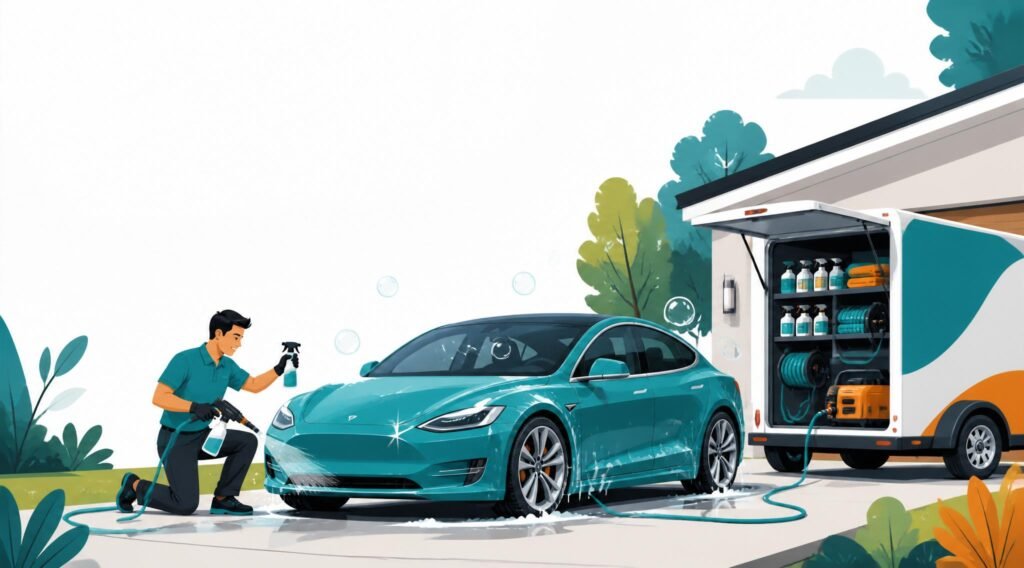
Car owners are busier than ever, and fewer of them want to spend a Saturday sitting in a waiting room while their vehicle gets cleaned at a fixed location. That shift in behavior is exactly why learning how to start a mobile car detailing business has become one of the smartest low-investment paths into entrepreneurship in 2026 — you bring the service directly to the customer’s driveway, office parking lot, or apartment complex, with no storefront rent to worry about.
This complete guide covers everything: startup costs, equipment, licensing, pricing packages, marketing, and how to scale a single-operator hustle into a multi-van detailing route. If you’re comparing low-overhead service businesses, this pairs naturally with other exterior-cleaning ventures covered in our guide to a pressure washing business startup kit, since many of the same principles around equipment, mobility, and client scheduling apply.
Table of Contents
- Why Mobile Car Detailing Is a Strong Business in 2026
- How Much Does It Cost to Start a Mobile Car Detailing Business?
- Choosing Your Service Menu and Niche
- Step-by-Step: How to Start a Mobile Car Detailing Business
- Equipment You’ll Actually Need
- Licensing, Permits, and Legal Requirements
- Pricing Your Detailing Packages
- Finding Your First Clients
- Marketing and Building a Recurring Client Base
- Insurance and Risk Protection
- Common Mistakes New Detailers Make
- Water, Waste, and Environmental Considerations
- Scaling Into a Multi-Van Detailing Business
- Frequently Asked Questions
1. Why Mobile Car Detailing Is a Strong Business in 2026
Mobile detailing sits in a sweet spot among small business models: low startup costs, strong repeat-customer potential, and a service that genuinely can’t be automated away. A few trends are fueling steady demand:
- Convenience-driven consumers increasingly prefer services that come to them rather than requiring a drop-off and pickup trip.
- Ride-share and delivery drivers need frequent interior cleaning to maintain their vehicle ratings, creating a built-in recurring customer segment.
- Corporate and fleet contracts are growing, with companies hiring mobile detailers to service entire fleets of delivery vans or company cars on-site.
- Eco-conscious waterless detailing products have opened up new service options in areas with water restrictions or HOA rules against driveway washing.
- Subscription-based detailing memberships are becoming standard, giving customers a predictable monthly cost and detailers predictable recurring revenue.
Like other accessible service businesses featured on Ideas Junction — such as the equipment-focused approach behind a pressure washing startup kit — mobile detailing rewards operators who invest early in quality tools and build a reputation for consistent, careful work.
2. How Much Does It Cost to Start a Mobile Car Detailing Business?
One of the biggest draws of mobile detailing is how little capital is required to get your first paying customer.
| Expense | Estimated Cost |
|---|---|
| Pressure washer / water tank system | $300 – $1,200 |
| Vacuum (wet/dry shop vac or dedicated auto vacuum) | $100 – $400 |
| Detailing chemicals and supplies (initial stock) | $200 – $500 |
| Buffer/polisher and pads | $150 – $400 |
| Generator (if not using a mobile power station) | $400 – $900 |
| Business registration & licensing | $50 – $500 |
| Liability insurance (annual) | $400 – $1,200 |
| Vehicle wrap/branding for your van or truck | $300 – $1,500 |
Total starting investment typically ranges from $1,500 to $5,000, making mobile detailing one of the more accessible service businesses to launch — comparable in accessibility to other low-investment startups like a stationery business, where most of the upfront cost goes into inventory and tools rather than a physical retail location.
3. Choosing Your Service Menu and Niche
Deciding what you’ll offer — and to whom — shapes your equipment needs, pricing, and marketing from day one.
Basic Wash and Interior Cleaning
The entry-level offering most detailers start with: exterior wash, tire shine, vacuuming, and interior wipe-down. Fast to perform and easy to price competitively.
Full Detail Packages
Includes deep interior shampooing, leather conditioning, engine bay cleaning, clay bar treatment, and paint decontamination — commanding significantly higher prices than a basic wash.
Ceramic Coating and Paint Correction
A premium, higher-skill niche requiring additional training but commanding some of the highest per-job prices in the industry, often $500–$1,500 per vehicle.
Fleet and Commercial Contracts
Servicing delivery vans, rideshare fleets, or company vehicles on a recurring schedule — this niche offers the most predictable, recurring revenue of any detailing segment.
Waterless and Eco-Friendly Detailing
Using specialized waterless wash products, this niche serves HOA-restricted neighborhoods, apartment complexes, and environmentally conscious customers.
Boat, RV, and Motorcycle Detailing
An underserved niche in many markets, often commanding premium prices due to limited local competition and specialized surface care needs.
4. Step-by-Step: How to Start a Mobile Car Detailing Business
Step 1: Learn the Craft
Before charging clients, practice on your own vehicle and those of friends or family to build genuine skill and confidence with your equipment and chemicals.
Step 2: Choose Your Business Structure
Most mobile detailers start as a sole proprietorship or LLC, with an LLC offering better liability protection as you take on more clients and equipment.
Step 3: Register Your Business
Register your business name, obtain an EIN, and open a dedicated business bank account to keep finances organized from day one.
Step 4: Purchase Core Equipment
Start with reliable, mid-tier equipment rather than the cheapest or most expensive options — durability matters since your tools will be used daily.
Step 5: Set Up Your Mobile Water and Power Systems
Invest in a water tank system or portable water tank plus a generator or battery power station so you can operate at any location without relying on the client’s utilities.
Step 6: Build Your Pricing Menu
Create 3–4 clearly defined packages (basic wash, full interior/exterior detail, premium ceramic add-on, fleet contract rate) to simplify client decision-making.
Step 7: Brand Your Vehicle
A wrapped van or truck with your business name and contact information turns every job into a piece of mobile advertising.
Step 8: Launch Your Online Booking Presence
Set up a simple website or booking page, along with active Google Business and social media profiles showcasing before-and-after photos.
Step 9: Start Local Outreach
Offer introductory pricing to your first 10–15 customers in exchange for reviews and referrals.
Step 10: Track Jobs and Reinvest
Use scheduling and invoicing software to track recurring clients, then reinvest early profits into better equipment and additional marketing.
5. Equipment You’ll Actually Need
New detailers often overspend on equipment before landing consistent bookings. Here’s what genuinely matters at the start:
- A reliable water tank and pump system so you’re never dependent on a client having an outdoor spigot
- A quality wet/dry vacuum for thorough interior cleaning — this single tool has an outsized impact on client satisfaction
- A dual-action polisher for basic paint correction and wax application
- Microfiber towels in bulk — cheap towels that scratch paint will cost you far more in reputation than they save in price
- A generator or portable power station to run vacuums and polishers at locations without accessible power outlets
- A stocked chemical kit: pH-neutral soap, all-purpose cleaner, tire shine, glass cleaner, leather conditioner, and a spray wax or sealant
Resist the urge to buy premium ceramic coating equipment or ozone generators until you’ve built a client base specifically requesting those services.
6. Licensing, Permits, and Legal Requirements
Requirements vary by city and state, but generally include:
- General business license from your city or county
- Sales tax permit, since detailing services are taxable in most states
- Vehicle/commercial use registration if operating a branded van or trailer
- Wastewater discharge compliance, since some municipalities restrict where soapy runoff can enter storm drains — this is one of the most commonly overlooked legal details in mobile detailing
- HOA and property compliance, since some residential communities have specific rules about mobile service vehicles operating on-site
Always confirm current requirements with your city’s business licensing office and the U.S. Small Business Administration for guidance on registering a service-based small business correctly.
7. Pricing Your Detailing Packages
Pricing depends on vehicle size, service depth, and local market rates, but here are realistic starting benchmarks:
| Service | Typical Price Range |
|---|---|
| Basic exterior wash + vacuum | $40 – $80 |
| Full interior/exterior detail | $120 – $250 |
| Premium detail with clay bar and wax | $200 – $400 |
| Ceramic coating application | $500 – $1,500 |
| Fleet contract (per vehicle, monthly) | $60 – $150 |
| Engine bay detailing add-on | $30 – $75 |
As your reputation grows, consider offering monthly or quarterly membership plans — a predictable recurring detail schedule benefits both your cash flow and your customer’s vehicle maintenance, similar to subscription models used successfully across other consumer service businesses.
8. Finding Your First Clients
Before investing heavily in marketing, focus on these fast, low-cost ways to land your first paying jobs:
- Offer a discounted “founding customer” rate to friends, family, and neighbors in exchange for honest reviews.
- Partner with a local car dealership to detail vehicles before delivery to new owners.
- Reach out to rideshare and delivery driver Facebook groups in your area, since these drivers need frequent, affordable detailing.
- Leave flyers or business cards at apartment complexes and gyms with parking lots.
- Approach small local businesses with company vehicles about a recurring fleet cleaning arrangement.
9. Marketing and Building a Recurring Client Base
Detailing is a visually driven business, so certain marketing channels consistently outperform others:
- Before-and-after photos and short video clips on Instagram and TikTok tend to generate strong local engagement.
- Google Business Profile optimization helps you rank for searches like “mobile detailing near me.”
- Referral discounts — offering existing clients a discount for referring friends — work particularly well since car care is a naturally social topic among car owners.
- Recurring booking reminders via text or email keep past clients coming back on a predictable schedule rather than as one-time customers.
- Local partnerships with car dealerships, auto body shops, and property managers can create a steady stream of referral business.
10. Insurance and Risk Protection
Just as other exterior-service businesses require proper coverage — as outlined in best insurance for pressure washing business — mobile detailers should carry:
- General liability insurance to cover accidental damage to a customer’s vehicle or property
- Garage keepers insurance, which specifically covers damage to vehicles in your care, custody, or control
- Commercial auto insurance if using a dedicated work vehicle to transport equipment
- Equipment insurance to protect against theft or damage to your pressure washer, vacuum, and polishers
Many commercial and fleet clients will request proof of insurance before signing a contract, so securing coverage early can directly help you close larger, more lucrative accounts.
11. Common Mistakes New Detailers Make
- Underpricing services to win early customers, making it difficult to raise rates later without pushback.
- Using cheap microfiber towels and pads that introduce paint swirls and damage your reputation.
- Skipping insurance — a single vehicle damage claim without coverage can end a new business immediately.
- Overbooking without buffer time, leading to rushed jobs and inconsistent quality.
- Ignoring water and waste regulations, which can result in fines in some municipalities.
- Not tracking recurring clients systematically, leaving predictable revenue on the table.
12. Water, Waste, and Environmental Considerations
Because mobile detailing involves runoff water containing soap, wax, and vehicle contaminants, many cities regulate where that wastewater can go. Best practices include:
- Using biodegradable, phosphate-free soaps whenever possible
- Avoiding direct runoff into storm drains, which often connect directly to local waterways untreated
- Considering waterless or low-water detailing products for HOA-restricted or drought-prone areas
- Using a wastewater reclamation system for high-volume fleet or ceramic coating work, which is increasingly required by some municipalities
Building these practices into your standard operating procedure early not only keeps you compliant but also becomes a genuine marketing advantage with environmentally conscious customers.
13. Scaling Into a Multi-Van Detailing Business
Once your schedule is consistently full, there are several natural paths to grow:
- Hire and train a second detailer to run a second van, doubling your daily job capacity without doubling your personal workload.
- Add a ceramic coating specialist to your team to capture higher-margin premium jobs you may currently be turning away.
- Pursue fleet and commercial contracts for predictable, recurring monthly revenue rather than relying solely on one-off residential jobs.
- Invest in a dedicated mobile detailing trailer with built-in water tanks and power systems, improving efficiency across multiple daily jobs.
- Expand into adjacent services like headlight restoration, odor removal, or minor paint touch-up to increase your average ticket size per visit.
This same reinvest-and-expand approach — prove the model with one operator, then scale into a team — mirrors the growth path recommended across many of the service-based business guides on Ideas Junction.
13.5 Seasonal Planning for Mobile Detailers
Weather and seasonality affect mobile detailing far more than most new operators expect, and planning around it protects both your schedule and your equipment.
- Cold-weather challenges: Freezing temperatures can damage water tank systems and pumps if not properly winterized, and exterior washing becomes impractical below certain temperatures in many regions.
- Spring demand surge: Pollen season and post-winter road salt removal typically drive a significant seasonal spike in bookings, making early spring one of the best times to ramp up marketing.
- Summer heat management: High temperatures can cause soap and wax products to dry too quickly on painted surfaces, requiring adjusted techniques and often working in shaded areas or early morning hours.
- Fall preparation services: Many customers request a full detail before winter storage or before holiday travel, creating another predictable seasonal demand window.
Building a simple seasonal marketing calendar around these patterns — rather than marketing generically year-round — helps you time promotions when demand is naturally highest.
13.6 Technology and Software That Streamline a Detailing Business
As your client base grows, manual scheduling and paper invoices become a genuine bottleneck. Consider adopting:
- Online booking software that lets clients schedule and pay without a phone call, reducing missed appointments and back-and-forth messaging.
- Route optimization apps to minimize drive time between jobs once you’re servicing multiple locations in a single day.
- Automated review request tools that text or email clients shortly after a job, significantly increasing the volume of Google and social media reviews you collect.
- Simple inventory tracking for chemicals and supplies, preventing the common problem of running out of a key product mid-route.
- Digital before-and-after photo tools that automatically build a shareable portfolio from each job, feeding directly into your marketing content.
Adopting even one or two of these tools early can save hours per week once your business grows beyond a handful of weekly clients.
14. Frequently Asked Questions
How much does it cost to start a mobile car detailing business? Most operators start with $1,500–$5,000, covering core equipment, initial supplies, licensing, and basic vehicle branding.
Do I need a license to start a mobile detailing business? Yes, requirements typically include a general business license and sales tax permit, with some municipalities also requiring wastewater discharge compliance.
Is mobile car detailing profitable in 2026? Yes — with a full daily schedule, detailers commonly earn $100–$300 in profit per standard job, and premium services like ceramic coating can generate $500 or more per vehicle.
What’s the biggest expense when starting a mobile detailing business? Core equipment — a water tank system, vacuum, and polisher — typically represents the largest single upfront cost, though it’s still modest compared to most storefront-based businesses.
Can I run a mobile detailing business part-time? Yes, many detailers start on evenings and weekends around a full-time job before transitioning to full-time work once bookings become consistent.
Do I need insurance to operate a mobile detailing business? While not always legally required, garage keepers and general liability insurance are strongly recommended, and many commercial or fleet clients will require proof of coverage before hiring you.
How do I handle bad weather cancellations? Most established mobile detailers build a simple weather policy into their booking confirmation — offering free rescheduling for rain or extreme temperatures rather than an outright cancellation fee, which keeps client relationships positive while protecting your own schedule and equipment.
What’s the fastest way to build a base of recurring clients? Offering a modest discount for scheduling a recurring monthly or quarterly detail — rather than a single one-time job — tends to convert a meaningful share of first-time customers into predictable repeat revenue within the first few months.
Final Thoughts
Learning how to start a mobile car detailing business comes down to investing in reliable core equipment, pricing your services clearly, and building the kind of reputation that turns one-time customers into recurring monthly clients. It’s a business that rewards consistency and attention to detail far more than large upfront capital, making it one of the more realistic paths into entrepreneurship for someone starting with a modest budget and a strong work ethic.
If you’re exploring more low-investment service business ideas, browse additional guides in our Business Startup category for more startup paths tailored to first-time founders. Whether you start with a single water tank and a weekend schedule or move straight into a branded van, the operators who succeed long-term are the ones who treat every job — no matter how small — as an opportunity to earn a repeat customer.
Internal links used: pressure washing startup kit (x2), best insurance for pressure washing business, stationery business, business-startup category External authority link used: U.S. Small Business Administration (SBA.gov)