
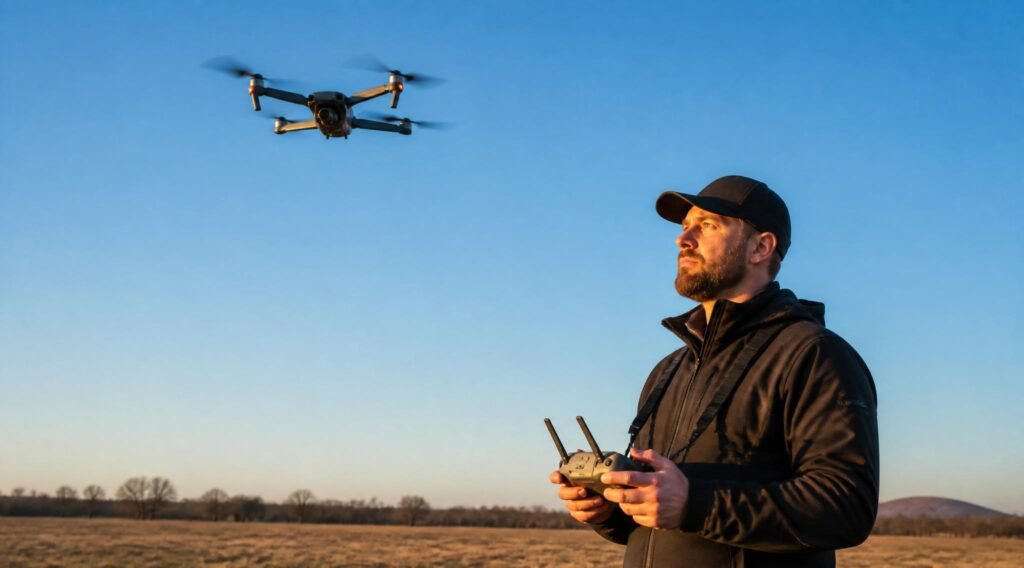
If you’re building a drone photography business, one question tends to stall people right before launch: do you actually need a license to fly for money? It’s a fair thing to get stuck on. Recreational drone rules are everywhere online, commercial rules are scattered across FAA pages, and state and local add-ons vary so much that it’s easy to assume “probably fine” and hope for the best.
The most common mistake new operators make is treating a drone like a camera with wheels — legal to use however they like as long as they own it. The FAA doesn’t see it that way. The moment a flight touches your business — even a single paid shoot, or free footage for a client’s website — it stops being recreational flying and becomes a regulated commercial operation.
The good news: the licensing path itself is well-defined, affordable, and doesn’t take long to complete. This guide walks through exactly when you need a license, what the FAA’s Part 107 certificate actually involves, what it costs, and where state, insurance, and local rules still apply on top of it — so you can launch compliant instead of guessing.
Quick Answer
Yes — if you fly a drone for any business purpose in the United States, you need an FAA Remote Pilot Certificate under Part 107, not just a hobbyist registration. A single paid client shoot needs it. So does free footage used to promote a business, including your own. Purely recreational flying only requires the free TRUST certificate, which does not authorize commercial work. Beyond the federal certificate, most drone photographers also need a standard local business license (the same one any service business would register for), and many carry liability insurance even though the FAA doesn’t require it. In short: the drone itself needs FAA registration, the pilot needs a Part 107 certificate, and the business needs the ordinary local paperwork any small business needs.
Table of Contents
- What Is a Drone Photography Business License?
- How to Choose the Right Licensing Path
- Your Licensing & Compliance Options
- Licensing Comparison Table
- Requirements for Different Drone Photography Use Cases
- How to Get Your Part 107 Certificate: Step by Step
- Common Licensing Mistakes
- Expert Tips
- Final Thoughts
- Frequently Asked Questions
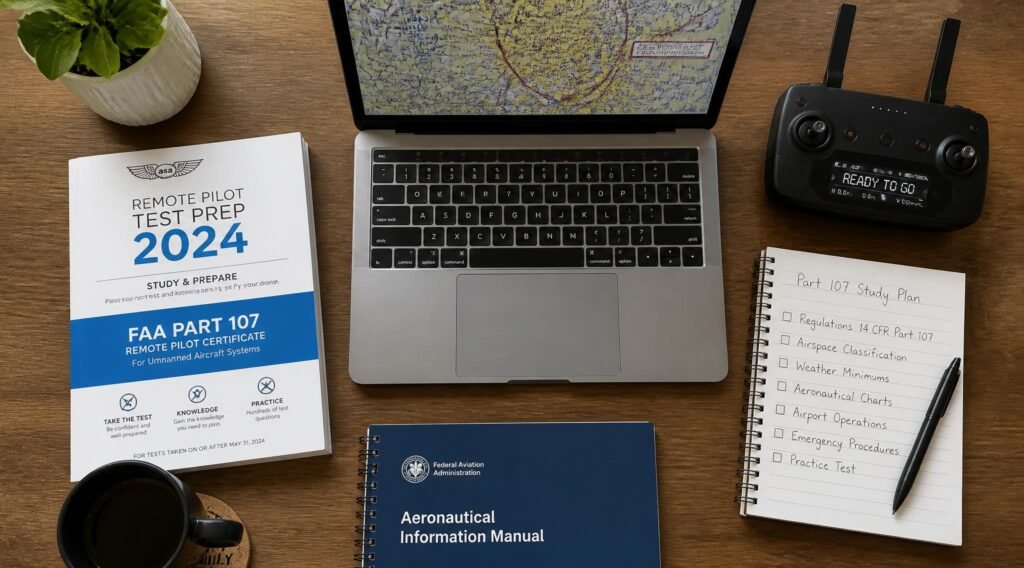
What Is a Drone Photography Business License? {#what-is-it}
There’s no single document called a “drone photography business license.” Instead, operating legally requires stacking three separate approvals, each governed by a different authority:
Federal — FAA Remote Pilot Certificate (Part 107): This is the actual “drone license” people mean when they ask the question. It’s issued by the FAA under 14 CFR Part 107, the rule covering all commercial small-drone operations. It certifies that you understand airspace rules, weather effects on flight, and safe operating procedures — not that you’re a skilled photographer.
State/Local — General Business License: Same registration any freelance photographer or service business needs: a business license or DBA filing with your city or county, plus sales tax registration if you sell physical products like prints.
Aircraft — FAA Drone Registration: Separate from the pilot certificate, your actual drone must be registered with the FAA at FAADroneZone, which costs $5 and lasts three years.
The FAA’s own guidance is direct: <cite index=”7-1″>to operate the controls of a drone under Part 107, you need a remote pilot certificate with a small UAS rating, or you must be under the direct supervision of a person who holds one</cite>. Understanding this distinction early keeps you from confusing “I registered my drone” with “I’m licensed to fly it for business” — they’re two different steps.
If you haven’t finalized your business structure yet, it’s worth reviewing general small business startup requirements and compliance basics alongside the drone-specific rules below, since the two overlap more than most new operators expect.
How to Choose the Right Licensing Path {#how-to-choose}
Before diving into paperwork, ask yourself three questions:
Is any part of the flight tied to a business purpose? The FAA defines commercial use broadly — it means “in furtherance of a business,” not just “getting paid directly.” <cite index=”10-2″>Even unpaid volunteer footage for a nonprofit or church website still counts as commercial use requiring Part 107, because it helps that organization’s operations</cite>.
Are you 16 or older? <cite index=”7-1″>You must be at least 16 years old to qualify for a remote pilot certificate</cite> — this is a hard federal floor, not a suggestion.
Does your state or city require anything beyond the federal certificate? Some municipalities restrict drone launch/landing locations in public parks, and some states require additional privacy disclosures for aerial photography of private property. A quick call to your local city clerk’s office before your first paid shoot saves headaches later — a step the FAA itself recommends checking through official channels like faa.gov/uas.
Your Licensing & Compliance Options {#your-options}
FAA Part 107 Remote Pilot Certificate
Overview: This is the core requirement and the one that actually authorizes commercial flight. It’s earned by passing a knowledge test, not a flight test — there’s no in-air exam involved.
Key Features:
- 60 multiple-choice questions covering airspace, weather, loading, and regulations
- Passing score of 70%
- Certificate has no expiration, but requires recurrent training every 24 months
- Application processed through the FAA’s IACRA system
Best For: Anyone earning any income, sponsorship, or business benefit from drone footage.
Pros: ✅ Legally required — no workaround ✅ One-time knowledge test, no ongoing flight exams ✅ Opens the door to waivers for night flights, flights over people, and more
Cons: ❌ Requires in-person testing at an approved center ❌ TSA vetting can add several days to processing
Our Verdict: Non-negotiable if you’re taking client work. Pair this with your drone photography business plan early, since insurance carriers and most commercial clients will ask to see it before booking you.
TRUST Certificate (Recreational Only)
Overview: A free, short online test for hobbyist flyers. It does not authorize any commercial or business-adjacent flying.
Key Features:
- Free and entirely online
- No fail state — incorrect answers just prompt a re-read and retry
- Required even for pure hobby flying
Best For: Someone flying purely for personal enjoyment, with zero business tie-in.
Pros: ✅ Free ✅ Takes under 30 minutes
Cons: ❌ Cannot be used for any paid or business-related flight ❌ Easy to mistakenly assume it “counts” — it doesn’t
Our Verdict: Skip straight to Part 107 if there’s any chance you’ll monetize your flying later. Switching from TRUST to Part 107 mid-business means re-registering your intent anyway.
General Business License / Local Registration
Overview: The standard registration any local service business needs — separate from anything FAA-related.
Key Features:
- Filed with your city, county, or state
- May include a DBA (doing business as) filing if you’re not operating under your own legal name
- Often bundled with sales tax permits if you sell prints or physical media
Best For: Formalizing the business side once you know you’re moving past hobby status.
Pros: ✅ Usually inexpensive ($50–$400 depending on location) ✅ Establishes legal legitimacy for contracts and invoicing
Cons: ❌ Requirements vary significantly by city/county — no single national standard
Our Verdict: Handle this alongside forming your business entity. If you’re still deciding between a sole proprietorship and an LLC, review the liability tradeoffs before you start invoicing clients.
Liability Insurance
Overview: Not legally mandated by the FAA, but functionally required by most real clients and venues.
Key Features:
- Typically sold as hourly, monthly, or annual drone liability policies
- Some clients (real estate firms, event venues) won’t book you without proof of coverage
- Rates vary by coverage limits and drone value
Best For: Any operator taking paid client work, especially real estate or event shoots near people and property.
Pros: ✅ Protects personal assets if a flight causes damage ✅ Often a prerequisite for landing higher-paying commercial contracts
Cons: ❌ Ongoing cost even in slow months ❌ Coverage details vary widely between providers
Our Verdict: Treat this as part of your startup budget, not an optional add-on — most serious drone photography businesses carry it from day one.
Licensing Comparison Table {#comparison-table}
| Requirement | Issued By | Cost | Who Needs It | Renewal |
|---|---|---|---|---|
| Part 107 Remote Pilot Certificate | FAA | $175 test fee | Anyone flying for business purposes | Recurrent training every 24 months |
| TRUST Certificate | FAA | Free | Recreational-only flyers | None (one-time) |
| Drone (Aircraft) Registration | FAA | $5 | Anyone flying a registered-weight drone | Every 3 years |
| General Business License | City/County | $50–$400 | Anyone formally operating as a business | Varies, often annual |
| Liability Insurance | Private insurer | Varies | Recommended for all paid work | Ongoing/annual |
Requirements for Different Drone Photography Use Cases {#use-cases}
Real Estate & Property Photography
This is the most common entry point into drone photography, and it’s unambiguously commercial — you’re being paid to market someone else’s property. Part 107 is required, and many brokerages now ask photographers to show proof of certificate and insurance before booking. If you’re building your service list, pairing this with other small business ideas for a diversified income stream is common among new operators.
Weddings & Events
Event footage is commercial even when the couple is a friend or family member being charged a “discounted” rate — payment of any kind triggers the requirement. Flights over guests also fall under the FAA’s operations-over-people rules, which have specific weight and shielding requirements beyond the base certificate.
Content Creation & Monetized Social Media
This is the case new operators most often miss. If your drone footage runs on a monetized YouTube channel or sponsored social post, that’s business use in the FAA’s eyes, even without a traditional client. The same logic that governs a photography side hustle, food truck business, or mobile car detailing operation applies here — if a flight supports revenue in any form, it needs the commercial certificate.
[IMAGE 4 — Step-by-Step Process | Alt text: “steps to get FAA Part 107 remote pilot certificate for drone photography”]
How to Get Your Part 107 Certificate: Step by Step {#how-to}
Full details and official forms are available directly from the FAA’s Become a Drone Pilot page.
Step 1: Confirm Eligibility
Make sure you meet the baseline requirements: at least 16 years old, able to read/speak/write/understand English, and in a physical and mental condition that allows safe operation. No medical exam is required — this is a self-assessment.
Step 2: Create an FAA Tracking Number (FTN)
Register in the FAA’s IACRA system to receive your FTN before scheduling the knowledge test.
Step 3: Study and Schedule the Knowledge Test
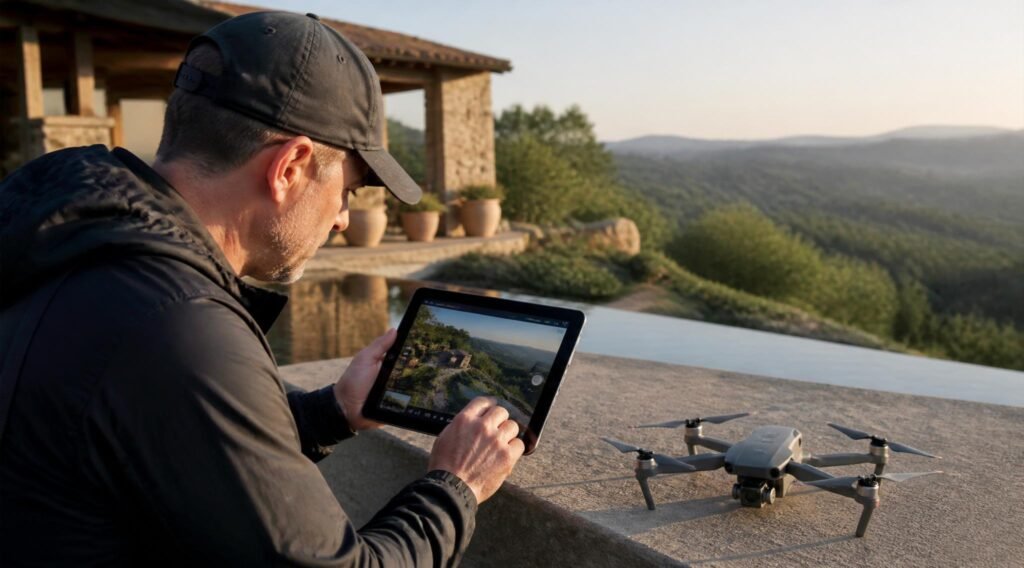
The exam covers regulations, airspace classification, weather, loading, and emergency procedures. <cite index=”13-1″>The test consists of 60 multiple-choice questions, and a score of 70% or higher is required to pass</cite>. Testing happens in person at an FAA-approved knowledge testing center, with the fee currently running $175.
Step 4: Complete the Application in IACRA
After passing, log back into IACRA to complete FAA Form 8710-13, the official application for your remote pilot certificate.
Step 5: Clear TSA Vetting and Receive Your Certificate
Your application goes through routine TSA security vetting before your permanent certificate is issued — <cite index=”7-1″>the FAA anticipates issuing temporary certificates within about 10 business days of a completed application</cite>, after which you’re cleared to fly commercially.
Common Mistakes {#mistakes}
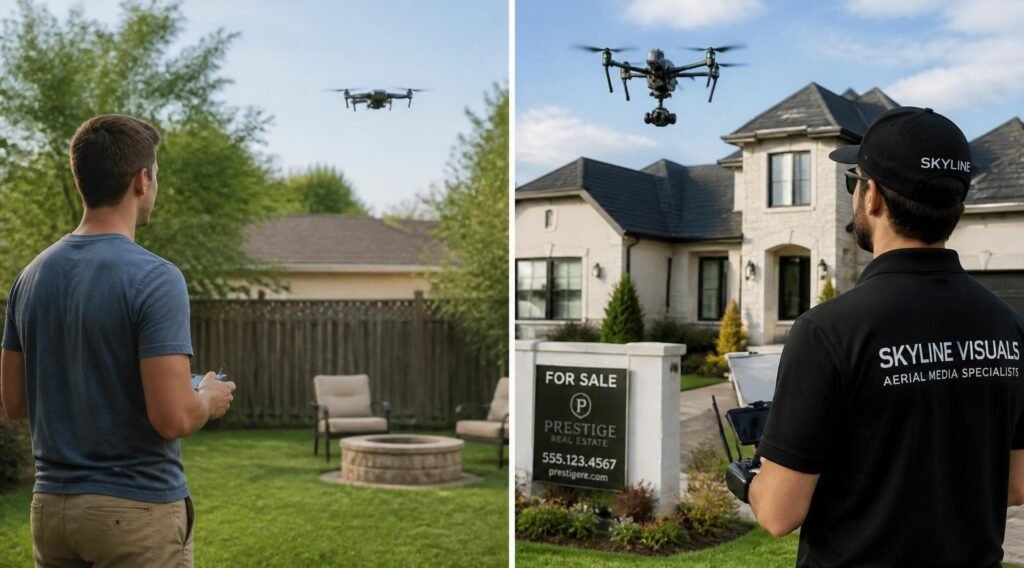
Assuming “unpaid” means “recreational.” Free footage that promotes any business — including your own — still counts as commercial use requiring Part 107. This trips up more new operators than any other rule on this list.
Skipping drone registration because “I already have my pilot certificate.” The pilot certificate and the aircraft registration are separate FAA requirements. Both are needed, similar to how a vending machine operator needs both a business license and separate machine placement permits.
Ignoring local and state add-ons. Federal certification doesn’t override city park drone bans or state privacy statutes around filming private property. Treat Part 107 as the floor, not the ceiling, the same way you would with any general business license requirement for a service-based business.
Expert Tips {#tips}
Get certified before you buy your “real” gear. Many new operators buy an expensive drone first, then discover the licensing timeline. Studying and testing typically take 2–4 weeks part-time, so start the certification process in parallel with your equipment research, not after.
Keep your recurrent training date on a calendar reminder. The 24-month recurrent training is free and doesn’t require a re-test, but letting it lapse means your operating privileges pause until you complete it — an easy, avoidable gap in an active client business.
Bundle your legal setup in one pass. Handle your business entity formation, business license application, and insurance quote requests in the same week you’re studying for the knowledge test. Stacking your general business compliance steps with your FAA certification means you launch with everything in place on day one, rather than scrambling for a missing document when your first client asks for proof.
Final Thoughts {#final-thoughts}
Best overall approach: Get your Part 107 certificate first, register your drone second, and handle your local business license and insurance in parallel — all before you accept your first paid booking.
Best for budget-conscious beginners: Study using the FAA’s free materials and take the $175 knowledge test once, rather than paying for a bundled prep course you may not need.
Best for those already flying recreationally: Don’t rely on your TRUST certificate once you take on any paid or promotional work — the switch to Part 107 needs to happen before that first flight, not after.
Getting licensed isn’t the exciting part of building a drone photography business, but it’s the part that lets you actually invoice clients, get insured, and avoid a grounded business before it starts. Once the paperwork is behind you, the creative and business-growth side — covered in our broader guides on starting a small business and life-stage business ideas — is where the real momentum builds.
Frequently Asked Questions {#faq}
Do I need a license to fly a drone for personal, non-business photos? No. Purely recreational flying only requires the free TRUST certificate, not the Part 107 Remote Pilot Certificate. The moment any flight supports a business purpose, though, Part 107 becomes mandatory.
How much does a drone photography business license cost in total? Budget roughly $175 for the Part 107 knowledge test, $5 for drone registration, and $50–$400 for a local business license depending on your city or county. Insurance costs vary but are typically billed hourly, monthly, or annually.
How long does it take to get FAA Part 107 certified? Most people complete the process in four to six weeks, including 2–4 weeks of part-time studying, scheduling the in-person test, and waiting for TSA vetting to clear. <cite index=”10-1″>The temporary certificate typically becomes available a few days after your knowledge test score is linked in IACRA and TSA vetting clears</cite>.
Do I need Part 107 if I only fly for one friend’s small event, and they’re paying me a little? Yes. Any compensation, even a small or informal payment, makes the flight commercial in the FAA’s eyes.
What’s the difference between a drone pilot “license” and a “certificate”? Technically, the FAA calls it a certificate, not a license — but the two terms are used interchangeably in everyday conversation. Functionally, they mean the same thing: legal authorization to fly commercially.
Do I need a separate business license if I already have my Part 107 certificate? Yes. Part 107 only covers your authorization to fly commercially under FAA rules. It doesn’t replace the standard local business license or DBA registration your city or county requires of any small business.
Can I fly commercially under someone else’s Part 107 certificate? Only if you are directly supervised by the certificate holder during the flight, per FAA rules. You cannot simply operate under another pilot’s certificate remotely or independently.
Do I need insurance to fly commercially? The FAA doesn’t require it, but most clients, venues, and brokerages do in practice. It’s considered a standard cost of doing business rather than a legal mandate.
What happens if I fly for business without a Part 107 certificate? You risk FAA enforcement action, including civil penalties, in addition to any liability exposure if something goes wrong during the flight. Clients may also refuse to work with uncertified operators once they ask for documentation.
Do I need to renew my Part 107 certificate? The certificate itself doesn’t expire, but you must complete free recurrent online training every 24 calendar months to keep your operating privileges active.
Can I take the Part 107 knowledge test before I turn 16? You can study and even sit for the test earlier in some cases, but you cannot be issued the actual Remote Pilot Certificate until you meet the minimum age requirement of 16.
Do local or state rules ever override Part 107? Part 107 governs federal airspace and pilot certification, but states and cities can still add restrictions on launch/landing locations, privacy protections, and specific commercial-use permits. Always check local rules in addition to your federal certification.
Author: Morne Winston Last Updated: July 2026