

Starting a service-based business online almost always begins the same way — you’re good at something, you want clients, and the fastest path to your first paying customer is a marketplace that already has buyers looking. The catch is that not every platform is built the same way underneath. Some take a fee that shrinks with your earnings; others take a flat cut no matter how much you grow. Some are flooded with race-to-the-bottom pricing; others are curated enough that clients arrive already expecting to pay a fair rate.
Which platform you build your early reputation on matters more than most new freelancers realize, because reviews, ranking history, and repeat clients don’t transfer if you switch later. If you’re weighing freelancing against other online business models, our guide on best digital products to sell online covers a different path worth comparing — this one is specifically about where to find and sell ongoing service work. Here are the five best freelance marketplaces for service providers who want real clients, fair fees, and room to grow a genuine business rather than just picking up occasional gigs.

Table of Contents
- What to Look for in a Freelance Marketplace
- Upwork — Best Overall for Volume & Variety
- Fiverr — Best for Productized, Fixed-Price Services
- Toptal — Best for High-End, Vetted Clients
- Contra — Best for Commission-Free Freelancing
- PeoplePerHour — Best for UK & European Clients
- Comparison Table
- How to Choose Based on Your Service Type
- FAQs
- Final Verdict

What to Look for in a Freelance Marketplace
Before comparing specific platforms, it’s worth understanding which factors actually determine long-term earning potential — not just how easy a platform is to sign up for.
Fee structure. Platforms charge freelancers in very different ways — a flat percentage of every payment, a sliding scale that decreases as you earn more from a single client, or in some cases, no commission at all with a different revenue model. Over a year of steady work, this difference can add up to thousands of dollars, so it’s worth calculating against your expected earnings rather than judging by the headline number alone.
Client quality and budget level. Some marketplaces attract clients specifically looking for the lowest possible price; others are curated or positioned toward businesses with real budgets for quality work. This single factor often matters more than the platform’s fee structure, since a 20% fee on a well-paying project beats a 0% fee on a severely underpriced one.
Vetting and application process. Platforms with a genuine vetting process (skills tests, application review, portfolio screening) tend to have less competition from underqualified freelancers racing to the bottom on price, which generally means better rates for the freelancers who do get accepted.
Payment protection. Escrow systems, milestone payments, and dispute resolution processes protect freelancers from clients who disappear after work is delivered. This matters enormously once you’re taking on larger projects with more at financial stake.
Long-term relationship potential. Some platforms are built around one-off gig purchases; others actively support ongoing, ongoing client relationships and direct communication. If your goal is building repeat clients into a stable business rather than constantly finding new one-off work, this distinction matters significantly.
Reputation portability. Reviews and ratings built on one platform generally don’t transfer if you switch elsewhere, which is worth factoring in before investing years of work building a profile on a single marketplace.
With those criteria in mind, here are the five marketplaces that consistently deliver for service-based freelancers building a real business.
1. Upwork — Best Overall for Volume & Variety
Best for: Freelancers across nearly any service category who want the largest pool of available client work and the flexibility to bid on custom projects.
Upwork remains the largest general freelance marketplace, covering everything from writing and design to software development and consulting. Its scale is both the biggest advantage and the biggest challenge — an enormous volume of available projects, but also significant competition on lower-budget listings. Freelancers who build a strong profile, collect reviews, and target better-budgeted clients tend to do well long-term, while those competing purely on low price often struggle to earn sustainably.
Pros:
- Massive volume and variety of available projects across nearly every service category
- Strong payment protection through escrow and milestone systems
- Long-term contract options for building recurring client relationships
- Detailed profile and portfolio tools to differentiate from competitors
Cons:
- Sliding-scale fees still take a meaningful cut, especially early with new clients (20% on the first $500 with a given client)
- High competition on lower-budget listings can create race-to-the-bottom pricing pressure
- Takes real time and strategy to build enough reviews to stand out
Ideal for: Freelancers across most service categories who want the widest possible pool of client opportunities and are willing to invest time building a strong profile.
2. Fiverr — Best for Productized, Fixed-Price Services
Best for: Freelancers who want to package their service into clear, fixed-price offerings (called “Gigs”) rather than bidding on custom project listings.
Fiverr flips the traditional freelance model — instead of applying to client-posted jobs, freelancers create listed service packages at set prices, and clients browse and buy directly, similar to shopping on an e-commerce site. This structure works especially well for freelancers offering clearly definable, repeatable services (logo design, voiceover work, video editing, copywriting) where the scope doesn’t vary dramatically project to project.
Pros:
- Productized “Gig” model removes the need for constant proposal writing
- Strong built-in discovery — clients search and find you rather than the reverse
- Tiered pricing packages (Basic/Standard/Premium) encourage upselling
- Large, consistent volume of buyer traffic across most service categories
Cons:
- Flat 20% commission on every transaction, regardless of project size
- Race-to-the-bottom pricing is common in saturated categories
- Less suited to complex, highly custom projects that don’t fit a fixed-scope package
Ideal for: Freelancers offering clearly packageable, repeatable services who want to be found by clients rather than constantly applying to job listings.
3. Toptal — Best for High-End, Vetted Clients
Best for: Highly experienced freelancers in software development, design, or finance who want access to well-funded clients and are willing to go through a rigorous screening process.
Toptal positions itself explicitly as an exclusive network, accepting a small percentage of applicants through a multi-stage vetting process that includes skills tests, live interviews, and test projects. The tradeoff for that difficulty is access to clients — often well-funded startups and enterprises — who are specifically seeking top-tier talent and are prepared to pay accordingly, without the race-to-the-bottom pricing common on open marketplaces.
Pros:
- Access to well-funded clients specifically seeking top-tier talent
- Rates are significantly higher on average than open marketplaces
- Rigorous vetting means less competition from underqualified freelancers
- Dedicated support for matching freelancers with suitable projects
Cons:
- Extremely competitive and time-consuming application process
- Limited to specific service categories (development, design, finance, product, project management)
- Not accessible for freelancers early in their career without a strong portfolio already
Ideal for: Experienced professionals in development, design, or finance who can pass a rigorous vetting process in exchange for access to higher-paying clients.
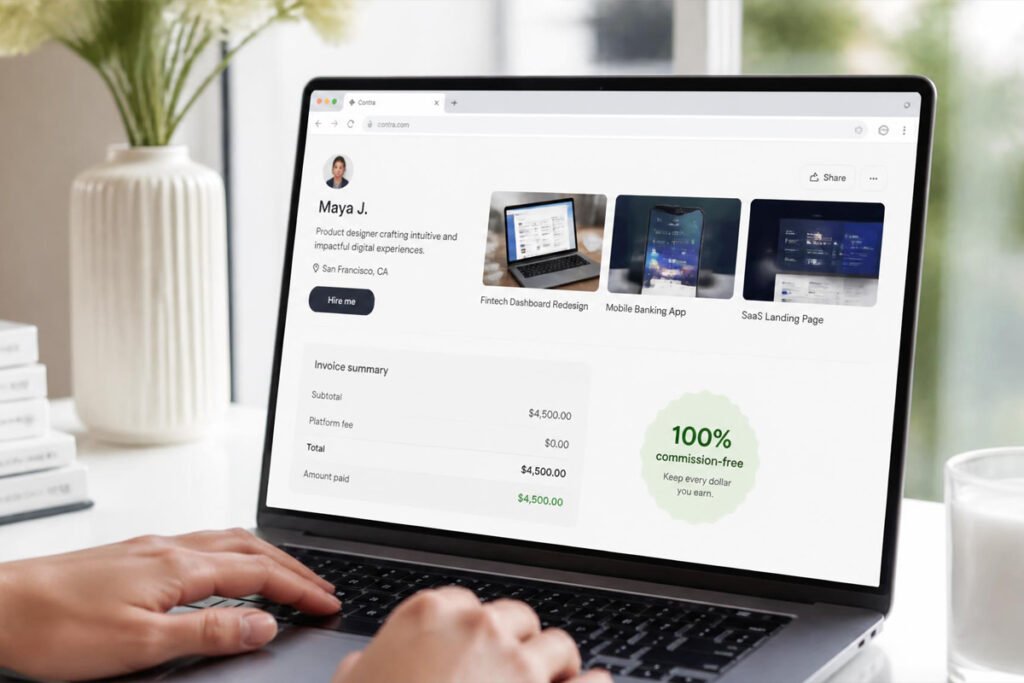
4. Contra — Best for Commission-Free Freelancing
Best for: Freelancers who want to keep 100% of what they earn and build direct, ongoing relationships with clients rather than paying a percentage on every project indefinitely.
Contra distinguishes itself with a genuinely commission-free model for freelancers — the platform earns revenue through optional premium features and a client-side subscription rather than taking a cut of freelancer earnings. This makes it particularly attractive for freelancers with existing client relationships who want a professional portfolio and payment infrastructure without losing a percentage of every invoice indefinitely.
Pros:
- Genuinely commission-free — freelancers keep 100% of project payments
- Clean, modern portfolio and profile presentation
- Built-in invoicing and contract tools for direct client relationships
- Growing client base actively seeking commission-free talent
Cons:
- Smaller client discovery volume compared to Upwork or Fiverr, given its newer market position
- Less established payment protection track record than more mature platforms
- Fewer categories of specialized client demand compared to larger marketplaces
Ideal for: Freelancers who already have some client relationships and want to move toward a commission-free model as their business matures.
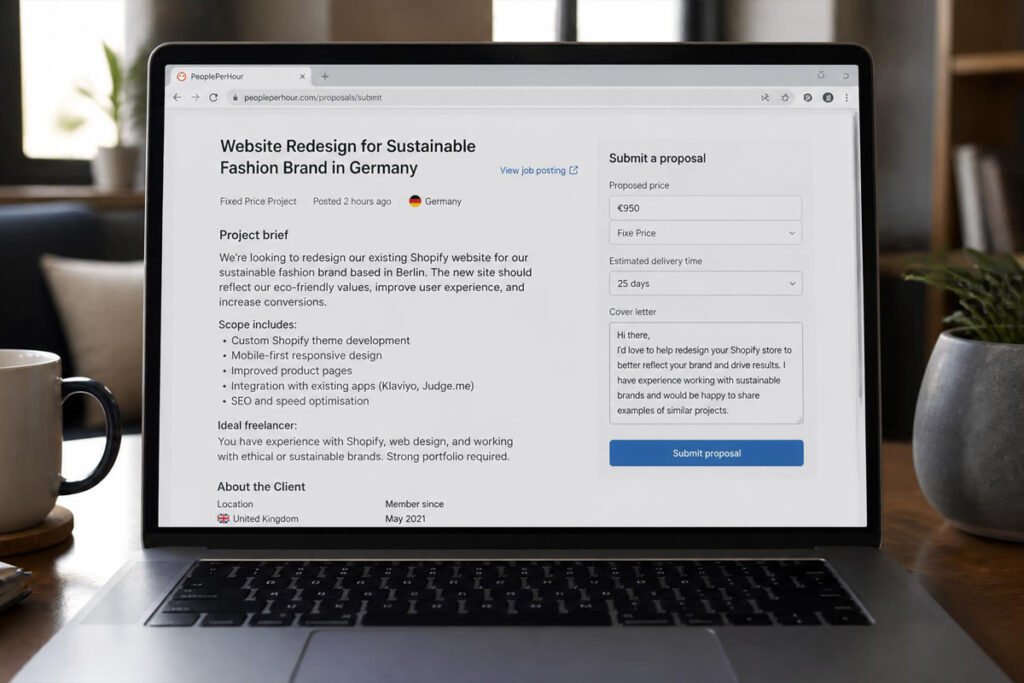
5. PeoplePerHour — Best for UK & European Clients
Best for: Freelancers targeting UK and European clients specifically, or those who want an alternative marketplace outside the dominant US-centric platforms.
While Upwork and Fiverr have a global client base skewed heavily toward US buyers, PeoplePerHour has built a particularly strong presence among UK and European small businesses. Its hybrid model supports both fixed-price “Hourlies” (similar to Fiverr’s Gigs) and traditional proposal-based projects, giving freelancers flexibility in how they present their services depending on what fits their work best.
Pros:
- Strong presence among UK and European clients, useful for geographic targeting
- Hybrid model supports both fixed-price and proposal-based work
- WorkStream feature supports ongoing client relationships beyond single projects
- Lower overall competition than the largest global platforms in certain categories
Cons:
- Smaller overall client volume compared to Upwork or Fiverr globally
- Fee structure is less favorable than commission-free alternatives like Contra
- Less brand recognition outside the UK/European market
Ideal for: Freelancers specifically targeting UK or European clients, or those looking for a less saturated alternative to the largest global marketplaces.
Comparison Table
| Marketplace | Best For | Fee Structure | Client Quality | Vetting |
|---|---|---|---|---|
| Upwork | Volume & variety | Sliding scale, up to 20% | Mixed | Open |
| Fiverr | Productized services | Flat 20% | Mixed | Open |
| Toptal | High-end vetted clients | Platform-side fee | High | Rigorous |
| Contra | Commission-free | 0% freelancer commission | Growing | Open |
| PeoplePerHour | UK/European clients | Sliding scale | Mixed | Open |
(Fee structures and terms change periodically — always confirm current rates directly on each platform before committing.)
How to Choose Based on Your Service Type
The right marketplace depends less on general reputation and more on what kind of service you actually offer and who you’re trying to reach.
- Freelancers across most service categories seeking the widest opportunity pool should start with Upwork, especially early on while building reviews.
- Freelancers with a clearly repeatable, packageable service — design, editing, writing, voiceover — will benefit most from Fiverr’s productized Gig model.
- Highly experienced developers, designers, and finance professionals willing to go through rigorous vetting should pursue Toptal for access to better-funded clients.
- Freelancers with existing client relationships who want to stop losing a percentage to commission should consider transitioning to Contra.
- Freelancers specifically targeting UK or European clients will find a stronger fit and less saturated competition on PeoplePerHour.
Common Mistakes Freelancers Make When Choosing a Marketplace
Chasing the lowest fees without considering client quality. A 0% commission platform is worthless if it can’t deliver clients willing to pay fair rates. Weigh fee structure against realistic earning potential on each platform, not fees in isolation.
Spreading effort too thin across too many platforms early on. Building a strong profile with solid reviews takes focused time on one or two platforms. New freelancers who scatter minimal effort across five platforms often end up with weak, unconvincing profiles everywhere instead of a strong one anywhere.
Underpricing to win early reviews. It’s tempting to price far below market rate to land the first few projects, but this can trap a freelancer in a low-price reputation that’s difficult to escape later. A more sustainable approach is pricing fairly from the start and being patient with the first few projects.
Ignoring the platform’s dispute resolution process before it’s needed. Understanding how a platform handles a client who refuses to pay or disputes work quality matters far more once an actual problem arises than at signup, when everything is theoretical.
Neglecting to build a portfolio outside the platform. Relying entirely on marketplace-hosted reviews and portfolio pieces leaves a freelancer with nothing if a platform changes its policies or an account issue arises. An independent website or portfolio protects against that risk.
Where to Start and How to Protect Your Business
Most freelancers benefit from starting with one primary platform that matches their service type and building a genuinely strong profile before expanding to a second. Read each platform’s fee schedule and payment protection policy carefully before committing significant time, since terms and structures do change periodically.
Once established, a few habits protect a growing freelance business: maintain records of all client communication and contracts outside the platform in case of a dispute, diversify gradually across a second platform or direct client relationships to avoid being fully dependent on one marketplace’s policies, and set aside a portion of marketplace earnings for taxes, since most platforms don’t withhold anything automatically for independent contractors.
FAQs
Which freelance marketplace has the lowest fees? Contra offers a genuinely commission-free model for freelancers, while Fiverr charges a flat 20% and Upwork uses a sliding scale that can drop below 10% for long-term clients on larger cumulative billings.
Is Toptal worth it for a freelancer just starting out? Generally not — Toptal’s rigorous vetting process is designed for highly experienced professionals with an established portfolio. Freelancers early in their career typically build experience on more accessible platforms like Upwork or Fiverr first.
What’s the difference between Upwork and Fiverr? Upwork is primarily proposal-based, where freelancers apply to client-posted job listings, while Fiverr is primarily catalog-based, where freelancers list fixed-price service packages that clients browse and purchase directly.
Can I use multiple freelance marketplaces at the same time? Yes, and many established freelancers do, though it’s generally more effective to build a strong profile on one platform first before splitting attention across several, especially early in a freelance career.
How do freelance marketplaces handle payment protection? Most major platforms use escrow or milestone-based payment systems, holding client funds until work is delivered and approved, which protects freelancers from clients who might otherwise refuse to pay after receiving completed work.
Final Verdict
If you want the widest pool of available work across nearly any service category, Upwork remains the strongest overall starting point. If your service is clearly packageable into a fixed-price offering, Fiverr‘s Gig model removes the friction of constant proposal writing. And if you’re an experienced professional ready to trade a rigorous application process for access to better-funded clients, Toptal delivers the highest earning potential on this list.
Whichever you choose, remember that the marketplace is just the starting point — the real business grows once you turn marketplace clients into direct, repeat relationships. Pair your freelance work with the right tools from our guide to best invoicing and business proposal software, and you’ve covered both sides of turning freelance work into a sustainable business.