
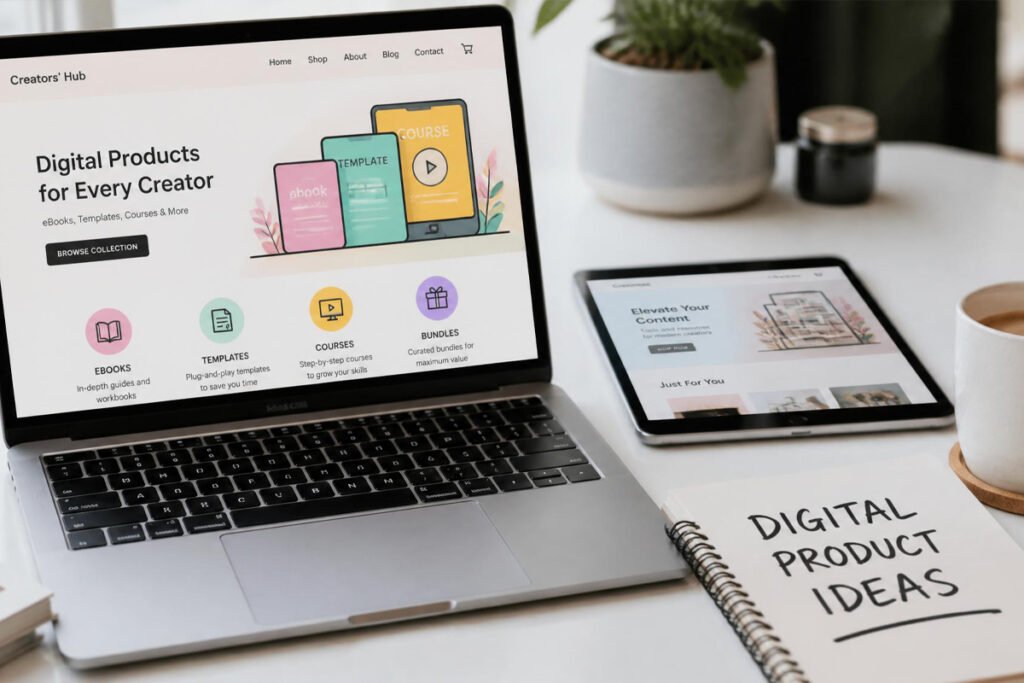
Every successful digital product business starts with the same decision: which product to actually make. It’s easy to get stuck here, because almost anything can technically become a digital product — the real question is which format gives you the best return on the time you’re willing to put in as a beginner.
If you’ve already looked into tools to build a digital product or platforms to sell it on, this guide fills in the piece that comes before both of those steps: choosing a product format that actually matches your skills, your available time, and realistic buyer demand in 2026.
Quick Answer
The best digital product for you depends on your skills and how much time you can invest before your first sale. Printables and templates are the fastest to create and sell well on marketplaces like Etsy, making them the strongest starting point for total beginners. Notion templates are a close second if you’re comfortable with productivity tools, since demand has grown quickly with relatively low competition. Online mini-courses take more effort but command the highest prices, especially in AI skills, ecommerce, and content creation niches. Digital presets and design assets — think Lightroom presets or Canva template packs — are ideal if you have any photography or design background. Ebooks and guides remain reliably profitable and are often the easiest format to test an idea with before committing to something bigger.
Table of Contents
- Why Digital Products Are Still Worth Starting in 2026
- How to Choose the Right Product for Your Skills
- Top 5 Best Digital Products to Sell
- Product Comparison Table
- Best Digital Product by Skill Set
- How to Launch Your First Digital Product Step by Step
- Common Mistakes New Digital Product Sellers Make
- Expert Tips for Picking a Winning Product
- Final Thoughts
- Frequently Asked Questions
Why Digital Products Are Still Worth Starting in 2026
Digital products remain one of the few business models with genuinely low startup costs and no inventory, shipping, or warehousing to manage. A file created once can be sold repeatedly with almost no added cost per sale, which is why profit margins in this category commonly run between 70 and 95 percent — a figure that’s difficult to match in almost any physical product business.
That said, “digital product” isn’t one single opportunity — it’s a category of very different formats with very different time investments and buyer expectations. Choosing the wrong one for your current skills and schedule is one of the most common reasons a promising idea never gets finished, the same trap that affects passive income projects more broadly.
How to Choose the Right Product for Your Skills
Before committing to a format, answer these three questions:
- What do you already know how to do? Design skills point toward templates or presets, subject-matter expertise points toward courses or ebooks, and organizational skills point toward Notion templates and planners.
- How much time can you invest before your first sale? Printables and simple templates can be finished in days; a full course can take weeks or months to produce properly.
- Are you validating an idea or committing long-term? Start with a smaller, faster format to test demand before investing in something more time-intensive, the same logic that applies before starting any small business.

Top 5 Best Digital Products to Sell Online
1. Printables and Templates
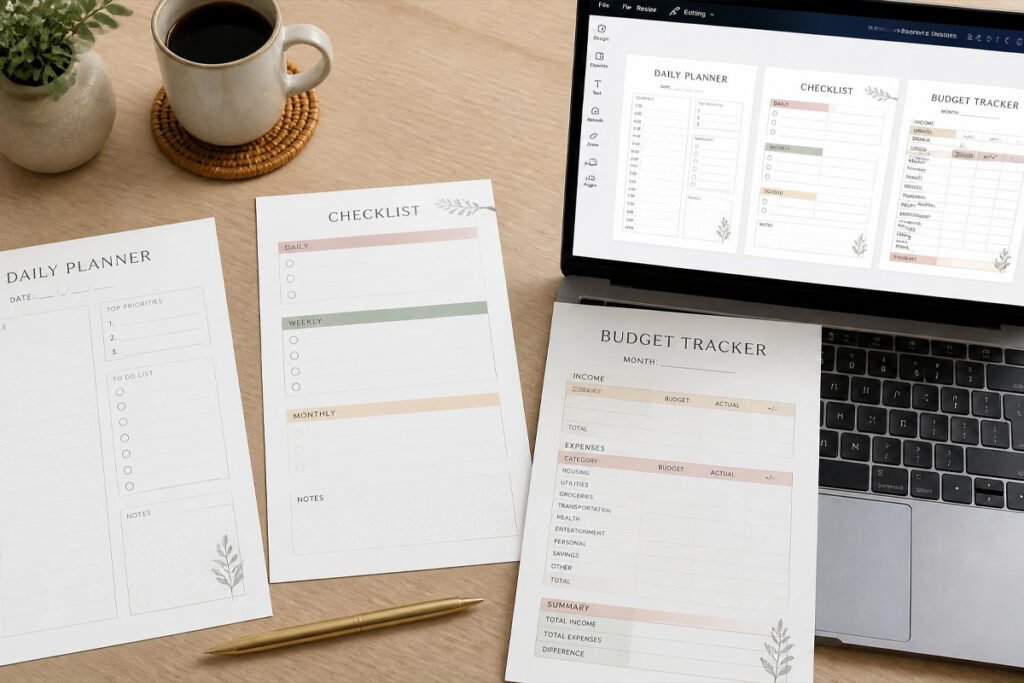
A flat-lay photograph showing a printed planner page, a checklist template,
and a budget tracker sheet arranged neatly on a desk next to a laptop
displaying the same designs in an editable format, soft natural light,
photorealistic, high resolution.
Overview: Printables include planners, checklists, budget trackers, and worksheets — simple, ready-to-use documents that solve a specific, narrow problem for the buyer.
Key Features:
- Fastest format to design and launch, often in a single day
- Sells especially well on marketplaces with built-in search traffic
- Easy to bundle multiple printables into higher-priced packs
Best For: Total beginners with basic design tool skills and no prior selling experience.
Pros: ✅ Lowest time investment of any format on this list ✅ Strong existing buyer demand on marketplaces ✅ Easy to niche down and bundle Cons: ❌ Lower price point per item than courses or software ❌ Market can feel crowded in popular niches like planners
Our Verdict: If you’re validating your very first digital product idea, this is the format most likely to get you a finished, sellable product the fastest — and it pairs naturally with Canva AI for anyone without a design background.
2. Notion Templates and Dashboards
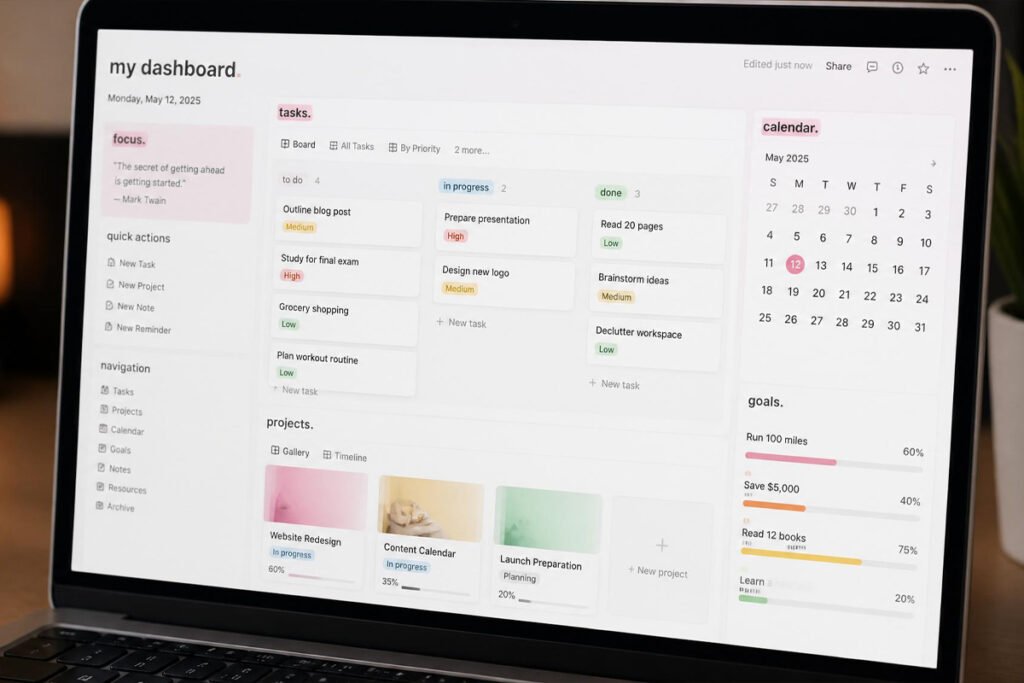
A close-up photograph of a laptop screen displaying a colorful, organized
Notion dashboard template with task boards, calendars, and progress trackers
visible, soft desk lighting, shallow depth of field, photorealistic.
Overview: Notion templates are structured productivity tools — trackers, planners, and dashboards — that buyers duplicate directly into their own Notion workspace, with demand growing quickly as more people adopt the platform for personal and work organization.
Key Features:
- Delivered by direct duplication, so there’s no separate file hosting or delivery step
- Growing dedicated marketplace demand specifically for Notion templates
- Can be built using Notion’s own AI tools to speed up the design process
Best For: Creators already comfortable using Notion who want a focused, relatively low-competition niche.
Pros: ✅ No file delivery hassle since buyers duplicate directly ✅ Still a comparatively less saturated niche than general printables Cons: ❌ Narrower audience, since buyers need an existing Notion account ❌ Requires some familiarity with the platform to build well
Our Verdict: If you’re already deep into productivity systems for your own life or work, this is one of the more focused, less crowded product ideas worth testing.
3. Online Mini-Courses
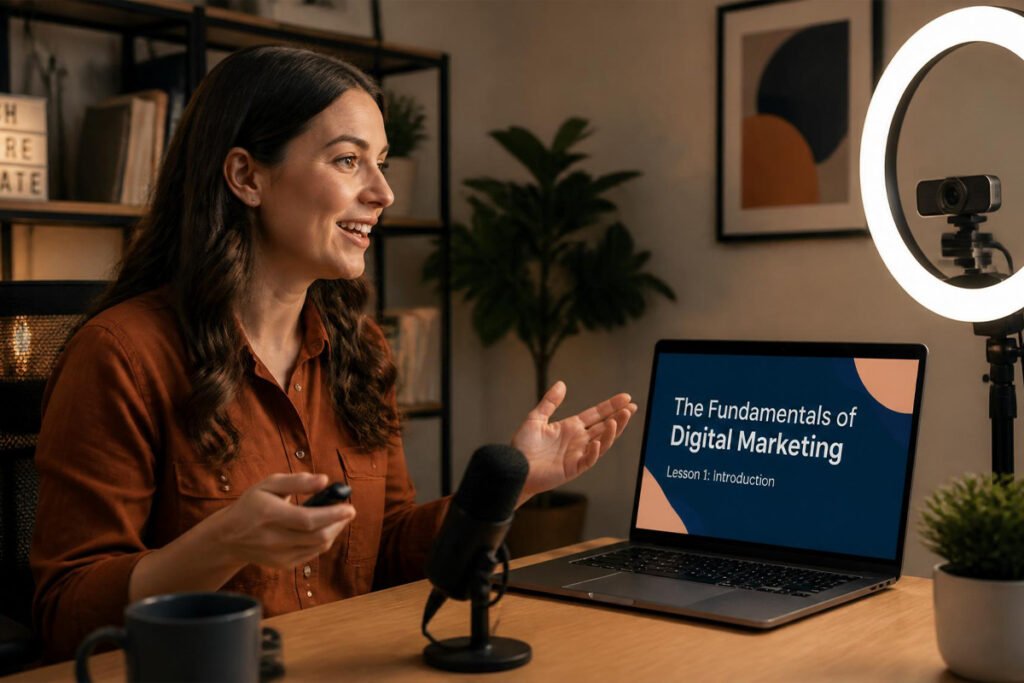
A photograph of a person recording a video lesson at a desk with a webcam,
ring light, and a laptop displaying course slides with a lesson title, warm
studio-style lighting, photorealistic, high resolution.
Overview: Courses package expertise into structured video, audio, or written lessons, and command the highest price points on this list — particularly in high-demand niches like AI skills, ecommerce, and content creation.
Key Features:
- Highest realistic price point among common digital product formats
- Strong recurring revenue potential through cohort-based or evergreen sales
- Works well delivered through platforms built specifically for course hosting
Best For: Creators with genuine expertise willing to invest more upfront time before their first sale.
Pros: ✅ Highest price point justifies the extra production time ✅ Builds long-term authority in a niche Cons: ❌ Takes considerably longer to produce than printables or templates ❌ Requires more marketing effort to justify a higher price
Our Verdict: This is the format worth working toward once you’ve validated demand with a smaller product — pair it with a platform like Podia, which is purpose-built for course delivery.
4. Digital Presets and Design Assets
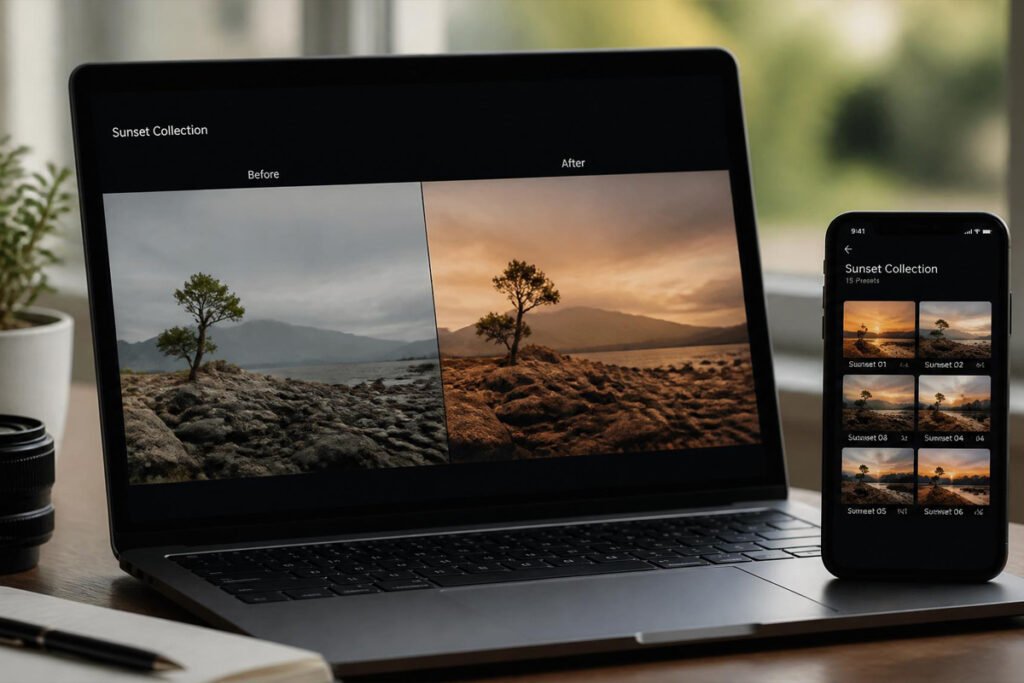
A photograph of a laptop screen showing a before-and-after photo edited with
a color preset, next to a smartphone displaying a preset pack thumbnail grid,
soft natural window light, shallow depth of field, photorealistic.
Overview: Presets, brushes, and design assets — Lightroom presets, Procreate brushes, Canva template kits — let buyers apply a professional look to their own photos or designs instantly, without needing the skill to create that look themselves.
Key Features:
- Extremely high perceived value relative to production time once your core style is developed
- Strong repeat-purchase potential as buyers return for new packs
- Works well bundled into themed collections for higher average order value
Best For: Creators with a photography or design background and a recognizable personal style.
Pros: ✅ High margin once your initial style and workflow are developed ✅ Strong bundling and repeat-customer potential Cons: ❌ Requires genuine design or photography skill to stand out ❌ Competitive in popular aesthetic niches
Our Verdict: If you already have a distinct visual style from other creative work, packaging it as a preset or asset pack turns an existing skill into a scalable product with very little extra effort per sale.
5. Ebooks and Guides
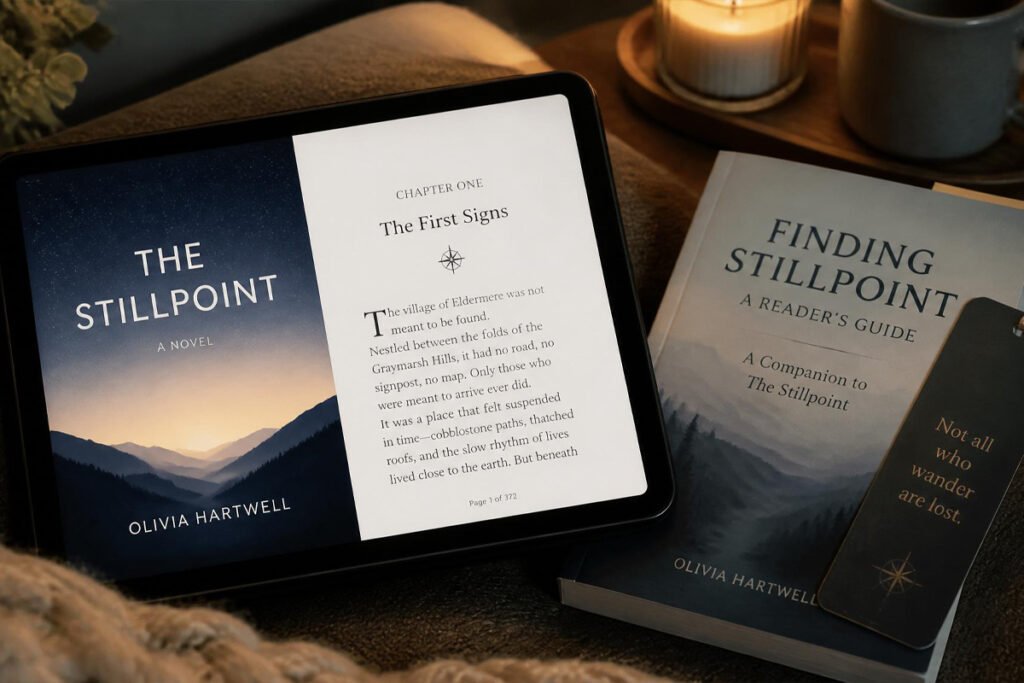
A photograph of a tablet displaying an ebook cover and opening page, next to
a printed guide with a bookmark, resting on a cozy reading nook surface, warm
ambient lighting, shallow depth of field, photorealistic.
Overview: Ebooks remain one of the most flexible and reliably profitable digital product formats, working for nearly any niche where you can offer a clear, specific answer to a reader’s problem.
Key Features:
- Works across almost any niche or subject matter
- Faster to produce than a full course, since there’s no video or audio component required
- Easy to expand later into a course once demand is validated
Best For: Writers and subject-matter experts who want a lower-effort format than a full course.
Pros: ✅ Versatile across nearly every niche ✅ Natural stepping stone toward a future course Cons: ❌ Generally lower price point than a full course ❌ Market can be crowded in very broad topics
Our Verdict: A strong middle-ground option — more substantial than a printable, but faster to produce than a full course, and a great way to validate whether a topic has real buyer demand using AI writing tools to speed up the first draft.
Product Comparison Table
| Product | Time to Create | Typical Price Range | Best For |
|---|---|---|---|
| Printables & Templates | Hours to 1–2 days | $3–$25 | Total beginners |
| Notion Templates | 1–3 days | $10–$40 | Productivity-minded creators |
| Online Mini-Courses | Weeks | $49–$499 | Subject-matter experts |
| Presets & Design Assets | 1–3 days (after style development) | $10–$50 | Photographers & designers |
| Ebooks & Guides | Days to 1–2 weeks | $9–$49 | Writers & niche experts |
Best Digital Product by Skill Set
If You Have No Special Skills Yet
Printables and simple templates are the most forgiving starting point, since tools like Canva remove most of the design skill requirement.
If You’re Organized and Productivity-Obsessed
Notion templates let you turn your own systems into a sellable product with relatively little competition compared to general planners.
If You Have Deep Expertise in a Topic
Online courses or ebooks let you package that knowledge directly, with ebooks as the faster, lower-commitment starting point before a full course.
If You Have a Design or Photography Background
Presets and design asset packs turn an existing creative style into a scalable, repeatable product line.
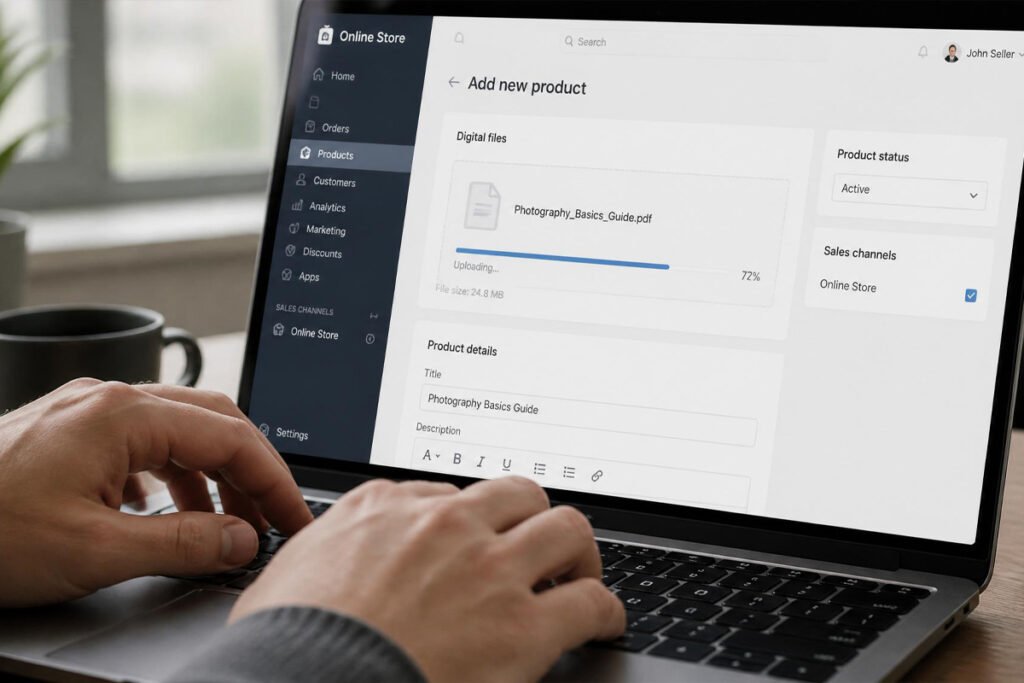
How to Launch Your First Digital Product, Step by Step
Step 1: Pick One Format Based on Your Skills and Time
Use the comparison table above to match your current skills and available time to a single product format — resist the urge to plan five products before finishing one.
Step 2: Validate Demand Before Building the Full Version
Check existing marketplace listings and search volume for your specific idea; if similar products are already selling, that’s a signal of real demand, not a reason to avoid the niche.
Step 3: Build a Small First Version
Create a smaller, faster version of your idea first — a single printable instead of a full bundle, or an ebook instead of a full course — to test the market before investing more time.
Step 4: Choose Where to Sell It
Match your product format to the right platform, whether that’s a marketplace for built-in traffic or your own storefront for more control.
Step 5: Launch, Gather Feedback, and Expand
Use early buyer feedback to decide whether to expand into a bundle, a higher-priced version, or a completely different niche.
Common Mistakes New Digital Product Sellers Make
Picking the most ambitious format first. Jumping straight to a full course before validating demand with a smaller product often means months of work before you know whether anyone wants it.
Ignoring existing competition as a bad sign. Competing listings in a niche usually mean proven demand, not a saturated dead end — the opportunity is in differentiation, not avoidance.
Underpricing out of uncertainty. New sellers frequently price too low out of fear nobody will buy, which can actually undermine perceived value — research typical pricing in your specific niche before setting yours.
Treating the business side as optional once sales start. Once a product is generating consistent income, it’s worth checking whether you need a business license to sell online and revisiting basic business insurance at that point.
Expert Tips for Picking a Winning Product
Study what’s already selling well in your niche. Successful sellers in your category are a research tool, not just competition — study what they’ve bundled, priced, and positioned before finalizing your own approach.
Bundle related products for higher average order value. A single template is a tough sell on its own; a themed bundle of several related items justifies a meaningfully higher price for roughly the same production effort.
Build a system, not just a single product. Once your first product validates a niche, document your exact process so your second and third products take a fraction of the time — the same efficiency mindset worth applying to any online business idea.

Final Thoughts
Best overall for beginners: printables and templates, for the fastest path to a finished, sellable product. Best for low competition: Notion templates, if you’re already comfortable with the platform. Best for highest price point: online mini-courses, once you’ve validated demand. Best for creative skill sets: presets and design assets, for photographers and designers. Best middle-ground option: ebooks and guides, for writers testing a niche before going bigger.
Whichever format you choose, the same rules apply once it starts selling: pick the right platform to host it, build an email list around it, and send traffic through a dedicated landing page rather than a generic link.
Frequently Asked Questions
What is the easiest digital product to create as a total beginner? Printable checklists, worksheets, and simple templates are generally the easiest starting point, since they can be designed in Canva without any prior design experience.
Which digital products make the most money? Online courses, software, and comprehensive template bundles tend to be the most profitable per sale due to higher price points, though they typically require more upfront time to produce.
Do I need special software to create digital products? Not necessarily. Free or low-cost tools like Canva cover most template and printable products, while course creation may require a screen recording tool or a course-hosting platform.
How much can beginners realistically earn selling digital products? Earnings vary enormously by niche, pricing, and marketing effort, but the appeal lies in profit margins commonly between 70 and 95 percent once a product exists.
Should I sell one digital product or several at once? Most successful sellers start by validating a single product before expanding into a bundle or additional related items, rather than launching several unrelated products simultaneously.
Is the digital product market too saturated to start in 2026? Existing competition in a niche is usually a sign of real demand rather than a reason to avoid it — differentiation and a specific angle matter more than being first to a category.
What’s the difference between a printable and a Notion template? A printable is typically a downloadable PDF designed to be printed or used digitally, while a Notion template is a structured digital workspace buyers duplicate directly into their own Notion account.
Can I turn an ebook into a course later? Yes, this is a common and effective progression — validating demand with a lower-effort ebook before investing the additional time required to build a full course around the same topic.
Do digital products require ongoing maintenance after launch? Some do, particularly courses and software, which may need updates over time, while simpler formats like printables and ebooks generally require little to no ongoing work once published.
What niche should I choose for my first digital product? Start with a topic where you already have some personal experience or interest, since that background makes it easier to create something genuinely useful and to speak credibly to your target buyer.
Author: Morne Winston Last Updated: July 2026
Pingback: Best Freelance Marketplaces for Service Providers: Top 5 Picks | Ideas Junction – Your Hub for Startups, Business Growth & Innovation