
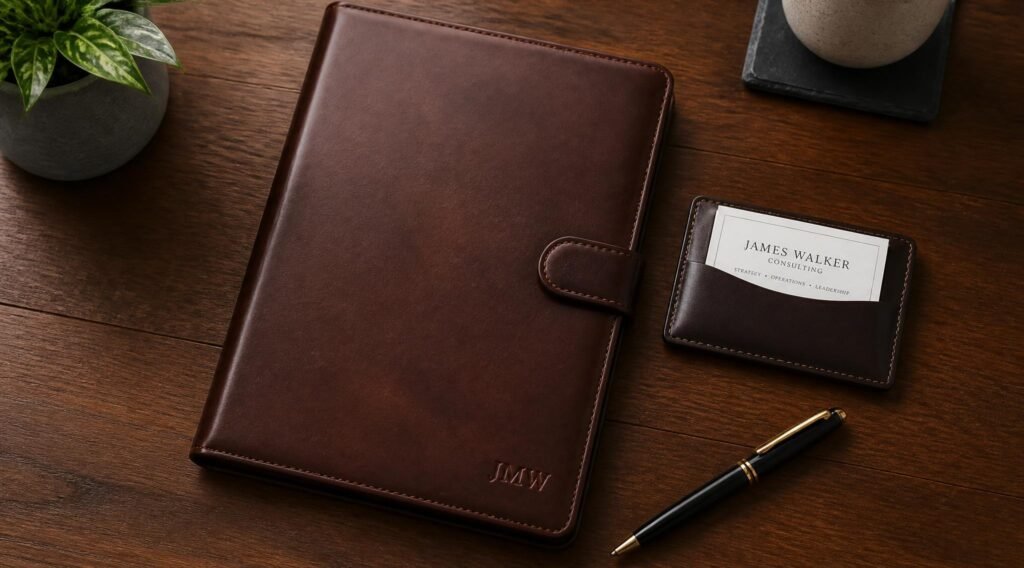
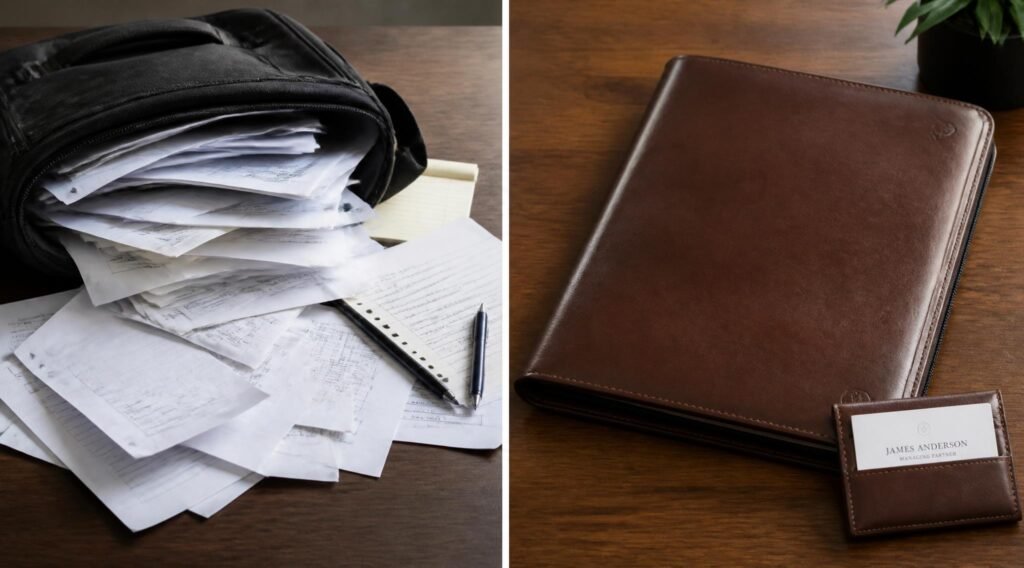
You walk into the meeting with a strong proposal, real expertise, and a genuinely good offer — then you fumble for a loose business card in your wallet, set your papers down in a messy stack, and click a pen that’s already running dry. None of it changes what you’re actually offering, but it changes how put-together you look while offering it, and clients notice these small details more than most founders expect.
This is one of the quieter details behind writing a business proposal that actually wins in person rather than over email. The content of your pitch matters most, but the physical presentation around it — how you hand over documents, how organized your notes look, whether you have a card ready the second someone asks — shapes the client’s first impression before they’ve evaluated a single number in your proposal. This matters just as much whether you’re starting a freelancing business and walking into your first few client meetings, or running an established firm where every in-person pitch needs to look the part.
The fix here is genuinely simple and inexpensive. A handful of well-chosen physical accessories — a proper portfolio, a card holder, a good pen, and somewhere organized to carry it all — close nearly the entire gap between looking scattered and looking like you’ve done this a hundred times.
In this guide, we break down the five presentation accessories worth investing in first, what impression each one actually protects, and how to build a kit that works for any in-person client meeting.
Quick Answer
The best client meeting kit depends on what’s currently making you look least prepared. If you’re setting loose papers down on a table or shuffling through a bag for documents, a leather portfolio or padfolio solves that instantly by giving every document a fixed, organized home. If you’ve ever dug through a wallet or pocket for a business card, a dedicated card holder keeps cards crisp and ready in seconds. If your notes and proposal copies still get creased or disorganized, a proper presentation folder or proposal binder keeps client-facing paperwork looking clean from the moment you hand it over. A good pen matters more than it should the moment a client hands you something to sign or initial in front of them. And a professional laptop sleeve or bag protects your equipment while completing the look on the walk in. The right principle: fix whichever detail has actually made you fumble in front of a client before, not the one that looks most impressive on a shelf.
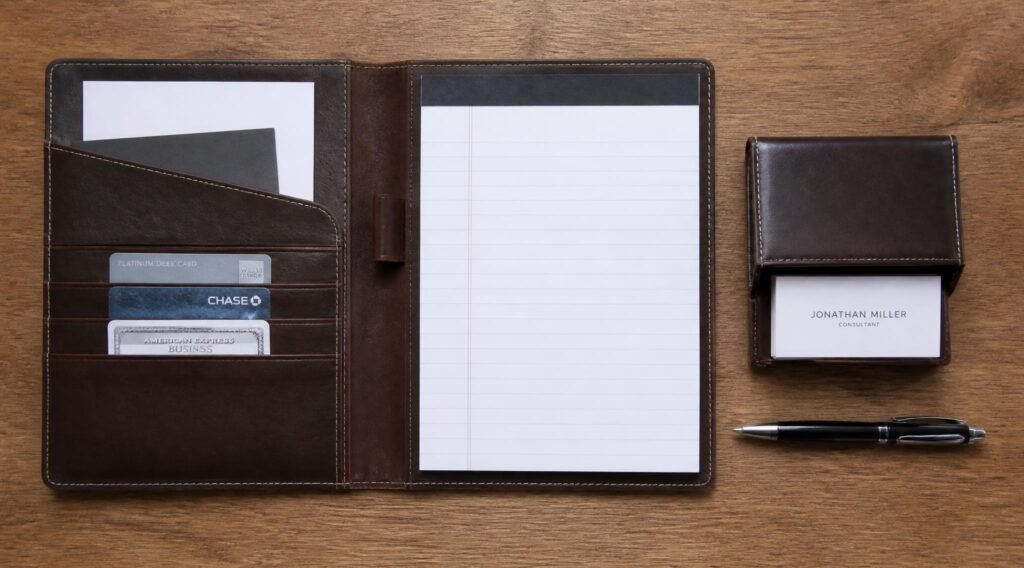
Table of Contents
- Why Physical Presentation Still Matters in a Digital-First World
- How to Choose the Right Accessories for Your Meeting Style
- Best Professional Presentation Accessories Available
- Comparison Table
- Best Kit for Different Types of Client Meetings
- How to Build Your Client Meeting Kit Step by Step
- Common Mistakes
- Expert Tips
- Final Thoughts
- Frequently Asked Questions
Why Physical Presentation Still Matters in a Digital-First World {#what-is}
Most business today happens over email, video calls, and shared documents, which makes the rare in-person client meeting carry disproportionate weight — it’s often the one moment a client forms a physical, tangible impression of you as a professional. Small details in how you carry and present yourself in that room read as signals of competence and preparation, even though none of them technically affect the quality of your work.
The physical details that most consistently shape a client’s impression are:
- Organization, since fumbling through a bag or loose papers reads as unprepared, regardless of how good the actual content is
- Consistency, since a scuffed, mismatched, or overly casual set of accessories can undercut an otherwise polished pitch
- Small courtesies, like having a business card immediately ready rather than making someone wait while you search for one
- Care for shared documents, since handing a client a creased or dog-eared proposal copy signals less attention to detail than a clean one
These impressions form quickly and are hard to fully undo later in the same meeting, which is why the physical kit around your pitch deserves the same intentional thought as the proposal content itself.
How to Choose the Right Accessories for Your Meeting Style {#how-to-choose}
Before buying anything, ask yourself three questions:
How often are you meeting clients in person versus over video? If in-person meetings are rare for you, prioritize just a portfolio and card holder over a full kit. If you’re regularly in conference rooms, invest in the complete set.
Do you hand over physical documents, or work entirely from a screen? If you print proposals or contracts for in-person signing, a proper presentation folder matters more than it would for someone who works entirely from a tablet or laptop during meetings.
What’s your industry’s general formality level? A creative agency pitching a startup can lean more casual than a consultant meeting with a traditional corporate client — match your accessory style to what would feel appropriate in the room, not to what looks best in a product photo.
Best Professional Presentation Accessories Available {#best-options}
1. Leather Portfolio (Padfolio)
Overview: A leather portfolio, often called a padfolio, is the single accessory that does the most to make you look organized and prepared in a client meeting. It holds a notepad, loose documents, business cards, and a pen all in one closed, professional-looking case instead of a loose stack of papers or a bulky folder pulled from a bag.
Key Features:
- Interior notepad holder sized for standard letter or A4 paper
- Built-in business card slots and a pen loop
- A document sleeve or pocket for proposal copies or contracts
- Closure (zipper, snap, or simple fold) to keep everything contained while walking between meetings
Best For: Anyone who currently carries loose papers or a bulky folder into client meetings.
Pros: ✅ The single biggest visual upgrade to how organized you appear walking into a meeting ✅ Keeps notes, cards, documents, and a pen together in one place ✅ A durable, long-lasting purchase that improves every future meeting
Cons: ❌ Genuine leather options cost meaningfully more than basic faux-leather versions ❌ Adds one more item to carry if you’re used to going in with just a laptop
Our Verdict: If you’re pitching clients as a freelancer and still walking in with loose papers, this is the first upgrade to make — it solves the most visible organizational gap in a single purchase.
2. Business Card Holder
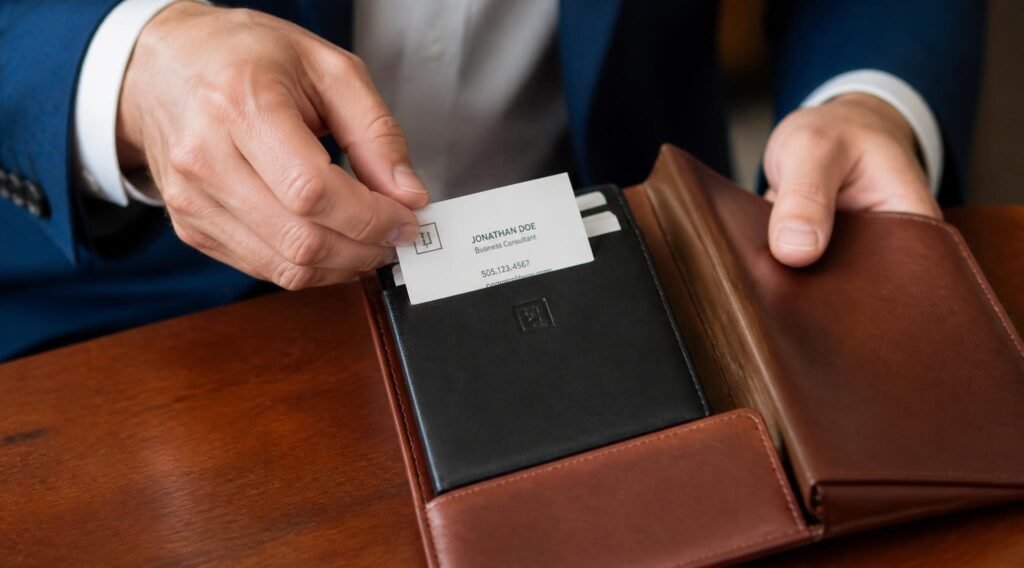
Overview: Digging through a wallet or bag for a slightly bent business card is a small moment, but it’s a noticeable one — and a dedicated card holder eliminates it entirely. It keeps cards crisp, protected, and instantly accessible the moment a client asks for one.
Key Features:
- Rigid or semi-rigid construction that prevents cards from bending or creasing
- Slim profile that fits easily in a jacket pocket, bag, or portfolio card slot
- Capacity for both your own cards and cards you collect from others
- Available in materials matching most portfolio styles for a consistent look
Best For: Anyone who has ever handed over a bent or slightly worn business card, or fumbled to find one during an introduction.
Pros: ✅ One of the cheapest items on this entire list ✅ Solves a small but genuinely noticeable moment of friction ✅ Doubles as a place to store cards you receive from others
Cons: ❌ Limited capacity compared to carrying a full box of cards ❌ An easy item to forget to restock once it runs low
Our Verdict: A tiny investment that removes one of the most common small stumbles in a first client meeting — pair it with your portfolio’s built-in card slot if it has one, or carry it separately if not.
3. Presentation Folder / Proposal Binder
Overview: When you hand a client a printed proposal, contract, or leave-behind document, the folder it’s presented in shapes how seriously that document is taken before a single word is read. A proper presentation folder with clean pockets keeps client-facing paperwork crisp, organized, and free of the creases and dog-ears that come from tossing loose pages into a bag.
Key Features:
- Interior pockets sized for standard letter or A4 documents
- Business card slot on the inside cover for a leave-behind card
- Clean, professional exterior finish — matte, textured, or branded depending on your style
- Enough rigidity to protect documents from bending in transit
Best For: Anyone who regularly hands over printed proposals, contracts, or leave-behind materials during client meetings.
Pros: ✅ Protects the physical proposal itself from looking worn or creased ✅ Reinforces a polished impression at the exact moment a document changes hands ✅ Inexpensive relative to the impression it protects
Cons: ❌ Redundant if you exclusively handle proposals digitally through proposal software ❌ Needs to be restocked or swapped for each client if left behind with them
Our Verdict: Worth buying specifically if your workflow still includes printed leave-behind materials — skip it entirely if every proposal you send is already handled end-to-end online.
4. Professional Pen
Overview: It’s a small object, but the moment a client hands you something to sign, initial, or jot a quick note on in front of them, a pen that skips, runs dry, or feels cheap is a tiny but real dent in an otherwise polished impression. A single well-chosen professional pen removes that risk permanently.
Key Features:
- Smooth, reliable ink flow that doesn’t skip or require pressing hard
- Comfortable weight and grip for actual handwriting, not just for show
- Refillable cartridge system so one good pen lasts indefinitely
- Compact enough to clip into a portfolio’s built-in pen loop
Best For: Anyone who has ever reached for a pen in a client meeting and had it fail, skip, or simply look cheap.
Pros: ✅ One of the least expensive items on this list relative to how often it’s actually used ✅ A single purchase that lasts years with basic refills ✅ Small but genuinely noticeable detail in an in-person signing moment
Cons: ❌ Easy to misplace if it isn’t kept in a dedicated portfolio loop ❌ Higher-end options can feel like an unnecessary expense if you rarely hand-sign anything
Our Verdict: A low-cost, low-effort fix — keep it clipped into your portfolio so it’s never the reason a signing moment feels awkward.
5. Professional Laptop Sleeve or Bag
Overview: If you’re bringing a laptop into client meetings, how you carry it matters just as much as how you carry your papers. A proper protective sleeve or bag keeps your equipment safe in transit while completing a consistent, professional look from the moment you walk in the door.
Key Features:
- Padded protection sized specifically for your laptop model
- Clean, professional exterior material and color that matches a business setting
- Additional pockets for a charger, portfolio, or small accessories
- Comfortable carry method — handle, strap, or both — for moving between meetings
Best For: Anyone regularly carrying a laptop into client-facing meetings, especially alongside other presentation accessories.
Pros: ✅ Protects your equipment while reinforcing a consistent professional look ✅ Extra pockets keep your full kit — portfolio, cards, pen — organized in one bag ✅ A durable, one-time purchase that improves the walk-in impression, not just the meeting itself
Cons: ❌ A larger investment than the smaller accessories on this list ❌ Unnecessary if you never bring a laptop to in-person meetings
Our Verdict: Worth prioritizing last on this list — it matters most once you’ve already got the portfolio, cards, and pen sorted and want the whole kit to look cohesive from the moment you arrive.
Comparison Table {#comparison-table}
| Accessory | Best For | Relative Cost | Solves | Priority |
|---|---|---|---|---|
| Leather Portfolio | Overall organization and first impression | Low–Moderate | Loose papers, disorganization | Highest |
| Business Card Holder | Fast, crisp card exchanges | Very Low | Fumbling for cards | High |
| Presentation Folder / Binder | Clean, professional handoff of documents | Low | Creased or worn proposal copies | Moderate |
| Professional Pen | Reliable in-meeting signing moments | Very Low | Skipping or unreliable pens | Moderate |
| Laptop Sleeve or Bag | Protecting equipment, completing the look | Moderate | Equipment damage, inconsistent look | Lower |
Prices vary by material and brand — leather options cost meaningfully more than faux-leather or synthetic alternatives.
Best Kit for Different Types of Client Meetings {#use-cases}
First-Time Client Pitches
If you’re meeting a prospective client for the first time, prioritize the portfolio and card holder together — these two solve the most visible signals of preparation in a single first impression, which matters most when you’re starting a freelancing business and building trust from scratch.
In-Person Contract Signings
If your meeting is likely to end with a signature on the spot, bring the professional pen and, if you’re working with printed documents, the presentation folder as well — this pairs well with a portable scanner if you need to digitize the signed copy immediately afterward.
Regular, Recurring Client Meetings
If you meet the same clients repeatedly rather than pitching new ones, a full consistent kit — portfolio, cards, pen, and bag — reinforces reliability over time in a way a single strong first impression can’t on its own.

How to Build Your Client Meeting Kit Step by Step {#how-to}
Step 1: Identify What’s Actually Gone Wrong Before
Think back to a real meeting where something felt disorganized or awkward — a missing card, loose papers, a dry pen — and prioritize fixing that specific gap first.
Step 2: Start With the Portfolio
Buy the portfolio first, since it has the broadest impact and typically includes slots for cards and a pen loop that reduce what else you need to buy separately.
Step 3: Stock It Properly Before Your Next Meeting
Fill the card slots, clip in a working pen, and load a fresh notepad — an empty or half-stocked portfolio doesn’t solve anything on its own.
Step 4: Add a Presentation Folder Only if You Print Documents
Skip this step entirely if your proposals are handled digitally — there’s no reason to carry printed leave-behinds you don’t actually use.
Step 5: Do a Final Check Before Every Meeting
Confirm your card holder is stocked, your pen works, and your portfolio is organized before walking in — a two-minute check that prevents the exact small stumbles this kit is meant to avoid.
Common Mistakes {#mistakes}
Buying accessories but never actually restocking them. An empty business card holder or a portfolio with no notepad solves nothing — the value only shows up when the kit is actually kept ready between meetings.
Mismatching materials and formality levels. A casual canvas bag paired with a formal leather portfolio can look inconsistent — pick a general style and stay reasonably consistent across your full kit.
Treating this as more important than the actual proposal. These accessories support a strong pitch, they don’t replace one — the content of what you’re proposing still needs to be the foundation everything else supports.
Expert Tips {#tips}
Keep a small backup pen in your bag, not just the one clipped to your portfolio. Pens get lost or lent out more often than people expect, and a backup avoids being caught without one at the worst moment.
Restock your business card holder the same day you notice it running low. It’s easy to keep meaning to refill it and forget, until you’re standing in a meeting with none left.
Match your kit’s formality to your industry, not to what looks most premium. An overly formal leather kit can feel mismatched in a casual creative pitch, just as an overly casual bag can undercut a formal corporate meeting.
Final Thoughts {#final-thoughts}
There’s no single accessory that fixes every in-person impression gap — only the right combination for how you actually meet clients. If you’re currently walking in with loose papers, the leather portfolio is the highest-impact first purchase. If small fumbling moments have tripped you up before, the card holder and pen are cheap, immediate fixes. And if your kit needs to look cohesive from the moment you walk in, a matching laptop bag ties the whole presentation together.
Whichever piece you start with, remember this kit supports your pitch, it doesn’t replace it — the strongest portfolio in the world won’t save a weak proposal, but a weak physical presentation can genuinely undercut a strong one, which is why it’s worth getting right alongside the proposal content itself.
Frequently Asked Questions {#faq}
Do I really need a leather portfolio, or is a plain folder fine? A plain folder works functionally, but a proper portfolio consolidates your notepad, cards, documents, and pen into one organized case — which matters most if you’ve ever fumbled through a bag mid-meeting.
Is genuine leather worth the extra cost over faux leather? Genuine leather looks and ages better over years of use, but high-quality faux leather options look nearly identical in a meeting setting and cost significantly less — the choice comes down to budget and how long you expect to use it.
How many business cards should I actually carry? A card holder that fits 15–20 cards comfortably covers most single-day meeting schedules without needing to restock mid-week for most professionals.
Do I need a presentation folder if I use proposal software with e-signatures? Not necessarily — if your entire proposal process happens digitally through tools like proposal software, a presentation folder is optional rather than essential.
What should I look for in a professional pen? Prioritize smooth, reliable ink flow and a comfortable grip over brand name or price — the goal is a pen that never fails in front of a client, not necessarily the most expensive option available.
Is a laptop bag necessary if I already have a padfolio? Only if you regularly bring a laptop to meetings. If you work entirely from printed materials or a tablet that fits inside your portfolio, a separate bag may be unnecessary.
How often should these accessories be replaced? A quality portfolio, card holder, and bag can last years with normal use — replace them when visible wear (scuffing, fraying, broken zippers) starts to look noticeable rather than on a fixed schedule.
Does physical presentation actually affect whether I win a proposal? It’s a supporting factor, not the deciding one — a disorganized physical presentation can create doubt that undercuts an otherwise strong pitch, but no accessory kit will save a proposal that’s weak on substance.
Should I personalize or brand my portfolio and folder? It’s optional, but a subtle branded touch (embossed initials or a company logo) can reinforce professionalism without looking excessive, particularly for client-facing roles where you meet the same contacts repeatedly.
What’s the single most important item on this list if I can only buy one? The leather portfolio — it has the broadest impact, often includes card and pen storage built in, and solves the most visible sign of disorganization in a single purchase.
Author: Morne Winston Last Updated: July 2026