
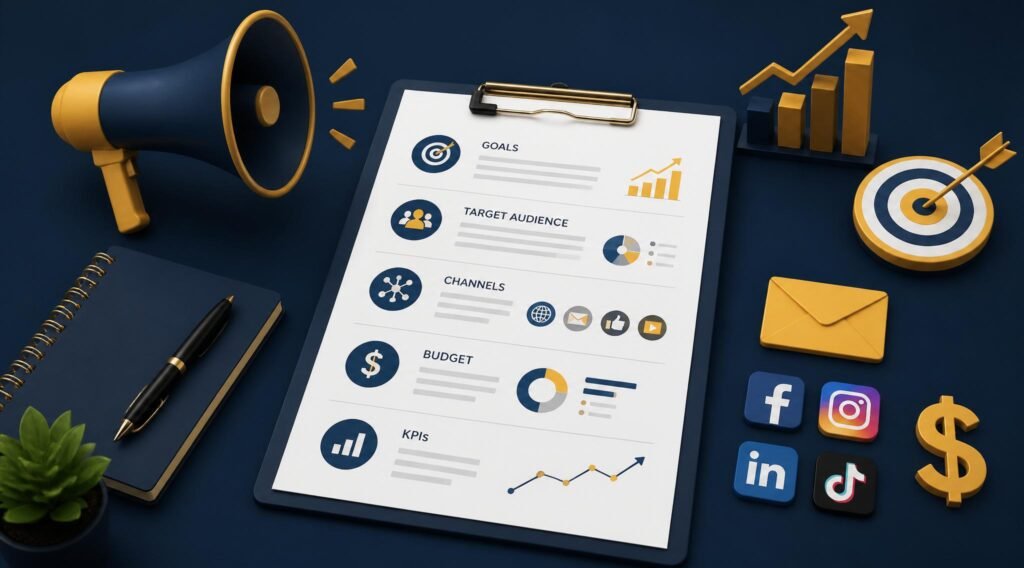
Most businesses fail at marketing not because they lack creativity or budget — they fail because they don’t have a plan. They try random tactics, chase the latest trend, and wonder why nothing seems to work. The businesses that grow consistently are the ones with a clear, documented marketing plan that connects their goals, their audience, their channels, and their budget into a coherent strategy.
A marketing plan doesn’t need to be a 50-page document. A one-page plan that answers the right questions is more valuable than a detailed report that never gets implemented. This guide on how to write a marketing plan in 2026 gives you the framework, the questions, and the templates to build a plan you’ll actually use.
💡 A marketing plan is not your business plan — it’s a specific document focused on how you’ll attract, convert, and retain customers. It typically covers 12 months and is reviewed quarterly.
🔗 Related: How to Write a Business Plan That Actually Gets Results
🔗 Related: How to Write a Business Proposal That Wins Clients (2026)
Table of Contents
- What Is a Marketing Plan and Why Do You Need One?
- The 8 Core Sections of a Marketing Plan
- Section 1: Executive Summary
- Section 2: Situation Analysis (SWOT + Market Research)
- Section 3: Target Audience and Buyer Personas
- Section 4: Marketing Goals and Objectives (SMART)
- Section 5: Marketing Strategy and Positioning
- Section 6: Marketing Channels and Tactics
- Section 7: Marketing Budget
- Section 8: KPIs and Measurement
- The 1-Page Marketing Plan Template
- Frequently Asked Questions
1. What Is a Marketing Plan and Why Do You Need One?
A marketing plan is a written document that outlines your marketing strategy for a defined period — typically 12 months. It covers your target market, your positioning, the channels you’ll use to reach customers, your budget, and the metrics you’ll use to measure success.
A Marketing Plan vs. a Marketing Strategy:
Marketing strategy: The big-picture thinking — who you’re targeting, how you’re positioning yourself, what makes you different. Long-term direction.
Marketing plan: The specific, time-bound action plan that puts the strategy into practice. Campaigns, channels, budgets, timelines. Short-term execution.
Why Every Business Needs a Written Marketing Plan:
- Prevents reactive, random marketing — gives you a framework for decision-making
- Aligns your team on priorities, budget, and responsibilities
- Makes it easier to measure what’s working and what isn’t
- Forces you to understand your customer deeply before spending money
- Creates accountability — written goals are achieved more consistently than mental ones
- Required by investors and lenders as part of a business plan package
💡 Businesses with a documented marketing strategy are 313% more likely to report success than those without one (CoSchedule State of Marketing 2024). Writing it down is not bureaucracy — it’s a competitive advantage.
🔗 Related: How to Start an Online Business from Scratch in 2026
2. The 8 Core Sections of a Marketing Plan
A complete marketing plan has eight sections, each building on the previous one. You don’t need to write them in this order, but the final document should present them in this sequence:
- Executive Summary — the ‘what and why’ overview
- Situation Analysis — where you are now (SWOT, market, competition)
- Target Audience — who you’re marketing to
- Marketing Goals — what you’re trying to achieve (SMART objectives)
- Marketing Strategy — your positioning and differentiation approach
- Channels and Tactics — how and where you’ll reach your audience
- Budget — how much you’ll spend and on what
- KPIs and Measurement — how you’ll track success
⚡ Write sections 2–4 first. Understanding your current situation, your audience, and your goals makes every other section easier and more accurate.
Section 1: Executive Summary
The executive summary is a concise overview of your entire marketing plan — written last, placed first. It gives readers (investors, partners, team members) a clear picture of your marketing direction without requiring them to read the full document.
What the Executive Summary Includes:
- Business overview — what you sell, to whom, and your current market position
- Key marketing goals for the period — your top 2–3 objectives in plain language
- Primary marketing channels you’ll focus on
- Total marketing budget for the period
- The single most important competitive advantage you’ll emphasize
Length: 1–2 paragraphs for a small business plan; up to 1 page for a larger organization.
⚡ Write this section last. You can’t summarize what you haven’t written yet. Leave a placeholder while you complete the rest of the plan.
Section 2: Situation Analysis (SWOT + Market Research)
The situation analysis answers the question: ‘Where are we now?’ It’s the foundation of a realistic marketing plan — without understanding your current position, any goals you set are guesswork.
2a: SWOT Analysis
A SWOT analysis evaluates four dimensions of your current position:
Strengths (internal): What does your business do better than competitors? What unique resources, capabilities, or positioning do you have?
Weaknesses (internal): Where are you behind? What resources, capabilities, or market position do you lack?
Opportunities (external): What market trends, gaps, or shifts could you exploit? What are competitors failing to do?
Threats (external): What market conditions, competitors, or trends could hurt your growth?
2b: Market Research
Document what you know about your market:
- Market size — total addressable market (TAM) and serviceable addressable market (SAM)
- Market growth rate — is the market growing, stable, or declining?
- Key trends — what’s changing in the industry? AI, regulation, consumer behavior shifts?
- Competitive landscape — who are the top 3–5 competitors? What are they doing in marketing?
2c: Competitor Analysis
For each key competitor, document:
- Their primary marketing channels
- Their apparent target audience
- Their pricing and positioning
- Their strengths and weaknesses from a customer perspective
- Content gaps or underserved audiences you could target
✅ Your competitor analysis often reveals the most valuable opportunities. The channels they’re ignoring, the audiences they’re underserving, and the messaging they’re getting wrong are all opportunities for your marketing plan to exploit.
🔗 Related: How to Validate Your Business Idea Before Spending a Dollar
Section 3: Target Audience and Buyer Personas
Your marketing plan is only as good as your understanding of who you’re marketing to. This section defines your target audience in specific, actionable terms — not ‘small business owners’ but ‘solo service business owners doing $50K–$150K annually who are overwhelmed by inconsistent client flow.’
Building a Buyer Persona:
A buyer persona is a semi-fictional representation of your ideal customer, built from real data and research. Create 1–3 personas for your main customer segments.
Demographics:
- Age range, gender, location, income level
- Job title, industry, company size (for B2B)
- Education level, family situation
Psychographics:
- Goals — what are they trying to achieve in their professional or personal life?
- Frustrations — what problems keep them up at night?
- Values — what do they care about?
- Information sources — where do they get information? What podcasts, newsletters, platforms do they use?
Buying Behavior:
- How do they research products/services?
- What objections do they have before buying?
- What triggers their buying decision?
- How long is their buying cycle?
⚡ The best way to build accurate personas is to interview 5–10 real customers or potential customers. Ask them about their goals, frustrations, and decision-making process. Real conversations reveal insights that no amount of desktop research can.
🔗 Related: How to Build a Personal Brand in 2026: The Complete Step-by-Step Guide
Section 4: Marketing Goals and Objectives (SMART Framework)
Marketing goals without specificity are wishes. The SMART framework turns vague aspirations into actionable targets that you can measure and manage.
SMART Goals Defined:
Specific: Clearly defines what you want to achieve. ‘Increase website traffic’ is not specific. ‘Increase organic website traffic from Google’ is specific.
Measurable: Includes a number. ‘Increase organic traffic by 40%’ is measurable.
Achievable: Realistic given your resources and timeline. 400% growth in 3 months is not achievable for most businesses.
Relevant: Tied to a business outcome. More traffic should lead to more leads, which leads to more revenue.
Time-bound: Has a deadline. ‘by December 31, 2026’ makes it actionable.
Example SMART Marketing Goals:
- Increase monthly organic website traffic from 2,000 to 5,000 visitors by December 31, 2026
- Generate 50 qualified leads per month through LinkedIn content by Q3 2026
- Grow email subscriber list from 800 to 2,500 by end of 2026
- Achieve a 3:1 ROAS on paid Facebook advertising by month 3 of the campaign
- Increase customer retention rate from 65% to 80% by implementing an email nurture sequence by Q2
Aligning Goals to Business Objectives:
Every marketing goal should connect to a revenue or growth objective. For each marketing goal, ask: ‘How does achieving this goal contribute to revenue?’ If you can’t answer clearly, reconsider whether the goal belongs in your marketing plan.
🔗 Related: How to Start a Freelancing Business in 2026
Section 5: Marketing Strategy and Positioning
Your marketing strategy defines how you’ll position yourself in the market and what core message you’ll consistently communicate. It answers: ‘Why should someone choose us over every alternative?’
Value Proposition:
Your value proposition is the specific benefit your product or service delivers to your target customer, and why you deliver it better than alternatives. It’s not a tagline — it’s a clear statement of differentiation.
Value Proposition Formula: We help [specific customer] achieve [specific outcome] by [specific approach] — unlike [alternative] which [limitation].
Example: ‘We help early-stage SaaS founders get their first 100 paying customers in 90 days using a proven outbound sales system — unlike generic marketing agencies that focus on brand awareness over revenue.’
Positioning Statement:
Your positioning statement defines your place in the market relative to competitors. It’s used internally to guide all marketing decisions.
Positioning Formula: For [target customer], [brand name] is the [category] that [key benefit] because [reason to believe].
Core Messaging Pillars:
Define 3–5 core messages that every piece of marketing content reinforces. These are the consistent themes that build your brand positioning over time — every blog post, social media post, ad, and email should connect back to at least one of these pillars.
💡 Consistency is the multiplier in marketing. A mediocre message repeated consistently outperforms a brilliant message delivered inconsistently. Define your core messages and stick to them.
Section 6: Marketing Channels and Tactics
This is where strategy meets execution. Based on your target audience (where they spend time), your goals (what you need to achieve), and your resources (budget and team), you select the specific channels and tactics for your marketing plan.
| Channel | Best For | Avg. Cost | Time to Results | Difficulty |
| SEO / Content Marketing | Long-term organic traffic | Low (time) | 6–12 months | Medium |
| Social Media (Organic) | Brand awareness, community | Low (time) | 3–6 months | Low–Medium |
| Email Marketing | Repeat customers, nurturing leads | Low ($10–$50/mo) | Immediate | Low |
| Paid Social (Meta/TikTok Ads) | Fast audience growth, product sales | Medium–High ($500+/mo) | Immediate | Medium |
| Google Ads (PPC) | High-intent buyers, local service | High ($500+/mo) | Immediate | Medium–High |
| Influencer Marketing | Product launches, brand awareness | Medium–High | 1–3 months | Medium |
| Content / Video (YouTube) | Authority, evergreen traffic | Low (time) | 6–18 months | Medium |
| Affiliate Marketing | Performance-based revenue | Low (commission) | 3–6 months | Medium |
| Podcast / Audio | Thought leadership, niche audience | Low–Medium | 6–12 months | Medium |
| PR / Media Outreach | Credibility, mass awareness | Low (DIY) to High | Variable | High |
Choosing Your Channels — The 2-Channel Rule:
Most small businesses and startups should focus on 2 primary marketing channels rather than spreading effort across 6–8. A focused approach on 2 channels executed well outperforms a diluted approach on many channels almost every time.
For B2C product businesses: Instagram/TikTok (awareness) + Email (conversion)
For B2B service businesses: LinkedIn (awareness) + Email/Newsletter (nurturing)
For local service businesses: Google (search intent) + Social proof/reviews
For content/media businesses: SEO/Blog (traffic) + Email (audience ownership)
Tactics for Each Channel:
For each channel you select, document the specific tactics:
- Content types — what will you create? (blog posts, videos, carousels, emails)
- Publishing frequency — how often will you post/send?
- Content themes — which of your messaging pillars does each content piece address?
- Paid vs. organic — will you boost with advertising or rely on organic reach?
- Team/resource assignment — who is responsible for this channel?
⚡ Start with one channel until you can post consistently and see results. Adding channels before mastering the first one is one of the most common small business marketing mistakes.
Section 7: Marketing Budget
Your marketing budget determines what’s possible — but it doesn’t need to be large to be effective. The most important thing is allocating it strategically based on your goals and channels.
| Business Stage | Monthly Revenue | Recommended Marketing Budget | Priority Channels |
| Pre-launch | $0 | $0–$500 (organic focus) | Content, SEO, social media |
| Early Stage | $1K–$5K/mo | 10–20% of revenue | Email, social, content |
| Growth Stage | $5K–$20K/mo | 15–20% of revenue | Paid ads + content + email |
| Scaling | $20K–$100K/mo | 10–15% of revenue | Paid ads, SEO, partnerships |
| Established | $100K+/mo | 8–12% of revenue | Multi-channel, brand, retention |
How to Allocate Your Marketing Budget:
Content creation (30–40%): Writing, design, video production — the raw material of your marketing
Paid advertising (30–40%): Social ads, search ads, sponsored content — amplification for your content
Tools and software (10–15%): Email platform, CRM, analytics, scheduling tools
PR and partnerships (10–20%): Sponsorships, collaborations, affiliate commissions
Testing and experiments (5–10%): Budget reserved for trying new channels or tactics
Zero-Budget Marketing Tactics That Work:
If your budget is genuinely $0, focus on these high-ROI, time-intensive tactics:
- SEO content — write comprehensive blog posts targeting keywords your audience searches
- LinkedIn personal brand — post consistently, engage genuinely, build connections
- Cold outreach — direct, personalized email or LinkedIn messages to potential customers
- Community participation — add value in forums, Facebook groups, Reddit, and niche communities
- Referral program — ask satisfied customers to refer others
💡 Time is a marketing budget. If you have no money but have time, invest it in SEO content and personal branding — both build compounding assets that generate returns for years.
🔗 Related: 15 Passive Income Ideas That Actually Work in 2026
🔗 Related: 25 Low-Cost Business Ideas with High Profit Margins in 2026
Section 8: KPIs and Measurement
A marketing plan without measurement is a wish list. KPIs (Key Performance Indicators) connect your marketing activities to business outcomes and tell you objectively whether your plan is working.
| KPI | What It Measures | How to Track | Target Benchmark |
| Website Traffic | Total visitors per month | Google Analytics | 10–20% MoM growth |
| Conversion Rate | % of visitors who take action | Google Analytics / CRM | 2–5% (industry varies) |
| Customer Acquisition Cost (CAC) | Cost to acquire one customer | CRM / Ad platform | Lower than LTV |
| Customer Lifetime Value (LTV) | Total revenue per customer | CRM / spreadsheet | 3x+ higher than CAC |
| Email Open Rate | % of subscribers opening emails | Email platform (Mailchimp etc.) | 20–30% average |
| Social Media Reach | People who saw your content | Platform analytics | Track MoM growth |
| Return on Ad Spend (ROAS) | Revenue per $1 spent on ads | Ad platform | 3:1 or better minimum |
| Brand Awareness | % of target market who know you | Surveys / branded search volume | Improve quarter over quarter |
| Lead Generation | New qualified leads per month | CRM | Set specific monthly target |
| Revenue from Marketing | Revenue attributed to marketing | CRM / attribution model | Track vs. marketing spend |
Setting Up Your Measurement System:
- Install Google Analytics 4 (GA4) on your website — it’s free and tracks traffic, behavior, and conversions
- Connect your ad platforms (Meta, Google) to your analytics for full funnel visibility
- Set up a CRM (HubSpot Free, Notion, or a spreadsheet) to track leads and customers
- Create a monthly marketing dashboard — a single view of all your key metrics
- Schedule a monthly review — review what’s working, what isn’t, and adjust
The Monthly Marketing Review:
At the end of each month, review:
- Did you hit your traffic, lead, and revenue targets?
- Which channels are performing above or below expectations?
- What content or campaigns generated the most engagement or conversions?
- Where should you increase or decrease budget next month?
- What’s one test you’ll run next month based on this month’s learnings?
✅ Review your marketing plan quarterly and update it based on what you learn. A plan that isn’t adjusted based on data isn’t a living strategy — it’s a historical document.
The 1-Page Marketing Plan Template
For most small businesses, a one-page marketing plan is more actionable than a 20-page document. Here’s a simple template structure you can complete in 1–2 hours:
ONE-PAGE MARKETING PLAN TEMPLATE — 2026
Business Overview
Business name: [Your business name]
What we sell: [Product/service in one sentence]
Current monthly revenue: [$X]
Plan period: January 1, 2026 – December 31, 2026
Target Customer
Primary persona: [Name, role, key challenge, primary goal]
Where they spend time online: [Platform 1, Platform 2]
Their main objection to buying: [Objection]
SWOT (One line each)
Strength: [Top internal advantage]
Weakness: [Top internal gap]
Opportunity: [Top market opportunity]
Threat: [Top market risk]
Marketing Goals (3 SMART Goals)
Goal 1: [Specific, measurable, time-bound marketing goal]
Goal 2: [Specific, measurable, time-bound marketing goal]
Goal 3: [Specific, measurable, time-bound marketing goal]
Core Value Proposition
We help: [Specific customer] achieve [specific outcome] by [specific approach]
Primary Channels (Max 2)
Channel 1: [Channel] — [Tactic] — [Frequency] — [Owner]
Channel 2: [Channel] — [Tactic] — [Frequency] — [Owner]
Monthly Marketing Budget
Total budget: $[X]/month
Content creation: $[X]
Paid advertising: $[X]
Tools: $[X]
Top 3 KPIs
KPI 1: [Metric] — Current: [X] — Target: [Y] by [date]
KPI 2: [Metric] — Current: [X] — Target: [Y] by [date]
KPI 3: [Metric] — Current: [X] — Target: [Y] by [date]
Next Review Date
Quarterly review: [Date]
⚡ Print this one-pager and keep it somewhere visible. A marketing plan that stays in a drawer doesn’t drive decisions.
Frequently Asked Questions
What is a marketing plan?
A marketing plan is a written document that outlines your marketing strategy, goals, target audience, channels, budget, and success metrics for a specific period — typically 12 months. It serves as the operational guide for all your marketing activity, ensuring that everything you do is connected to specific business outcomes.
How long should a marketing plan be?
For a small business or startup, a one-page to five-page marketing plan is sufficient and more likely to be used consistently. Larger organizations with multiple products, markets, or teams may have 20–50-page plans with detailed appendices. Length should match complexity — a simple, actionable plan always outperforms a detailed plan that sits unread.
What’s the difference between a marketing plan and a business plan?
A business plan covers the entire business — operations, financing, team, products, and market overview. A marketing plan is a focused subset that covers only the marketing strategy and execution. Most business plans include a marketing section — the marketing plan expands that section into a standalone operational document.
How often should I update my marketing plan?
Review your marketing plan monthly (to check KPIs and adjust tactics) and update it formally on a quarterly basis. A full annual review and reset at the beginning of each year is best practice. Markets change, channels evolve, and your business learns — a good marketing plan adapts accordingly.
How much should a small business spend on marketing?
The widely cited benchmark for small businesses is 7–12% of revenue. Early-stage businesses typically need to spend a higher percentage (10–20%) to build awareness. Established businesses with strong word-of-mouth and retention can spend less. The most important thing is that every marketing dollar is tracked and tied to a measurable outcome.
Do I need a marketing plan if I’m a solo business owner?
Yes — arguably more than anyone. Solo business owners have the least margin for error in their marketing spend and time. A simple one-page marketing plan prevents the random, reactive marketing that most solopreneurs fall into: posting when they feel like it, trying every new platform, and wondering why nothing converts.
Final Thoughts
Writing a marketing plan doesn’t need to be complicated — it needs to be done. A simple, one-page plan that you actually implement and review monthly will outperform a detailed document that collects dust. The act of writing forces clarity: who you’re targeting, what you’re offering, where you’ll reach them, what it will cost, and how you’ll know it’s working.
Start with the sections that are hardest to write — your target audience and your SWOT analysis. Get those right, and the rest of the plan follows naturally. Build your channels around your audience, set goals that connect to revenue, assign a budget, and measure relentlessly. That’s the entire framework.
Continue Building Your Business Foundation:
- How to Write a Business Plan That Actually Gets Results → https://ideasjunction.com/how-to-write-a-business-plan-that-actually-gets/
- How to Write a Business Proposal That Wins Clients (2026) → https://ideasjunction.com/how-to-write-a-business-proposal-that-wins/
- How to Write a Winning Pitch Deck → https://ideasjunction.com/how-to-write-a-winning-pitch-deck/
- How to Build a Personal Brand in 2026 → https://ideasjunction.com/how-to-build-a-personal-brand-guide-2026/
- How to Start an Online Business from Scratch in 2026 → https://ideasjunction.com/how-to-start-an-online-business-from-scratch/
- How to Start an LLC in 2026: Step-by-Step Guide → https://ideasjunction.com/how-to-start-an-llc-in-2026-step-by-step/
- 15 Passive Income Ideas That Actually Work in 2026 → https://ideasjunction.com/passive-income-ideas-that-actually-work/
Written by Morne