
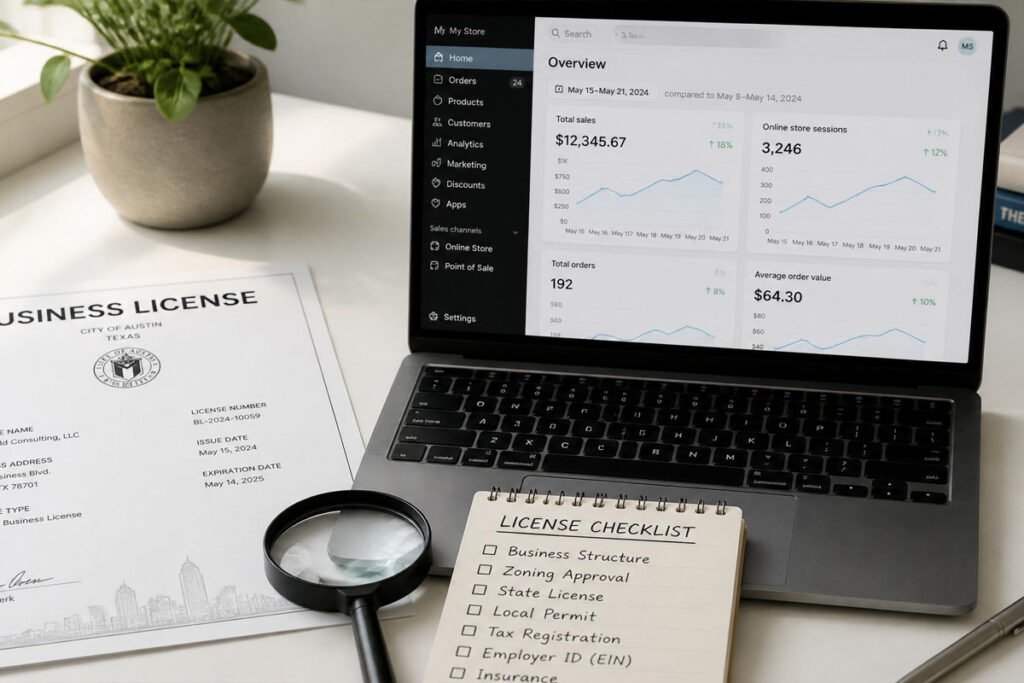
You built a store, listed your first products, and made your first sale — and now a nagging question won’t leave you alone: do you actually need a business license to sell online? It’s one of the most searched questions among new sellers, and for good reason. Marketplaces like Etsy, Amazon, and Shopify will let you open a shop in an afternoon without ever asking to see a license, which makes it easy to assume none is required.
That assumption is where most new sellers get into trouble. Platform rules and government laws are two completely different things. A platform only cares that your listing follows its policies; your city, county, state, and sometimes the federal government care whether you’re legally allowed to operate a business at all — and whether you’re collecting the sales tax you owe. If you’re building out a dropshipping store, a print-on-demand shop, or an affiliate marketing site, licensing is a step you can’t skip once real money starts moving.
This guide breaks down exactly when a license is required, which permits apply to online sellers specifically, and how to get compliant without hiring a lawyer.
Quick Answer
The short answer: yes, most online sellers need at least one license or registration, even if they never meet a customer in person or store inventory anywhere but their closet. What you specifically need depends on your location, your business structure, and what you sell. A hobby seller who occasionally lists a handful of items generally isn’t required to register as a business. A seller who’s actively trying to turn a profit — running ads, restocking inventory, building a brand — is treated as a real business by the IRS and by most local governments, which triggers general business license and sales tax registration requirements. Sellers of regulated goods, like food, alcohol, or supplements, face additional federal or state licensing on top of the basics.
Table of Contents
- What Counts as a Business License, and Why Selling Online Doesn’t Exempt You
- How to Tell If You’re a Hobby Seller or a Real Business
- The Licenses and Permits Online Sellers Actually Need
- How to Choose the Right Business Structure Before You Apply
- License Requirements by Platform (Etsy, Amazon, Shopify, eBay)
- How to Apply for a Business License Step by Step
- Common Mistakes New Online Sellers Make
- Expert Tips for Staying Compliant as You Scale
- Final Thoughts
- Frequently Asked Questions
What Counts as a Business License, and Why Selling Online Doesn’t Exempt You
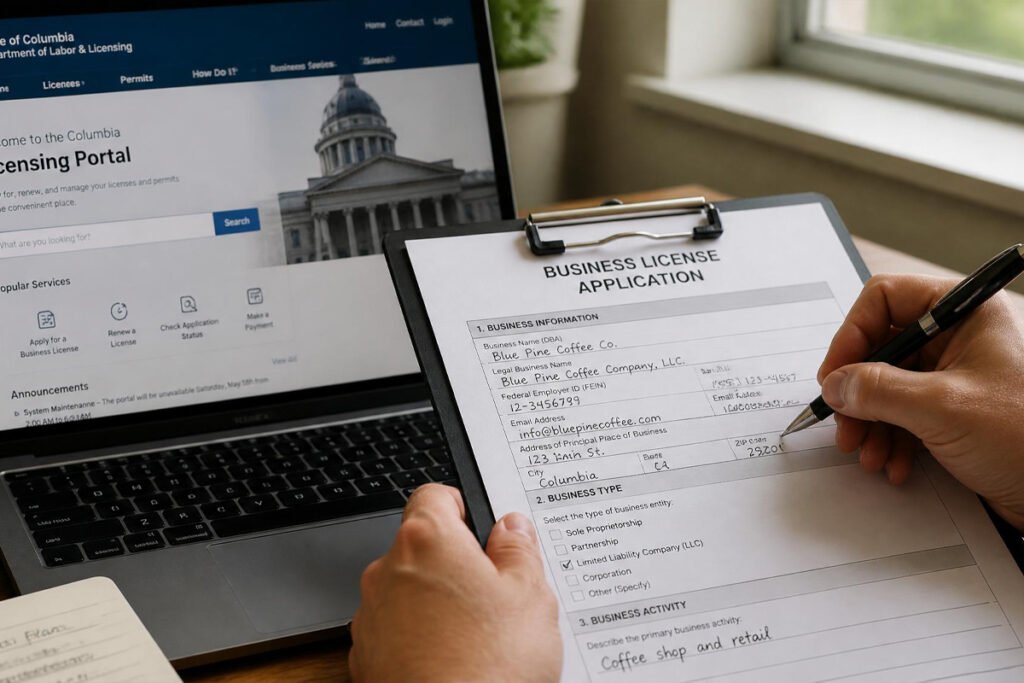
A business license is official permission from a government agency — city, county, state, or in some cases a federal regulator — to legally operate a business within its jurisdiction. It’s separate from your business structure (like an LLC) and separate from your seller’s permit; think of it as the base-level “yes, you’re allowed to do this here” approval that most local governments require of any commercial activity, home-based or not.
The mistake most new sellers make is assuming “online” means “no physical location, so no local rules apply.” In practice, your home office, garage, or spare bedroom is still your business location in the eyes of your city or county, and many municipalities require a home occupation permit alongside a general business license before you can legally run a commercial operation from a residential address. If you’ve read our guide on legal basics every new business owner must know, this will sound familiar — the same principle that applies to a home-based service business applies to an online store.
Selling exclusively through a marketplace doesn’t change this either. The platform is simply where the transaction happens; the legal responsibility for licensing sits with you as the seller, not with Etsy, Amazon, or Shopify.
How to Tell If You’re a Hobby Seller or a Real Business
Before you chase down licenses, it helps to know which side of the hobby-versus-business line you’re on, since that determines whether registration is even necessary yet.
- Are you trying to make a consistent profit, or just clearing out items you already own? Reselling a few personal items occasionally is generally treated as a hobby. Sourcing or making inventory specifically to resell is a business activity.
- Are you reinvesting revenue into ads, inventory, or tools? Active reinvestment is one of the clearest signals that you’ve crossed from casual selling into operating a business.
- Are you keeping records, tracking expenses, or planning to scale? Treating the activity like a business — even informally — usually means the law will too.
If you intend to earn a profit and are actively working toward it, it’s safest to assume licensing and tax rules apply, even before you’ve made your first dollar. This is also the point where many sellers start exploring related paths like freelancing or passive income projects — all of which carry the same underlying licensing logic once money starts moving with intent.
How to Choose the Right Business Structure Before You Apply
Before you fill out any license application, three quick questions will save you a lot of backtracking later:
- Are you operating under your own legal name or a brand name? Selling under anything other than your personal legal name usually requires a “Doing Business As” (DBA) registration before a license application will even go through.
- Do you want personal liability protection? Many online sellers eventually form an LLC once revenue grows, since it separates personal and business assets. If you haven’t decided yet, our step-by-step LLC guide walks through the full process.
- Where is your business legally based? Your home address, not your customers’ locations, generally determines which local and state licensing office you start with.
According to the U.S. Small Business Administration, licensing requirements and fees vary by business activity, location, and issuing agency, and most small businesses end up needing a combination of federal, state, and local approvals rather than a single license.

The Licenses and Permits Online Sellers Actually Need
There’s no single “online business license” — instead, online sellers typically deal with a stack of separate approvals. Here’s what applies most often:
General Business License
Issued by your city or county, this is the baseline permission to operate commercially in your area. It applies whether you sell out of a warehouse or a spare bedroom, and it’s usually inexpensive, often in the $50–$150 range depending on location.
Key Features:
- Required by nearly every municipality, including for home-based sellers
- Typically renewed annually
- Fees and rules vary significantly by city and county
Best For: Any online seller earning consistent revenue, regardless of platform.
Pros: ✅ Straightforward application ✅ Low cost in most areas ✅ Establishes legal legitimacy Cons: ❌ Requirements vary by every single city/county ❌ Easy to overlook if you assume “online” is exempt
Our Verdict: This is the license most new sellers miss entirely, because there’s no obvious trigger that tells you to apply. If you’re also researching structure at the same time, pair this step with our legal basics guide for new business owners so you’re not making two trips to the same offices.
Seller’s Permit (Sales Tax Permit)
If you sell taxable physical goods, most states require you to register for a seller’s permit — sometimes called a sales and use tax permit — before you can legally collect and remit sales tax.
Key Features:
- Required in nearly every state that charges sales tax
- Usually free to apply for through your state’s Department of Revenue
- Becomes mandatory once you hit a state’s “economic nexus” sales threshold, even without a physical presence there
Best For: Sellers of physical products, including dropshippers and print-on-demand sellers.
Pros: ✅ Free in most states ✅ Lets marketplaces and payment processors verify your compliance Cons: ❌ You may need one in multiple states as you scale ❌ Digital-only sellers face inconsistent rules state to state
Our Verdict: This is non-negotiable for anyone selling physical goods. If you’re running a dropshipping business, confirm your nexus obligations early — retroactive sales tax bills are one of the most common surprises for growing stores.
Home Occupation Permit
For sellers running their operation from a residential address, this permit confirms your home-based activity complies with local zoning rules.
Key Features:
- Confirms your business won’t create excessive traffic, noise, or storage issues in a residential zone
- Sometimes bundled with the general business license application
- Rules vary by whether you store inventory at home
Best For: Home-based sellers, especially those storing physical inventory.
Pros: ✅ Often low-cost or free ✅ Protects you from zoning complaints down the line Cons: ❌ Some residential zones restrict inventory storage or shipping volume ❌ Easy to forget since it’s rarely advertised
Our Verdict: If your online business shares an address with your home, don’t skip this step — zoning violations are one of the more preventable compliance issues sellers run into.
Industry-Specific or Federal Licenses
A small number of product categories require licensing regardless of where or how you sell.
Key Features:
- Applies to food, alcohol, tobacco, firearms, supplements, and a handful of other regulated categories
- Issued by specific federal agencies rather than local government
- Layered on top of, not instead of, your general and state-level requirements
Best For: Sellers in regulated product categories only.
Pros: ✅ Most online sellers never need to deal with this layer at all Cons: ❌ Penalties for skipping it in a regulated category can be severe
Our Verdict: If you’re outside food, alcohol, tobacco, firearms, or similarly regulated goods, this layer likely doesn’t apply to you — but it’s worth a five-minute check before launch if you’re in a gray area.
Comparison Table
| License Type | Who Needs It | Issued By | Typical Cost |
|---|---|---|---|
| General Business License | Nearly all online sellers | City/County | $50–$150/year |
| Seller’s Permit | Sellers of taxable physical goods | State Dept. of Revenue | Usually free |
| Home Occupation Permit | Home-based sellers | City/County zoning office | Free–$100 |
| Industry-Specific License | Regulated product categories only | Federal agency (varies) | Varies widely |
Business License Requirements by Different Platforms
Selling on Etsy or Amazon
Marketplaces handle sales tax collection and remittance in most states on your behalf, which leads many sellers to assume they’re fully covered. Platform-level tax collection doesn’t replace your general business license or, in some states, your own seller’s permit registration — it just handles one piece of the compliance picture.
Selling on Your Own Shopify Store
Once you control the storefront directly, the licensing responsibility sits entirely on you. Shopify doesn’t require a license to open a store, but that only means the platform itself has no gate — your city, county, and state rules still apply exactly as they would for any other business. This is especially relevant if you’re building out a broader print-on-demand or dropshipping operation where you’re the merchant of record.
Selling Through Freelance or Service Platforms
If your “online business” is really a service — consulting, design, writing, or similar work sold through your own site or a freelance marketplace — the licensing conversation looks a little different but isn’t skippable. Many service-based sellers also need a professional or occupational license depending on the field. Our freelancing business guide covers this distinction in more depth.
How to Get Licensed to Sell Online, Step by Step
Step 1: Confirm Hobby vs. Business Status
Before applying for anything, honestly assess whether you’re operating with profit intent. The IRS’s guidance on distinguishing a hobby from a business centers on whether the activity is carried on with the intention of making a profit, which affects both your tax treatment and whether licensing applies yet.
Step 2: Choose Your Business Name and Structure
Decide whether you’re operating as a sole proprietor under your own name, filing a DBA, or forming an LLC. This decision affects which forms you’ll file first.
Step 3: Apply for Your General Business License
Check with your city or county clerk’s office, or search your state’s official small business portal, to find the correct local application.
Step 4: Register for a Seller’s Permit
If you sell taxable physical goods, apply through your state’s Department of Revenue before you start collecting sales tax.
Step 5: Check for Home Occupation and Industry-Specific Requirements
Confirm zoning compliance if you’re home-based, and check for any federal licensing if your product category is regulated.
Common Mistakes New Online Sellers Make
Assuming the platform’s approval is the same as legal approval. Etsy, Amazon, and Shopify letting you open a store has nothing to do with whether your city or state considers you licensed. Treat platform onboarding and government licensing as two entirely separate checklists.
Ignoring sales tax nexus until it’s a problem. Many sellers only register for a seller’s permit in their home state, then get blindsided by an economic nexus threshold in another state once sales volume grows. Review your obligations regularly as revenue climbs, the same way you’d revisit operations and compliance basics as your business matures.
Skipping the home occupation permit entirely. Because it’s rarely advertised anywhere, this is the license most home-based sellers forget. If a neighbor ever files a zoning complaint, operating without it can create far more hassle than the permit itself would have.
Expert Tips for Staying Compliant as You Scale
Set calendar reminders for renewals before you forget them. Most licenses and permits require annual renewal, and a lapsed license can technically put you back in unlicensed territory without you realizing it.
Separate your business and personal finances the moment you register. Even as a sole proprietor, opening a dedicated business bank account makes your licensing, tax filings, and eventual LLC conversion far cleaner to manage.
Revisit your nexus map every time you hit a new sales milestone. Economic nexus thresholds are based on revenue or transaction volume in each state, so a strong sales month can quietly create a new registration requirement you didn’t have last quarter.
Final Thoughts
Best overall approach: register for your general business license and seller’s permit before your first serious sales push — it’s cheap insurance against fines later. Best for absolute beginners: start with the hobby-vs-business self-check, then only pursue licensing once profit intent is clear. Best for sellers already scaling: revisit your state-by-state nexus obligations quarterly rather than annually.
Whichever stage you’re at, licensing isn’t a one-time task — it evolves as your small business grows, adds product lines, or expands into new states. Treat it the same way you’d treat any other startup and online business roadmap step: something to revisit deliberately, not just set up once and forget.
<a id=”faq”></a>
Frequently Asked Questions
Do I need a business license to sell on Etsy? Most Etsy sellers who are operating with profit intent need at least a general business license from their city or county, even though Etsy itself doesn’t require you to show one to open a shop.
Do I need a business license to sell on Amazon? Yes, in most cases. Amazon collects and remits sales tax in many states on your behalf, but that doesn’t replace your own general business license or state registration obligations.
How much does a business license cost? Most general business licenses cost between $50 and $150 per year, though costs vary significantly by city, county, and industry.
Do I need a separate license for every state I sell in? Only if you have sales tax nexus there, which is usually triggered by physical presence or by crossing a state’s economic sales threshold — not simply by shipping a package there.
Can I sell online using just my Social Security Number? Yes, sole proprietors can typically operate using their SSN instead of an Employer Identification Number (EIN), though many sellers get an EIN anyway to avoid sharing their SSN with marketplaces and vendors.
Do I need a seller’s permit if I only sell digital products? It depends on the state. Some states tax digital goods and require a seller’s permit, while others exempt them entirely, so it’s worth checking your specific state’s Department of Revenue rules.
What happens if I sell online without a required license? Consequences vary by location but can include fines, back taxes, forced closure of the business activity, and in some states, misdemeanor charges for operating without required registration.
Do I need an LLC to sell online? No, an LLC isn’t required to sell online — you can operate as a sole proprietor — but forming one adds liability protection that many sellers pursue once revenue and risk increase. See our LLC formation guide for the full process.
Does dropshipping require a different license than holding inventory? Not fundamentally — the same general business license and seller’s permit rules apply. You’re still the merchant of record even if a supplier ships the product directly to your customer.
How long does it take to get a business license? Timelines vary widely by city and state, ranging from same-day online approval to several weeks for local offices that process applications manually. It’s worth starting the process 30–45 days before you plan to launch in earnest.
Author: Morne Winston Last Updated: July 2026