
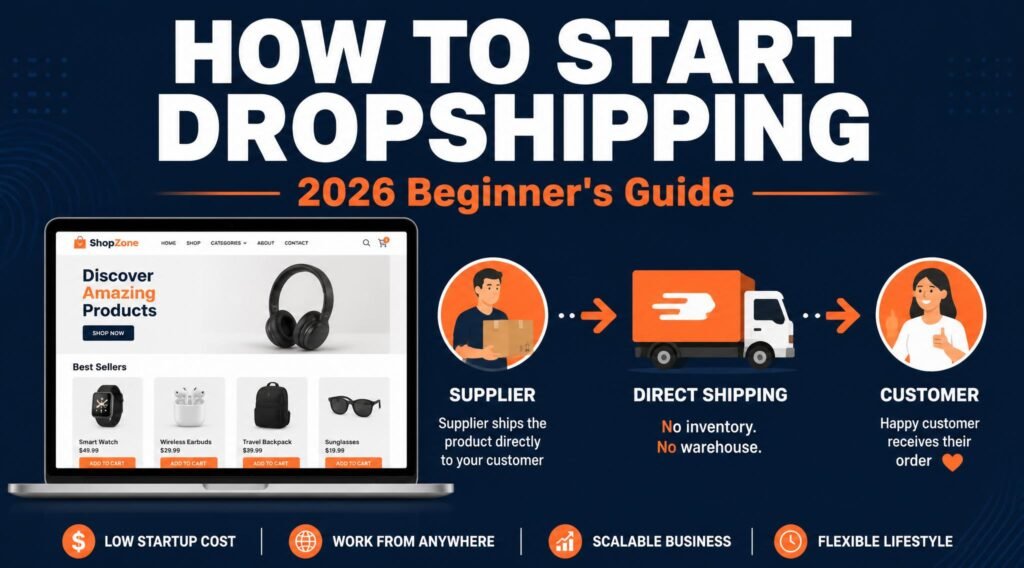
Starting a business with zero inventory, no upfront stock costs, and the freedom to work from anywhere — that is exactly what dropshipping offers. In 2026, dropshipping has evolved from a niche ecommerce hack into one of the most legitimate and scalable ways to build an online business from scratch.
But here is the truth most articles skip: dropshipping is not a “get rich quick” scheme. It is a real business model that requires strategy, research, and consistent effort. The good news? When done right, it can generate consistent income — even while you sleep.
This guide walks you through exactly how to start dropshipping in 2026, from understanding the fundamentals to making your first sale and scaling beyond it.
What Is Dropshipping? (And How Does It Work in 2026)
Dropshipping is a retail fulfilment model where you sell products online without ever holding inventory. Here is how the process works:
- A customer places an order on your online store.
- You forward that order to your supplier (automatically or manually).
- The supplier packs and ships the product directly to your customer.
- You keep the difference between what the customer paid and what the supplier charged you.
You are essentially the middleman — but a valuable one. You handle the storefront, the marketing, the customer experience, and the branding. The supplier handles warehousing and logistics.
Example: You sell a wireless phone charger for $39.99. Your supplier charges you $11.00. You keep $28.99 in gross profit per sale (before ad spend).
This model became widely popular because of its low barrier to entry — no warehouse, no bulk inventory purchases, and no massive upfront capital required. That said, understanding both the advantages and the challenges before you begin is essential.
Pros and Cons of Dropshipping in 2026
Advantages
- Low startup costs — You do not buy inventory until after you make a sale.
- Location independence — Run your store from anywhere with a Wi-Fi connection.
- Wide product selection — Test hundreds of products without financial risk.
- Scalable model — Add products or new stores without logistical headaches.
- Low overhead — No warehouse, no packing team, no shipping label printer.
Challenges
- Lower profit margins — Compared to holding your own inventory, margins are thinner.
- Supplier dependency — Stock issues, shipping delays, and quality problems are outside your control.
- High competition — Popular niches attract dozens of competing stores.
- Customer service responsibility — Even when the supplier makes a mistake, you are the face of your brand.
Knowing these trade-offs upfront allows you to build a more resilient dropshipping business from day one.
Step 1: Choose the Right Niche
The biggest mistake beginners make is picking a product before picking a niche. A niche is a specific, focused segment of a broader market — and choosing the right one determines everything from your supplier options to your ad targeting.
What Makes a Good Dropshipping Niche in 2026?
- Passionate buyers — Hobbies, pets, parenting, fitness, and home decor tend to attract emotionally engaged buyers.
- Repeat purchase potential — Consumables or products with accessories drive returning customers.
- Not overly saturated — Avoid “winning product” lists that have been circulating for 2+ years.
- Manageable product size — Heavy or fragile products increase shipping complications.
- Healthy price point — Products priced between $25–$150 tend to convert well while maintaining decent margins.
Niche Research Tools to Use
- Google Trends — Check whether interest in your niche is growing or declining.
- TikTok Creative Center — Identify viral product categories organically spreading.
- Amazon Best Sellers — A reliable indicator of what people are actively buying.
- Facebook Ad Library — See which dropshippers are actively advertising (if they are running ads, the niche converts).
Strong niches for 2026: pet accessories, smart home gadgets, eco-friendly products, home organization, posture and wellness tools, outdoor and adventure gear.
Step 2: Find Reliable Dropshipping Suppliers
Your supplier is the backbone of your business. A bad supplier means delayed shipments, poor product quality, and angry customers — all of which will destroy your store’s reputation before it gets started.
Top Dropshipping Supplier Platforms in 2026
1. AutoDS One of the most powerful automation platforms available today. AutoDS connects you to thousands of suppliers worldwide, automates order processing, and includes product research tools built in. Ideal for Shopify and eBay stores.
2. Spocket Spocket focuses on US and EU-based suppliers, which dramatically improves shipping times (2–7 days vs. 3–4 weeks from AliExpress). Excellent for stores targeting North American or European customers.
3. AliExpress / CJ Dropshipping Still relevant in 2026 for finding unique products at low cost. CJ Dropshipping in particular offers faster shipping than standard AliExpress and provides white-label packaging options.
4. Zendrop Built specifically for Shopify stores. Zendrop offers US-based warehousing for popular products, branded packaging, and automated fulfilment — making it ideal for building a branded experience.
5. SaleHoo A supplier directory with over 8,000 vetted wholesalers. Great for finding niche-specific suppliers that are not available on mainstream platforms.
What to Look for in a Supplier
- Processing times of 1–3 business days
- Clear return and refund policies
- Responsive customer support
- Product samples available (always order one before selling)
- Reviews and track record from other sellers
Step 3: Build Your Online Store
Once you have a niche and a supplier, you need a storefront. In 2026, building a professional dropshipping store has never been easier.
Best Platforms for Dropshipping Stores
Shopify remains the industry standard for dropshipping. It integrates natively with AutoDS, Zendrop, DSers, and dozens of other fulfilment apps. Plans start at $39/month and include everything you need: hosting, checkout, analytics, and mobile optimization.
WooCommerce (on WordPress) is a strong alternative if you prefer owning your platform. It requires more technical setup but offers complete customization with no monthly platform fee.
Wix eCommerce is worth considering for total beginners who want a simple drag-and-drop experience with basic dropshipping integrations.
For most beginners, Shopify is the recommended starting point due to its ease of use, large app ecosystem, and extensive support documentation.
Store Setup Checklist
- Purchase a professional domain name (use Namecheap or Google Domains)
- Choose a clean, fast-loading theme (Shopify’s free “Dawn” theme works well)
- Write a compelling About Us page that builds trust
- Set up clear Shipping Policy, Return Policy, and Privacy Policy pages
- Add a professional logo (use Canva or hire a freelancer)
- Enable multiple payment options (Shopify Payments, PayPal, Apple Pay)
- Install a trust badge app to increase checkout conversion
- Set up Google Analytics and Facebook Pixel before launching
Step 4: Select Your Winning Products
Product selection is where most dropshippers either win or lose. You are not guessing — you are researching with data.
The 5 Criteria for a Winning Dropshipping Product
- Solves a visible problem — Products that solve a frustration customers already have sell themselves.
- Has a wow factor — Something the customer has not seen everywhere already.
- Not widely available in retail stores — If it is at every Walmart, you cannot compete on convenience.
- Demonstrable in video — Converts extremely well on TikTok and Instagram Reels.
- Healthy margin — Aim for a minimum 30–40% gross margin after all costs.
Product Research Methods That Work in 2026
TikTok Organic Research: Search hashtags like #TikTokMadeMeBuyIt, #ProductReview, or niche-specific tags. Products with millions of views but few dedicated stores are goldmines.
Facebook Ad Spy Tools: Tools like Minea, AdSpy, or PiPiADS let you see which products are actively converting for other dropshippers — and how long they have been running ads (longevity indicates profitability).
AutoDS Product Research: Their built-in trending products feature filters by engagement, order volume, and supplier availability simultaneously.
Amazon Movers & Shakers: Updated hourly, this list shows products experiencing sudden surges in sales — often a leading indicator of viral potential.
Step 5: Price Your Products for Profit
Pricing is where many new dropshippers make a critical error — they price too low, thinking volume will compensate. It rarely does.
A Simple Dropshipping Pricing Formula
Selling Price = (Product Cost × 3) + Estimated Ad Spend Per SaleExample:
- Product cost from supplier: $12.00
- Baseline selling price: $36.00
- Estimated customer acquisition cost (ads): $8–12
- Net profit per sale: ~$14–18
This is a starting point. As you gather data on your actual conversion rate and ad costs, you will refine your pricing accordingly.
For a deeper breakdown of how to price your products for maximum profitability, read our guide: How to Price Your Products or Services: Complete 2026 Guide
Step 6: Drive Traffic to Your Store
Having a great store with great products means nothing if no one visits. Traffic is the fuel of your dropshipping business, and in 2026 you have more options than ever.
Paid Traffic: Fastest Path to Data
Meta Ads (Facebook and Instagram) remain the most powerful paid channel for dropshipping, particularly for visual products targeting specific demographics. The learning curve is steeper than it used to be, but the targeting capabilities are unmatched.
TikTok Ads have emerged as a dominant channel — lower cost-per-click than Meta, younger audience with high buying intent, and creative that doubles as organic content. If your product is demonstrable in 15–30 seconds, TikTok Ads should be your first channel.
Google Shopping Ads work best for products with high search intent — people who are already actively looking to buy something specific.
Organic Traffic: Free but Slower
SEO (Search Engine Optimization) — Writing product descriptions, blog content, and landing pages optimized for search terms your customers are already typing. If you are interested in building an online business that generates traffic without ad spend, read our complete guide: How to Start an Online Business from Scratch in 2026
TikTok Organic — Creating 30–60 second videos showing your product being used. When a video goes viral, the traffic spike can sell out virtual stock in hours. Multiple successful dropshippers have built six-figure businesses on organic TikTok alone.
Pinterest — Highly underrated for dropshipping in niches like home decor, fashion, beauty, and DIY. Pinterest users have high purchase intent and content has a much longer lifespan than other social platforms.
Influencer Partnerships — Micro-influencers with 5,000–50,000 engaged followers often convert better than mega-influencers, at a fraction of the cost. A product review or unboxing can generate immediate sales.
Step 7: Build a Marketing Plan
Driving traffic without a plan is like pouring water into a leaky bucket. Before you spend a single dollar on ads, map out your customer acquisition strategy.
Your marketing plan should answer:
- Who is your ideal customer? (age, interests, problems, platforms they use)
- Which channels will you use to reach them?
- What is your budget for the first 30 days?
- What metrics will you track? (ROAS, CPC, conversion rate, average order value)
- How will you retarget visitors who did not buy?
For a complete framework to document your strategy, visit: How to Write a Marketing Plan in 2026: Step-by-Step Guide with Free Template
Step 8: Handle Customer Service Like a Pro
In dropshipping, your supplier controls the fulfilment — but your customer only sees your brand. That means customer service excellence is your competitive advantage.
Customer Service Best Practices
- Respond within 24 hours — Ideally within a few hours. Speed builds trust.
- Set clear expectations — Be upfront about shipping times on your product page. A customer who knows shipping takes 7–12 days is far less frustrated than one who expected 3 days.
- Have a clear return policy — Even if your supplier does not accept returns, building a small “refund reserve” into your margins and offering hassle-free replacements will generate more positive reviews than disputes.
- Use help desk software — Tools like Gorgias (built for Shopify) or Freshdesk centralize all customer emails, chat messages, and social comments in one dashboard.
- Turn unhappy customers into loyal ones — A customer whose problem was solved quickly becomes a passionate advocate. A free replacement or discount on their next order costs you very little and builds enormous goodwill.
Step 9: Scale What Works
Once you have found a winning product and a profitable ad campaign, the next phase is scaling — carefully.
How to Scale a Dropshipping Store
Vertical scaling — Increase your ad budget incrementally on campaigns that are already profitable. Increase by no more than 20–30% every 48–72 hours to avoid disrupting the algorithm’s optimization.
Horizontal scaling — Duplicate your winning ad sets and test new audiences with the same creative. Expand to additional interest groups, lookalike audiences, and new geographic markets.
Add complementary products — Once customers trust your brand, upselling or cross-selling related products significantly increases average order value (AOV).
Launch email marketing — Every customer who buys from you is a lead for your next product. Build an email list from day one and use Klaviyo or Omnisend to automate post-purchase sequences, abandoned cart recovery, and promotional campaigns.
Explore passive income additions — A successful dropshipping store can also integrate affiliate marketing for products you do not dropship. Learn how: How to Start Affiliate Marketing in 2026: Complete Beginner’s Guide
Step 10: Manage Your Finances and Legal Setup
Many dropshippers neglect the business and legal side until problems arise. Do not make this mistake.
Register Your Business
Even as a solo operator, registering as an LLC provides personal liability protection and gives your business legitimacy with payment processors and suppliers. Learn more: How to Start an LLC in 2026: Step-by-Step Guide for Entrepreneurs
Open a Separate Business Bank Account
Keep personal and business finances separate from day one. This makes tax time dramatically simpler and gives you a clear picture of your actual profitability.
Understand Your Tax Obligations
In most countries, you are responsible for collecting and remitting sales tax on transactions within your jurisdiction. In the US, you will typically need to collect sales tax in any state where you have “nexus.” Consult an accountant or tax professional familiar with ecommerce.
Track Your Numbers Weekly
The metrics that matter most:
- Revenue — Total sales before expenses
- COGS (Cost of Goods Sold) — What you paid suppliers
- Gross Profit Margin — (Revenue – COGS) ÷ Revenue × 100
- Customer Acquisition Cost (CAC) — Total ad spend ÷ number of new customers
- Return on Ad Spend (ROAS) — Revenue generated per dollar of ad spend
- Net Profit — What is left after all expenses
Common Dropshipping Mistakes to Avoid
Even with a good plan, these mistakes trip up thousands of beginners every year:
1. Picking a niche based on personal interest, not market demand What you love and what the market will pay for are often different things. Validate first, commit second.
2. Selling branded or counterfeit products Selling products with trademarked logos (Nike, Apple, Supreme) without authorization is illegal and will result in account bans and potential legal action.
3. Ignoring shipping times in your marketing Advertising “fast shipping” when your supplier ships from overseas in 3–4 weeks is a guaranteed way to generate chargebacks and negative reviews.
4. Giving up after the first failed product Most successful dropshippers tested 5–10 products before finding a winner. The data from failed tests is valuable — it tells you what your audience does not want.
5. Not building an email list from day one Your ad account can be banned tomorrow. Your email list is yours forever. Start collecting emails from your first sale.
How Much Can You Earn Dropshipping in 2026?
Income potential varies enormously based on niche, product, marketing skill, and how aggressively you scale. Here is a realistic breakdown by stage:
| Stage | Monthly Revenue | Monthly Profit |
|---|---|---|
| Testing Phase (Month 1–2) | $0–$1,000 | -$200 to $200 |
| Getting Traction (Month 3–4) | $1,000–$5,000 | $200–$1,200 |
| Profitable Store (Month 5–8) | $5,000–$20,000 | $1,500–$6,000 |
| Scaling Phase (Month 9+) | $20,000–$100,000+ | $6,000–$30,000+ |
These numbers are achievable — but not guaranteed. They require consistency, willingness to learn from failures, and disciplined financial management.
For a broader view of income opportunities beyond dropshipping, explore: How to Make Money Online for Beginners in 2026: 10 Proven Ways That Actually Work
Frequently Asked Questions About Dropshipping in 2026
Is dropshipping still profitable in 2026? Yes — but the days of copying a product and running generic ads are over. Profitable dropshipping in 2026 requires branding, strong creatives, good supplier relationships, and genuine customer service.
How much money do I need to start dropshipping? You can technically start with as little as $100–$300 (store setup + first test ads). However, a realistic budget of $500–$1,500 for your first 60 days gives you enough runway to test multiple products and learn from the data.
Do I need a business license to start dropshipping? Requirements vary by country and state. In most places, you do not need a business license to start, but you will need one as your revenue grows. Registering an LLC early is strongly recommended.
Can I dropship on Amazon or eBay? Yes, both platforms allow dropshipping with conditions. Amazon requires that products ship within their expected timeframes and that you are listed as the seller of record. eBay has its own dropshipping policies. Many sellers use AutoDS to manage multi-channel dropshipping across Shopify, Amazon, and eBay simultaneously.
What is the best platform for dropshipping in 2026? Shopify remains the top choice for most beginners due to its ecosystem, ease of use, and fulfilment integrations. WooCommerce is the best alternative for those who want full ownership and lower ongoing costs.
Final Thoughts: Is Dropshipping Right for You?
Dropshipping is not the easiest path to online income — but it might be the most educational. Building a dropshipping store teaches you product research, copywriting, paid advertising, customer psychology, and business operations all at once.
The entrepreneurs who succeed are not the ones who found the “perfect product” on their first try. They are the ones who treated every failed test as tuition, refined their process, and kept going.
If you are serious about building an online business that can scale, generate income while you sleep, and operate from anywhere in the world — dropshipping in 2026 is absolutely worth your time and effort.
Start with one product. Learn the system. Scale what works.
Related Articles You Should Read Next
- 📌 How to Start an Online Business from Scratch in 2026
- 📌 15 Passive Income Ideas That Actually Work in 2026
- 📌 How to Make Money Online for Beginners in 2026
- 📌 How to Start Affiliate Marketing in 2026: Complete Beginner’s Guide
- 📌 25 Low-Cost Business Ideas with High Profit Margins in 2026
- 📌 How to Build a Personal Brand in 2026
- 📌 How to Write a Marketing Plan in 2026
- 📌 How to Price Your Products or Services: Complete 2026 Guide
- 📌 How to Start an LLC in 2026
- 📌 How to Write a Business Proposal That Wins Clients
Published by Ideas Junction | Category: Online Business Ideas © 2026 Ideas Junction – Your Hub for Startups, Business Growth & Innovation