
The appeal of print-on-demand is obvious: custom products, zero inventory, and no upfront manufacturing cost. What’s less obvious until you’re actually running a store is how much your chosen fulfillment partner affects everything downstream — product quality, shipping speed, customer complaints, and ultimately whether people order from you again.
If you’ve already looked into starting a print-on-demand business, the fulfillment company you pick is arguably the single most consequential decision in the entire setup, since it’s effectively your production team even though you’ll never speak to them directly. This guide compares the five print-on-demand companies sellers rely on most in 2026, broken down by what each one actually does best.
Quick Answer
The right print-on-demand company depends on what you’re prioritizing: quality, price, speed, or catalog size. Printful is the top overall pick for most new sellers, thanks to consistent product quality and an in-house production model that keeps quality control tighter than network-based competitors. Printify wins on catalog size and pricing, with over a thousand customizable products and generally lower base costs, making it especially popular with Etsy sellers. Gelato stands out for global sellers, routing orders to local production hubs in multiple countries to cut shipping times and costs for international customers. Gooten is built for established stores that need reliable automation and API-level control as order volume scales. Redbubble suits creators who want to sell without building a storefront at all, since it functions as a built-in marketplace rather than a fulfillment-only service.
Table of Contents
- What a Print-on-Demand Company Actually Does
- How to Choose the Right Fulfillment Partner
- Top 5 Best Print-on-Demand Companies
- Platform Comparison Table
- Best Print-on-Demand Company by Seller Type
- How to Launch Your First POD Product Step by Step
- Common Mistakes New POD Sellers Make
- Expert Tips for Choosing and Testing a Provider
- Final Thoughts
- Frequently Asked Questions
What a Print-on-Demand Company Actually Does
A print-on-demand company handles the parts of a physical product business you’d otherwise have to do yourself: printing your design onto the product, packaging it, and shipping it directly to your customer under your own branding. You never hold inventory or touch a physical product, which is exactly what makes this model appealing to sellers exploring online business ideas with limited upfront capital.
Providers generally fall into two categories worth understanding before you pick one: in-house providers like Printful print and ship from facilities they operate directly, giving tighter quality control, while network providers like Printify route your order to one of several third-party printers, which usually means lower prices but more variability in quality between orders.
How to Choose the Right Fulfillment Partner
- Do you care more about consistent quality or the lowest possible price? In-house providers tend to offer more predictable quality; network providers usually win on price but can vary between orders.
- Where are your customers located? A provider with production facilities near your customer base means faster, cheaper shipping — this matters far more once you’re selling internationally, similar to how affiliate marketers think about audience geography before choosing offers to promote.
- Do you want your own branded store, or are you fine selling on a shared marketplace? Marketplace-style options remove the need to build a storefront but limit your control over branding and customer relationships.
Top 5 Best Print-on-Demand Companies
1. Printful
Overview: Printful runs its own production facilities rather than routing orders through third-party printers, which is a big part of why it’s consistently rated the most reliable choice for product quality and brand consistency.
Key Features:
- In-house production facilities in the US, Europe, and Mexico for faster regional fulfillment
- Free to use with no monthly fee, plus an optional paid tier for extra discounts
- Built-in mockup generator to preview designs before committing to a sample order
Best For: New sellers who want the most consistent quality and are willing to pay slightly more for it.
Pros: ✅ Most consistent product quality due to in-house production ✅ No monthly fee required to get started ✅ Wide product range from apparel to home decor Cons: ❌ Generally pricier than network-based competitors ❌ Fewer ultra-niche product options than the largest catalogs
Our Verdict: If quality and brand consistency matter more to you than shaving a dollar off each item’s base cost, Printful remains the safest default choice for a new print-on-demand business.
2. Printify
Overview: Printify operates as a network connecting sellers to a large roster of print providers, giving access to over a thousand customizable products at generally lower prices than in-house alternatives.
Key Features:
- Catalog of 1,000+ customizable products across apparel, accessories, and home goods
- Competitive base pricing that often beats in-house providers
- Strong integration with Etsy and other major marketplaces
Best For: Etsy sellers and anyone prioritizing catalog size and lower base pricing.
Pros: ✅ Largest product catalog among major providers ✅ Generally the most affordable base pricing ✅ Strong marketplace integrations, especially Etsy Cons: ❌ Quality can vary between different print providers in the network ❌ Requires more research to pick the right specific provider for each product
Our Verdict: If you’re building a store on Etsy and want the widest possible product range at competitive prices, Printify’s catalog depth is hard to match — just expect to test a few providers within the network before settling on your go-to options.
3. Gelato
Overview: Gelato routes orders to local production hubs across multiple countries, which meaningfully cuts shipping time and cost for sellers with an international customer base.
Key Features:
- Local production network spanning numerous countries for faster regional delivery
- Strong sustainability positioning, with local production reducing shipping-related emissions
- No membership fee required to start selling
Best For: Sellers with a genuinely global customer base who want to avoid long international shipping times.
Pros: ✅ Fastest realistic shipping for international orders ✅ Reduces the customs and delay issues common with cross-border shipping Cons: ❌ Product catalog is smaller than Printify’s ❌ Quality can vary slightly between different regional production hubs
Our Verdict: If your audience spans multiple continents, Gelato’s local production model can meaningfully improve customer satisfaction in a way a single-country provider simply can’t match.
4. Gooten
Overview: Gooten positions itself as fulfillment infrastructure rather than a flashy storefront tool, with strong API integrations built for sellers who need automated, programmable order routing at real scale.
Key Features:
- Custom API integrations for wiring fulfillment directly into your store or middleware
- Catalog of 500+ products with transparent, no-membership pricing
- Built for reliability and automation rather than manual order-by-order management
Best For: Established stores with growing order volume that need fulfillment to run hands-free.
Pros: ✅ Strong developer-friendly API for automation ✅ Transparent pricing with no hidden membership fees ✅ Built to handle scaling order volume smoothly Cons: ❌ Less beginner-friendly than more storefront-focused providers ❌ Smaller brand recognition than Printful or Printify
Our Verdict: Not the right starting point for a first-time seller, but worth serious consideration once your small business has outgrown manual order management and needs real automation.
5. Redbubble
Overview: Redbubble functions as a built-in marketplace rather than a pure fulfillment service — you upload designs, and Redbubble handles both the selling and the fulfillment on its own platform, with no separate storefront required.
Key Features:
- No storefront setup required; designs go live directly on Redbubble’s existing marketplace
- Built-in buyer traffic from Redbubble’s own audience
- Handles printing, fulfillment, and customer service on your behalf
Best For: Artists and designers who want to start selling immediately without building or marketing their own store.
Pros: ✅ Fastest possible path from design to live listing ✅ Built-in marketplace traffic with zero marketing required to start Cons: ❌ Lower per-item profit margins than running your own store ❌ Minimal control over branding and customer relationship
Our Verdict: If you’re testing whether your designs sell at all before investing in a full branded store, Redbubble removes nearly every barrier to getting a first listing live today.
Platform Comparison Table
| Provider | Best For | Production Model | Standout Feature |
|---|---|---|---|
| Printful | Consistent quality | In-house | Tightest quality control |
| Printify | Etsy sellers, catalog size | Network | 1,000+ products, lower pricing |
| Gelato | International sellers | Network (local hubs) | Fastest global shipping |
| Gooten | Scaling stores | Network (API-first) | Automated, developer-friendly |
| Redbubble | Artists with no store yet | Marketplace | Built-in traffic, no setup |
Best Print-on-Demand Company by Seller Type
Brand-New Sellers Testing an Idea
Redbubble removes nearly every barrier to getting a first design live, making it the lowest-risk way to validate whether a niche or design style actually sells.
Etsy-Focused Sellers
Printify’s catalog depth and marketplace integrations make it the most commonly recommended choice specifically for Etsy-based dropshipping-style storefronts.
Brand-Focused Sellers Prioritizing Quality
Printful’s in-house production model gives the most consistent quality control, which matters most once you’re building a repeat-customer brand rather than testing one-off designs.
International or Scaling Stores
Gelato handles global shipping speed, while Gooten handles automation at volume — both worth exploring once your store has outgrown a single-provider setup.
How to Launch Your First POD Product, Step by Step
Step 1: Choose a Niche and Validate Demand
Research existing listings in your target niche before designing anything — competition is generally a sign of real demand, not a reason to avoid a category.
Step 2: Pick a Provider That Matches Your Priority
Use the comparison above to match your top priority — quality, price, speed, or ease of start — to the right provider rather than defaulting to whichever name is most familiar.
Step 3: Order a Sample Before Listing Publicly
Testing print quality, sizing, and shipping speed with a real sample catches problems before a customer ever sees them.
Step 4: Set Up Your Storefront or Marketplace Listing
Connect your chosen provider to a platform like Shopify or Etsy, or list directly on a marketplace-style provider like Redbubble if you’re skipping a standalone store.
Step 5: Launch, Monitor Reviews, and Adjust
Watch early customer feedback closely for quality or shipping complaints, and don’t hesitate to test a second provider if issues come up repeatedly.
Common Mistakes New POD Sellers Make
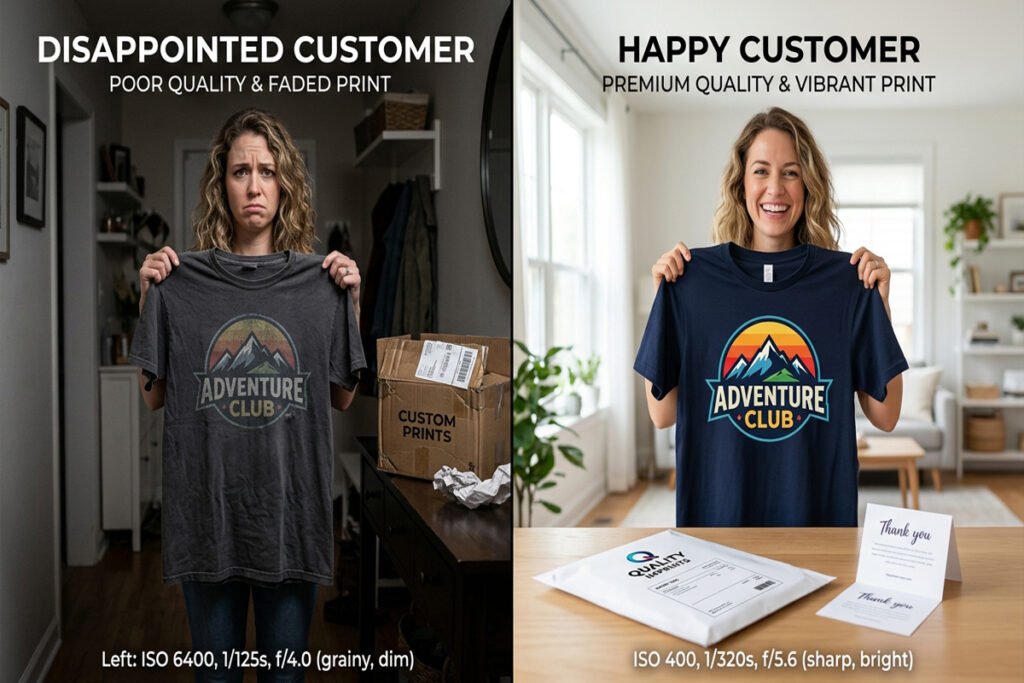
Skipping the sample order. Listing a product without ever seeing or holding a physical sample is one of the fastest ways to end up with unhappy customers over sizing, color accuracy, or print quality issues you never caught.
Choosing a provider based on price alone. The cheapest base cost doesn’t matter much if slow shipping or inconsistent quality drives returns and negative reviews that cost far more in the long run.
Ignoring shipping times for your actual customer base. A provider with fast US shipping isn’t much help if most of your traffic comes from Europe or Australia — match your provider’s production locations to where your customers actually are.
Forgetting to protect the business behind the store. Once a POD store is generating consistent revenue, it’s worth checking whether you need a business license to sell online, setting up proper accounting software to track margins, and considering basic business insurance as revenue grows.
Expert Tips for Choosing and Testing a Provider
Test more than one provider before committing fully. Ordering samples from two or three providers for your best-selling design gives you a real basis for comparison instead of relying entirely on other sellers’ reviews.
Factor shipping cost into your pricing from day one. POD shipping costs can meaningfully eat into thin margins if they’re not built into your pricing upfront, rather than treated as an afterthought once orders start coming in.
Revisit your provider choice as you scale. The provider that worked well for your first ten orders may not be the best fit at a hundred orders a month — periodically reassess against your evolving priorities, the same way you’d revisit any part of a growing online business or small business.

Final Thoughts
Best overall for most sellers: Printful, for the most consistent quality and brand reliability. Best for Etsy and budget-focused sellers: Printify, for catalog size and pricing. Best for international sellers: Gelato, for local production speed. Best for scaling automation: Gooten, for API-level control. Best for testing with zero setup: Redbubble, for the fastest path to a live listing.
Whichever provider you choose, pair it with real product research and a clear pricing and profit margin plan, since the fulfillment partner is only one piece of building a print-on-demand business that actually turns a profit.
<a id=”faq”></a>
Frequently Asked Questions
What is the best print-on-demand company for beginners? Printful is often recommended for beginners due to its consistent quality and no-monthly-fee starting model, while Redbubble offers an even lower-effort starting point for anyone testing designs before building a store.
Is Printful or Printify better? It depends on your priority — Printful generally offers more consistent quality through in-house production, while Printify offers a larger catalog and typically lower prices through its network model.
How much profit can you make with print-on-demand? Profit margins vary widely by product and pricing strategy, but many sellers target 20–40% margins after accounting for base cost, shipping, and platform fees.
Do print-on-demand companies charge a monthly fee? Most, including Printful, Printify, and Gelato, are free to use with no required monthly fee, charging only per order, though optional paid tiers offer extra discounts.
How long does print-on-demand shipping typically take? Domestic shipping commonly ranges from 2–5 business days for production plus standard shipping time, while international orders can take considerably longer depending on the provider’s production locations.
Can I use more than one print-on-demand provider at once? Yes, many sellers use multiple providers for different products, choosing whichever provider offers the best quality or pricing for that specific item.
Do I need my own website to sell print-on-demand products? No. Marketplace-style options like Redbubble let you sell without building a website, though a standalone store on a platform like Shopify or Etsy gives you more branding control.
How do I know if a print-on-demand provider has good quality? Ordering a sample yourself before listing publicly is the most reliable way to judge quality, since photos and reviews from other sellers only tell part of the story.
Can print-on-demand products be returned or exchanged? Policies vary by provider, and since you don’t hold inventory, you’re typically working within the provider’s own return and reprint policies rather than setting your own from scratch.
Is print-on-demand still profitable in 2026? Yes, though the market has grown more competitive, meaning sellers who find a specific niche and pair it with a well-matched fulfillment provider tend to outperform generic, broad-catalog stores.
Author: Morne Winston Last Updated: July 2026