
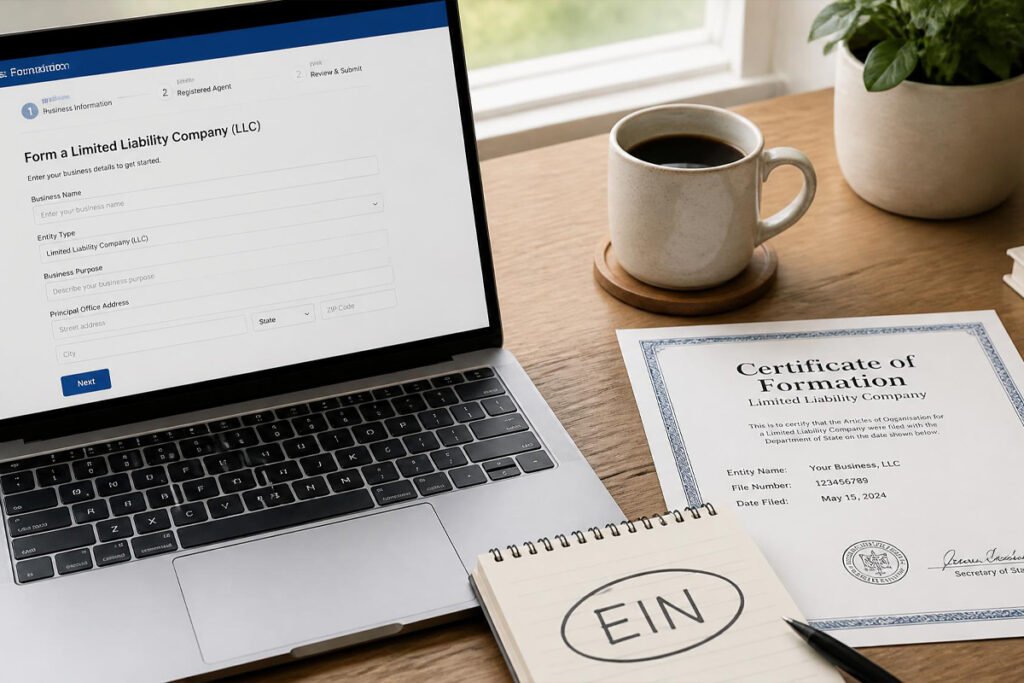
You’ve picked your business name, maybe even formed your LLC, and now a bank teller, a supplier, or a tax form is asking for a number you don’t have yet: your EIN. It’s a small piece of paperwork that quietly blocks almost everything else — opening a business bank account, hiring your first employee, filing certain tax forms — until it’s sorted out.
The good news is that getting an EIN is one of the few steps in starting a business that’s actually free, fast, and entirely under your control. There’s no waiting on a third party, no filing fee, and no legal review required. Most applicants finish in under fifteen minutes and walk away with the number immediately.
This guide walks through exactly how to get an EIN, in what order to do it relative to forming your LLC, what information the application actually asks for, and the mistakes that most commonly trip up first-time applicants. If you haven’t sorted out your broader business license requirements yet, it’s worth handling both around the same time — they’re separate steps, but new owners often assume one covers the other.
Quick Answer
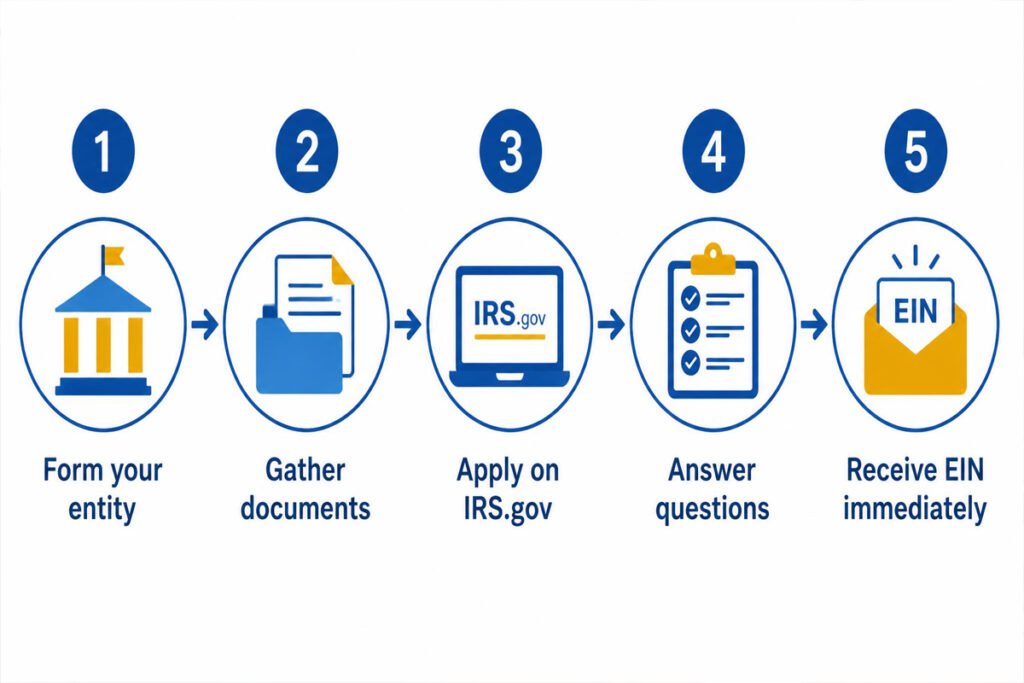
The fastest way to get an EIN is to apply directly through the IRS’s free online EIN assistant. It’s available Monday through Friday, 7 a.m. to 10 p.m. Eastern, and if your business is based in the U.S. and your responsible party already has a Social Security number or ITIN, you’ll receive your EIN immediately at the end of the session. Form your legal entity (LLC, corporation, etc.) with your state first — the IRS requires it to already exist before you apply. International applicants, or anyone who can’t use the online tool, can apply by fax or mail using Form SS-4, though both take noticeably longer. Never pay a third-party site for something the IRS gives away for free.
What Is an EIN, and Why Does It Matter?
An Employer Identification Number (EIN) is a nine-digit number the IRS assigns to identify your business for tax purposes — functionally, it’s the business equivalent of a Social Security number. It’s sometimes also called a Federal Tax Identification Number (FEIN).
You’ll be asked for it far more often than the name suggests. Despite the word “Employer” in the name, you don’t need to have any employees to get one, and plenty of solo founders apply for an EIN long before they hire anyone. Common situations where an EIN is required or strongly recommended include:
- Opening a business bank account (most banks require one, even for a single-member LLC)
- Hiring your first employee or contractor who needs a 1099
- Filing federal and state business tax returns
- Applying for business credit, loans, or a business credit card
- Registering with certain marketplaces, payment processors, or wholesale suppliers
If you’re a true sole proprietor with no employees and no plans to bring any on, you can sometimes use your personal Social Security number instead — but most people getting a free, separate EIN find it’s worth the ten minutes just to keep personal and business finances cleanly separated from day one. That separation matters even more once you’ve handled the legal basics every new business owner should know, since commingled finances are one of the fastest ways to undercut the liability protection an LLC is supposed to provide.
Do You Actually Need an EIN?
Before applying, confirm this step actually applies to you. You generally need an EIN if any of the following is true:
- You’ve formed an LLC, corporation, partnership, or nonprofit
- You have, or plan to have, any employees
- You file employment, excise, or alcohol/tobacco/firearms tax returns
- Your business has a Keogh plan or is involved with certain types of trusts
- You want to open a business bank account or apply for business credit
If none of these apply and you’re a single-member LLC or sole proprietor with no employees, an EIN is optional — but skipping it usually just delays a step you’ll need anyway once the business grows. If you’re still deciding on a business structure at all, our guide to starting an LLC covers that decision in more depth before you get to this step.
How to Get an EIN Online: Step-by-Step
Here’s the complete process, in order, for the fastest path to a free EIN.
Step 1: Form Your Legal Entity First
The IRS requires your business to legally exist before you apply for an EIN. If you’re forming an LLC, corporation, or partnership, complete that registration with your state first — the step-by-step LLC formation guide walks through this for all 50 states. Applying for an EIN before your entity is officially formed is one of the most common reasons applications get delayed or rejected.
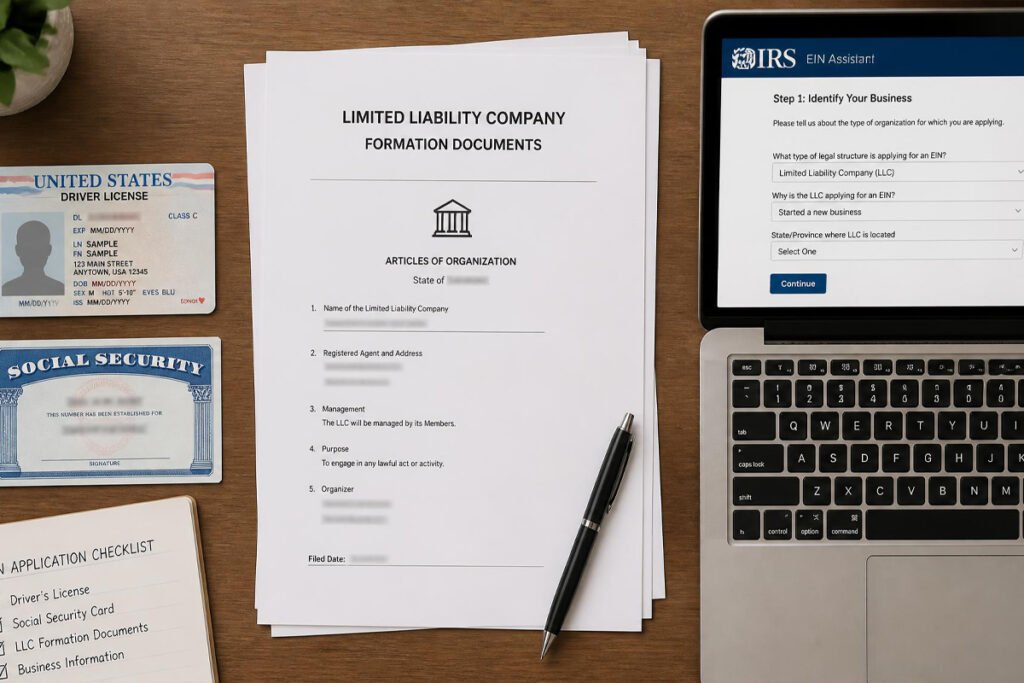
Step 2: Gather What You’ll Need
Have this information ready before you start — the online session times out if it sits idle too long, and the IRS doesn’t save partial applications:
- Your exact legal business name, including any suffix (LLC, Inc., Corp.)
- Your business address and mailing address, if different
- The name and Social Security Number (or ITIN) of your “responsible party” — generally the owner, general partner, or principal officer
- Your entity type and, for LLCs, the number of members
- A short description of what the business actually does
- The date the business started or was acquired
Step 3: Go to the IRS’s Official EIN Application
Apply directly at the IRS’s official Get an Employer Identification Number page. This is the only place to apply for free — plenty of third-party sites charge $50 to $300+ to fill out the exact same form on your behalf. The online tool is available Monday through Friday, 7 a.m. to 10 p.m. Eastern Time only.
Step 4: Select Your Entity Type
You’ll be asked to choose your business structure — sole proprietorship, LLC, corporation, partnership, or another entity type. This determines which follow-up questions you’ll see, so have your formation paperwork on hand to confirm the exact legal structure you registered.
Step 5: Enter Your Responsible Party’s Information
The “responsible party” is the person the IRS holds accountable for the entity and its funds — typically the owner for a sole proprietorship, a managing member for an LLC, or a principal officer for a corporation. This person needs a valid Social Security Number, ITIN, or existing EIN. Note that the IRS limits applicants to one EIN per responsible party per calendar day, regardless of how many businesses that person is forming.
Step 6: Answer the Application Questions
The remaining questions cover your business activity, whether you expect to have employees within the next 12 months, and your accounting period. Answer based on your actual near-term plans — you can update most of this information later if it changes, so don’t overthink projections you’re not certain about yet.
Step 7: Get Your EIN Immediately and Save Your Confirmation Letter
If you applied online and everything checks out, your EIN is issued immediately at the end of the session. Download and save the confirmation notice (Form CP 575) right away — it’s the only original copy the IRS issues. If you lose it later, you’ll need to call the IRS and request a replacement letter (Letter 147C) instead of simply reprinting it.
Alternative Ways to Apply (Fax, Mail, and Phone)
The online application is fastest, but it isn’t available to everyone. Use these alternatives if you can’t apply online:
- Fax: Complete Form SS-4 and fax it to the IRS. If you include a return fax number, you’ll typically receive your EIN within about four business days.
- Mail: Mail a completed Form SS-4. This is the slowest option, often taking four to five weeks.
- Phone (international applicants only): Applicants without a legal residence, principal office, or agency in the U.S. can apply by calling the IRS directly, since the online tool is restricted to U.S.-based applicants.
EIN vs. SSN vs. ITIN vs. State Tax ID: What’s the Difference?
New owners often lump every identifying number together, but each one serves a distinct purpose, and mixing them up is a common source of delayed applications:
- SSN (Social Security Number): Identifies you personally. Sole proprietors without an EIN can use their SSN for business taxes, but it ties your business identity directly to your personal one on every form.
- ITIN (Individual Taxpayer Identification Number): Issued to individuals who need a federal tax number but aren’t eligible for an SSN, often used by non-U.S.-citizen owners or the responsible party on certain applications.
- EIN (Employer Identification Number): Identifies your business entity at the federal level, issued by the IRS, and required for most LLCs, corporations, and partnerships.
- State Tax ID: A separate number many states issue for state-level tax obligations — sales tax, state income withholding, unemployment insurance — that exists alongside, not instead of, your federal EIN.
It’s easy to assume one number covers everything once you have it, but banks, the IRS, and your state each expect the right identifier for the right purpose. If you’re selling products directly to consumers, this is also a good moment to double-check whether you need a business license to sell online in addition to your state tax ID, since the two are often confused but serve different regulatory purposes.

EIN Requirements by Business Type
Not every business structure needs an EIN the same way. Here’s a quick reference:
| Business Type | Is an EIN Required? | Notes |
| Sole Proprietor (no employees) | Optional | Can use your SSN, but most banks prefer an EIN for a business account. |
| Single-Member LLC | Optional, but recommended | Needed to open most business bank accounts and to hire later. |
| Multi-Member LLC / Partnership | Required | Needed to file the required partnership return. |
| Corporation (S-Corp or C-Corp) | Required | Needed regardless of employee count. |
| Nonprofit / Tax-Exempt Org | Required | Needed before applying for 501(c)(3) status. |
Common Mistakes to Avoid
Paying a third-party site for something the IRS gives away free. Plenty of lookalike sites charge $50–$300 to submit the exact same free government form — a mistake similar to overpaying for business license paperwork you could have filed yourself directly with the issuing agency.
Applying before your entity is officially formed with your state. The IRS will often reject or delay applications where the legal entity doesn’t yet exist.
Letting the online session time out. The IRS online tool doesn’t save partial applications — have every piece of information ready before you start the clock.
Losing the CP 575 confirmation letter. This is the only original copy issued. Save a digital copy the same day you receive it, in the same place you keep your other formation documents.
Mismatching your legal business name. The name on your EIN application should exactly match your registered entity name, suffix included — a mismatch can cause issues later when opening accounts or filing licenses to sell online.
Expert Tips
Apply for your EIN the same week you finish forming your entity, even if you don’t plan to hire or open a bank account right away — it’s free, fast, and there’s no downside to having it ready.
Keep a single folder (digital or physical) for your CP 575 letter, formation documents, and any licenses, since you’ll be asked to produce this same paperwork repeatedly as you set up banking, payroll, and vendor accounts.
If you ever restructure your business — for example, converting a sole proprietorship into an LLC, or changing ownership — check whether you need a new EIN before assuming your existing one carries over automatically.
What to Do After You Get Your EIN
Getting the number is only the first step. Once you have it, most new owners move on to: opening a dedicated business bank account, registering for any remaining state and local business licenses your specific business type requires, and setting up basic bookkeeping so your EIN-linked accounts stay separate from personal spending from day one.
If your business involves in-person sales or services with any kind of specialized permit — a food truck, a drone photography operation, or work as a booth renter or roadside assistance provider — this is a good point in the process to confirm those requirements too, since they’re separate from your EIN and easy to overlook once the tax paperwork feels finished.
If you’re pitching clients rather than selling products, pair your new EIN with a properly registered business entity and a strong first impression — our guide on how to write a business proposal that wins clients and our breakdown of proposal software worth using both make that first client interaction look as legitimate as the paperwork now backing it.
Freelancers and service providers moving from side income to a formal business should also check our guide to starting a freelancing business, and anyone still working out of a spare room can compare notes with our guide to starting a small business from home — both cover the practical steps that typically follow right after your EIN is in hand.
Mobile and equipment-heavy businesses — think a mobile car detailing operation or a drone photography business — tend to need an EIN early since vendor accounts and equipment financing almost always ask for one. Once your tax and licensing paperwork is settled, our business operations and compliance guide and our roundup of passive income ideas that actually work are natural next reads for shaping what the business does once the paperwork stops being the bottleneck.

Final Thoughts
An EIN is one of the rare pieces of business paperwork that’s genuinely simple: it’s free, it’s fast, and once you have your formation documents ready, most of the work is just answering questions accurately. Apply directly through the IRS’s official EIN tool, save your confirmation letter the moment you receive it, and treat it as one checkbox in a slightly longer list that includes your business license and entity formation — not a substitute for either one.
Frequently Asked Questions
How much does it cost to get an EIN?
Nothing, if you apply directly through the IRS. Third-party sites that charge a fee are submitting the same free application on your behalf.
How long does it take to get an EIN?
Applying online gives you your EIN immediately, assuming your business is U.S.-based and your responsible party has a valid SSN or ITIN. Fax applications take about four business days; mailed applications can take four to five weeks.
Do I need an EIN if I’m a sole proprietor with no employees?
Not always — you can generally use your Social Security number instead. Most sole proprietors still get a free EIN anyway to keep business banking and taxes separate from personal finances.
Can I apply for more than one EIN in a day?
No. The IRS limits applicants to one EIN per responsible party per calendar day, regardless of how many entities that person is forming.
What if I lose my EIN confirmation letter?
Call the IRS Business & Specialty Tax Line and request a 147C letter, which verifies your previously issued EIN. It’s not a reprint of the original CP 575, but it serves the same purpose for banks and vendors.
Do I need to form my LLC before applying for an EIN?
Yes. The IRS requires your legal entity to already exist with your state before you apply. If you haven’t formed your LLC yet, start with our step-by-step LLC guide first.
Does my EIN expire?
No. Once issued, an EIN is permanent and tied to that legal entity for as long as it exists, even during periods when the business isn’t actively operating.
Can international applicants get an EIN?
Yes, but the online tool is restricted to applicants with a U.S.-based principal business, office, or agency. International applicants without a U.S. presence can apply by phone, fax, or mail.
Will I need a new EIN if my business changes ownership or structure?
Often, yes. Converting a sole proprietorship to an LLC, changing ownership structure, or certain other entity changes typically require a new EIN. Check current IRS guidance on when a new EIN is required before assuming your existing number carries over.
Is an EIN the same as a state tax ID?
No. An EIN is a federal number issued by the IRS. Many states also require a separate state tax ID for state-level tax filings — check this alongside your other state and local business license requirements.
Author: Morne Winston | Legal & Licensing | Last Updated: August 2026
Pingback: Best Project Management Software for Small Business: Top 6 Proven Picks | Ideas Junction – Your Hub for Startups, Business Growth & Innovation
Pingback: Best LLC Formation Services: Top 5 Picks Compared | Ideas Junction – Your Hub for Startups, Business Growth & Innovation