

A client pays your invoice, and the money lands in the same account that covers your groceries. Three months later your accountant asks which deposits were revenue, and nobody can answer cleanly. This is how most small business bookkeeping problems start: personal and business money sharing one account.
The fix is a dedicated account, but choosing among the best small business bank accounts is harder than it looks. Online platforms advertise $0 fees, traditional banks offer branches and cash handling, and the fine print on wires, balance minimums, and deposit insurance decides what you really pay.
This guide compares five proven options: Mercury, Relay, Bluevine, Chase Business Complete Banking, and Novo. For each one you’ll see what it costs, who it fits, and where it falls short. Nearly every bank asks for an EIN, so if you don’t have one yet, start with our guide on how to get an EIN for your small business. Once your account is open, pair it with the best accounting software for small business so every transaction is categorized from day one.
Quick Answer
The best small business bank account depends on how your business handles money. Mercury is the strongest default for online-first businesses: no monthly fee, no minimum balance, and free wires. Relay is better if you want separate accounts for taxes, payroll, and profit. Bluevine suits owners who hold larger balances and want interest. Chase works for businesses that take cash or want a branch. Novo fits online sellers who need invoicing and payment-platform integrations. Match the account to your daily workflow, then confirm current fees before you apply.

Table of Contents
- How the Best Small Business Bank Accounts Work
- How to Choose the Right Small Business Bank Account
- The 5 Best Small Business Bank Accounts
- Comparison Table
- Best Small Business Bank Accounts for Different Business Types
- How to Open a Business Bank Account Correctly
- Common Mistakes
- Expert Tips
- Final Verdict
- Frequently Asked Questions
How the Best Small Business Bank Accounts Work
A small business bank account is a checking account opened in your business’s name, typically tied to your EIN. Customers pay into it, you pay vendors and contractors from it, and whatever remains is profit. Because every transaction is a business transaction, your books stay clean and tax season stops being an excavation project.
Separation also matters legally. If you run an LLC, mixing personal and business funds can weaken the liability protection the LLC is meant to provide, though how courts treat this varies by state. A dedicated account is the simplest way to avoid the argument, and it creates a paper trail worth storing securely. Our guide to document security and recordkeeping tools for small business covers where to keep it.
There are two broad types. Traditional banks such as Chase hold your deposits directly and offer branches, cash handling, and in-person help. Fintech platforms such as Mercury, Relay, and Bluevine are software companies that partner with FDIC-insured banks, so they usually offer lower fees and better software but no branches. That distinction affects deposit insurance, which we cover next.
How to Choose the Right Small Business Bank Account
Three questions narrow the field quickly.
How do you get paid? If customers pay by card, ACH, or wire, an online account handles everything. If you take cash or paper checks, you need easy deposit options, which usually means a bank with branches or ATMs.
How much cash do you keep on hand? Larger balances raise two issues: interest and insurance. Standard FDIC coverage is $250,000 per depositor, per insured bank, per ownership category, as explained in the FDIC’s deposit insurance overview. Some platforms use sweep networks to spread deposits across several banks and extend that coverage, but conditions apply.
What do you need around the account? Check whether it connects to your accounting software, payment processor, and invoicing tools, and whether you need team cards or permissions.
One caution on fintech accounts: pass-through insurance protects you if the partner bank fails, not if the fintech company itself fails. For very large balances, understand exactly where your money sits.
The 5 Best Small Business Bank Accounts
We compared each account using providers’ published pricing and recent independent reviews as of October–November 2026. Fees and rates change, so confirm current terms before applying.
1. Mercury — Best Overall
Overview: Mercury is a financial technology platform, not a bank. Deposits are held at partner banks, including Choice Financial Group and Column N.A. It built its reputation with startups and LLCs through a clean dashboard, fast online applications, and no monthly fees.
Key Features:
- $0 monthly fee, no minimum balance, and no overdraft fees
- Free ACH transfers and domestic wires, plus USD international wires
- Up to $5 million in FDIC coverage through partner-bank sweep networks (conditions apply)
- Virtual and physical cards, invoicing, bill pay, and API access
Best For: LLCs, startups, and online-first businesses that don’t handle cash.
Pros: ✅ No monthly fees or minimums ✅ Free wires ✅ Strong software integrations
Cons: ❌ No branches or cash deposits ❌ Checking earns no interest, and certain industries don’t qualify
Our Verdict: Mercury is the safest default if your business runs mostly online. Setup takes little more than your EIN and formation documents. Connect it to your invoicing software and you have a clean path from sent invoice to deposited payment.
2. Relay — Best for Budgeting
Overview: Relay is another fintech platform with deposits held at a partner bank. Its core idea is splitting money into purpose-specific accounts, so taxes, payroll, and profit each get their own balance instead of sitting in one pile.
Key Features:
- Starter plan at $0 per month, with up to 20 checking accounts and two savings accounts
- Paid plans: Grow at $30 per month and Scale at $90 per month
- Debit cards with spending limits, plus a Relay Visa credit card earning 1% cash back on Starter
- Team permissions and accounting integrations
Best For: Owners who like envelope-style budgeting and teams that need controlled access.
Pros: ✅ Easiest structure for separating tax and profit money ✅ Generous free tier ✅ Useful team controls
Cons: ❌ Outgoing wires carry fees on the Starter plan ❌ No branches, and the best rates and cash back sit on paid plans
Our Verdict: Relay shines when your problem is discipline rather than features. Moving a slice of every payment into a tax account automatically keeps you honest. If you’re still working out what to charge, start with our guide on how to price a business proposal.
3. Bluevine — Best for Earning Interest
Overview: Bluevine is an online business checking platform known for paying interest on checking balances. Its Standard plan has no monthly fee, no minimum balance, and no overdraft fees.
Key Features:
- Standard plan at $0 per month, with a listed 1.3% APY when you meet a monthly activity goal (as of October 2026)
- Paid Plus and Premier plans offer higher yields, up to 3.0% APY, for a monthly fee
- FDIC coverage up to $3 million through a sweep network
- Optional lines of credit, underwritten separately
Best For: Owners who keep a meaningful cash cushion and want it earning something.
Pros: ✅ Interest on checking ✅ Free Standard plan ✅ Extended FDIC coverage through sweep
Cons: ❌ Weak for cash deposits ❌ The highest rates require paid plans, and rates are variable
Our Verdict: If you carry a few months of operating expenses in checking, Bluevine’s interest can beat a zero-yield account. Check the activity requirement for the rate you want. If you’re also weighing financing, compare it with our guide to the best small business loans.
4. Chase Business Complete Banking — Best for Cash and Branch Access
Overview: Chase is a traditional bank, which makes this the pick when you need in-person service. Business Complete Banking carries a $15 monthly fee that can be waived, and there’s no minimum deposit to open.
Key Features:
- $15 monthly fee, waivable through activities such as a $2,000 minimum daily balance, QuickAccept card-payment deposits, or Chase Ink card purchases (check Chase’s current list)
- Access to more than 15,000 ATMs and over 4,700 branches, per Chase
- No additional charge for deposits made at a Chase ATM
- Built-in card acceptance with same-day deposits
Best For: Restaurants, retail shops, trades, and service businesses that handle cash and checks.
Pros: ✅ Branches and ATMs nationwide ✅ Several ways to waive the fee ✅ Card acceptance built in
Cons: ❌ $15 fee if you can’t meet a waiver ❌ International wires are costly, with no multi-currency support
Our Verdict: Pay for Chase when physical access earns its keep. Cash-heavy launches such as food trucks gain the most, and licensing belongs on the same checklist. See our food truck business license guide before you open for business.
5. Novo — Best for Online Sellers
Overview: Novo is a digital-first platform for small businesses and online sellers, with banking services provided through Middlesex Federal Savings, F.A., Member FDIC. It aims to cut reconciliation work for owners who sell through online channels.
Key Features:
- $0 monthly fee and no minimum balance
- Free ACH transfers and incoming wires, plus ATM fee refunds up to $7 per month
- Built-in invoicing and integrations with platforms such as Stripe
- Up to 20 “Reserves” for splitting money into budgets
Best For: E-commerce sellers and freelancers who get paid through online platforms.
Pros: ✅ Built for online selling workflows ✅ No monthly fee ✅ ATM fee refunds
Cons: ❌ Beneficial owners generally need a Social Security number ❌ Limited international wire support
Our Verdict: Novo removes manual steps between a sale and a categorized deposit. Pair it with the right checkout stack from our guide to the best payment processors for online sellers and most reconciliation is handled before month-end.
Comparison Table
| Account | Best For | Monthly Fee | Interest on Checking | Branches / Cash |
|---|---|---|---|---|
| Mercury | Startups and LLCs | $0 | None | No branches or cash |
| Relay | Budgeting | $0 Starter ($30 Grow, $90 Scale) | Savings only | No branches |
| Bluevine | Earning interest | $0 Standard (paid plans higher) | 1.3% to 3.0% APY, conditions apply | No branches; limited cash |
| Chase Business Complete | Cash and branch access | $15, waivable | None | 4,700+ branches, 15,000+ ATMs |
| Novo | Online sellers | $0 | Varies by tier | No branches |
Figures reflect provider and review data as of October–November 2026. Always confirm current pricing.
Best Small Business Bank Accounts for Different Business Types
Freelancers and Service Providers
You need clean separation between personal and business money, simple invoicing, and an easy way to set tax money aside. Mercury, Relay, and Novo all fit. Marketplace payouts arrive as transfers, so free incoming ACH matters. See our roundup of freelance marketplaces for service providers for where that income comes from.
Tie each deposit to real work. Time tracking software shows what you billed, and e-signature software gives you a signed agreement behind every payment.
Online Sellers and Digital Creators
Novo is the natural first choice, with Mercury a strong alternative. Payment processors batch payouts, so look for accounts with free incoming transfers and good integrations. If you run a store without holding inventory, our guide to dropshipping tools covers the rest of the stack.
Creators selling downloads should read our list of the best digital products to sell online. Before the first sale, check whether you need a business license to sell online.
Startups and Growing Teams
Mercury offers investor-friendly tools and high FDIC coverage through sweep. Relay’s Grow and Scale plans add team controls, and Bluevine makes sense when idle cash is building up. As payroll and vendors multiply, so do risks.
Protect the business with our guide to the best small business insurance, keep work organized with project management software, and track customers with CRM software.

How to Open a Business Bank Account Correctly
Step 1: Prepare Your Documents
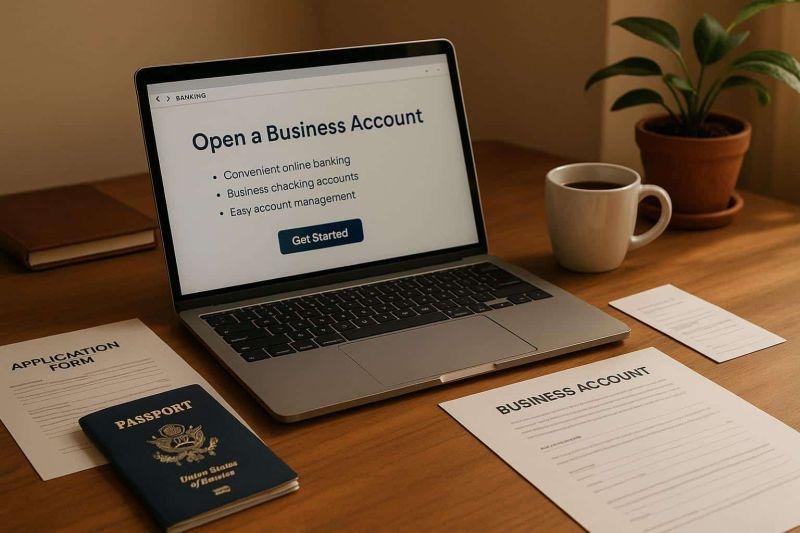
Most providers ask for your EIN confirmation letter, formation documents such as Articles of Organization, government photo ID for every owner, and proof of business address. Some also want an operating agreement. Several online providers expect a physical US address rather than a registered agent address, so check first.
Step 2: Compare the Fee Schedule
Read the full schedule, not the marketing page. Look at wire fees, cash deposit costs, balance requirements, and what happens if you miss a fee waiver.
Step 3: Apply
Online applications take minutes. The provider verifies the identity of every owner and signer. Traditional banks may prefer an in-person appointment.
Step 4: Wait for Approval and Fund the Account
Online providers commonly approve applications in one to five business days once your documents are in order. Make a small first deposit and confirm the routing and account numbers before pointing any payments at them.
Step 5: Connect Your Tools
Link the account to your accounting software, payment processor, and invoicing tool. Turn on multi-factor authentication and transaction alerts, and create a separate tax set-aside account if the platform supports one.
Common Mistakes
Choosing on the monthly fee alone. A $0 account can still cost you through wire fees, cash deposit charges, or international transfer markups. Total cost depends on how you use the account, not the headline fee.
Mixing personal and business money after opening. Paying for groceries from the business account undoes the whole point. Keep the separation strict and let accounting software categorize everything.
Assuming “FDIC-insured” covers everything. Pass-through coverage protects against partner-bank failure, not fintech failure. Keep your statements and agreements stored safely, using the recordkeeping tools we reviewed, in case you ever need to prove ownership of funds.
Expert Tips
Keep a backup account. Any provider can restrict an account during a compliance review. A second account at a different institution keeps payroll and vendor payments moving while you sort things out.
Automate your tax set-aside. Move a fixed percentage of every deposit into a separate account the day it arrives. You’ll never mistake tax money for profit.
Review your account every year. Fees, rates, and features shift often. If your deposits, balances, or cash handling have changed, so might the best account for you.
Final Verdict
For most owners, Mercury is the best all-round pick: no monthly fee, free wires, and strong FDIC coverage through sweep networks. Relay is best for budgeting, Bluevine for earning interest, Chase Business Complete Banking for cash and branch access, and Novo for online sellers. If you’re a beginner with an online business, Novo or Mercury will feel the most natural.
Once banking is sorted, protect the business with small business insurance, plan growth with small business loans, and keep your books accurate with accounting software.
Fees, rates, and eligibility change often. This article is general information, not financial advice, so confirm current terms with each provider before applying.
Frequently Asked Questions
What is the best bank account for a small business? There’s no single winner. Mercury is the best all-round pick for online-first businesses, Relay for budgeting, Bluevine for interest, Chase for cash and branches, and Novo for online sellers. Choose based on how you get paid and how much cash you keep on hand.
Do I need a business bank account as a freelancer? Sole proprietors can often operate without one, but a dedicated account is strongly recommended. It simplifies taxes and makes your income easy to prove. Our guide to freelance marketplaces for service providers shows where freelance payouts typically come from.
Can I open a business bank account online? Yes. Mercury, Relay, Bluevine, and Novo all accept online applications, and approval often takes one to five business days once your documents are ready. Traditional banks such as Chase may prefer an in-person visit in some situations.
What documents do I need? Typically an EIN confirmation letter, formation documents, ID for every owner, proof of business address, and sometimes an operating agreement. If you don’t have an EIN yet, follow our EIN guide first.
Are online business bank accounts safe? Reputable platforms hold deposits at FDIC-insured partner banks, and many add sweep networks for extra coverage. That insurance covers partner-bank failure, not the fintech itself. Keep balances at a level you’re comfortable with and consider a second account.
How much does a business bank account cost? From $0 to about $15 or more per month. Mercury, Novo, Relay Starter, and Bluevine Standard charge no monthly fee, while Chase charges $15 unless you meet a waiver. Also check wire, cash deposit, and international transfer fees.
Mercury or Relay: which is better? Mercury offers simplicity, free wires, and broad FDIC coverage through sweeps. Relay’s free plan gives you up to 20 checking accounts for budgeting. Choose Mercury for simple, startup-style needs and Relay if you want sub-accounts for tax and profit.
Can I use a personal account for my LLC? You can, but you shouldn’t. Mixing funds can weaken the liability protection an LLC provides and makes bookkeeping harder. Open a dedicated account as soon as you have your EIN. This is general information, not legal advice.
Author: Morne Winston
Last Updated: November 2026