

A client wants proof of coverage before they’ll sign the contract. A customer trips over a loose floor mat. A project you thought was finished turns into a dispute and a lawyer’s letter. Most owners don’t shop for coverage until one of these moments forces the issue, and a rushed purchase usually means overpaying or missing something important.
Finding the best small business insurance is harder than it should be, because the market is split into very different kinds of providers. Some sell app-based policies you can buy in minutes. Others are long-established carriers with deep claims departments. A few sell coverage by the hour, and marketplaces will shop several carriers on your behalf. Each model suits a different kind of business.
If you’ve already formed your company with our step-by-step LLC guide and sorted out permits using our business license guide, insurance is the next layer of protection. Below, we compare five proven options, explain what each policy type actually does, and walk through how to buy without leaving gaps.
Note: This guide is general information, not insurance or legal advice. Coverage, pricing, and availability vary by state, industry, and carrier, so confirm details with the insurer or a licensed agent before you buy.
Quick Answer
The best small business insurance depends on how your business earns money and what could hurt it most. Consultants and freelancers who face professional-negligence claims usually do well with Hiscox. Owners who want fast, low-friction online coverage for common risks often start with ERGO NEXT (formerly Next Insurance). Businesses with employees, where workers’ compensation matters, tend to lean toward The Hartford. Gig workers and seasonal operators can buy short-term coverage through Thimble, and owners with complicated risks can compare several carriers through Insureon. The guiding principle: match the policy to your biggest risk first, then compare price and claims service.
Table of Contents
- What Is Small Business Insurance?
- How to Choose the Right Small Business Insurance
- Best Small Business Insurance Companies in 2026
- Comparison Table
- Best Small Business Insurance by Business Type
- How to Buy Small Business Insurance Correctly
- Common Mistakes to Avoid
- Expert Tips
- Final Verdict
- Frequently Asked Questions
What Is Small Business Insurance?
Small business insurance is a set of policies that pay for specific financial risks your company faces, such as lawsuits, property damage, injured employees, or data breaches. Instead of absorbing a five-figure claim out of pocket, you pay a smaller premium and the insurer handles covered losses up to your policy limits.
Most owners run into the same handful of coverage types:
- General liability: covers claims that you caused bodily injury or property damage to someone else.
- Professional liability (errors and omissions): covers claims that your advice or work was negligent or cost a client money.
- Business owner’s policy (BOP): bundles general liability with business property and business income coverage, usually for less than buying each separately.
- Workers’ compensation: pays medical costs and lost wages for employees hurt on the job, and is required in many states once you hire.
- Commercial property, auto, and cyber: protect your equipment, work vehicles, and data.
Premiums depend on your industry, location, revenue or payroll, coverage limits, and claims history. One industry guide puts typical small business premiums at roughly $700 to $3,800 per year, but your own quote could land well outside that range.
Insurance also isn’t the same thing as a business structure. An LLC can separate your personal assets from certain business debts, but it doesn’t replace coverage for accidents, claims, or lost income. For the bigger legal picture, read our legal basics for new business owners.
How to Choose the Right Small Business Insurance
Ask yourself three questions before you request a single quote.
1. What could realistically hurt my business? A consultant’s biggest exposure is a client claiming bad advice cost them money. A shop owner worries about customer injuries and inventory. A company with staff has to think about workplace injuries. Rank your risks first, because that tells you which policy to prioritize.
2. Who is asking for proof of coverage? Landlords, clients, event venues, and lenders often require specific policies and limits. The U.S. Small Business Administration’s guide to business insurance recommends talking with insurance agents, comparing terms and prices, and revisiting coverage whenever your operations change.
3. Do I want speed or advice? Digital-first insurers let you quote and buy in minutes. Agents and marketplaces take longer but can explain trade-offs on complicated risks.
Have your basics ready before you start: legal business name, address, estimated revenue, employee count and payroll, and your EIN if you have one. If you don’t, our free EIN guide walks through getting one.
Best Small Business Insurance Companies in 2026
These five cover the main ways owners actually buy coverage. We weighed breadth of coverage, buying experience, financial backing, and reported claims experience, using provider information and independent reviews. Prices shown are advertised starting points, not typical quotes.
1. ERGO NEXT (Formerly Next Insurance): Best Overall for Fast Online Coverage
Overview: Next Insurance built its reputation on letting small businesses buy several policies online without a broker. It’s now part of the ERGO Group, a Munich Re company, and is rebranding as ERGO NEXT, so you’ll see both names. The company advertises general liability starting around $19 a month, with final pricing depending on your trade, location, and limits.
Key Features:
- Online quotes and purchase, with policy management through a website and mobile app
- Broad lineup: general liability, BOP, workers’ compensation, commercial auto, professional liability, property, and tools and equipment
- Easy access to certificates of insurance
- Coverage tailored to many small trades and professions
Best For: Solo operators and small teams that want common coverages from one fast, digital provider.
Pros:
✅ Quick, mostly online process
✅ Wide range of policy types in one place
✅ Low advertised entry pricing
Cons:
❌ Some reviewers describe claims support as the weak spot
❌ Exclusions and limits can be strict for higher-risk or complex businesses
Our Verdict: For most new owners with straightforward risks, ERGO NEXT is the easiest place to start. Read your exclusions closely, and keep your paperwork organized alongside your invoicing software so proof of coverage and client billing live in one workflow.
2. Hiscox: Best for Professional Liability and Consultants
Overview: Hiscox traces its roots to 1901 and holds an AM Best A (Excellent) rating. It’s best known for professional liability, the coverage that protects you when a client claims your work caused a loss. Online, you can buy general liability, professional liability, a BOP, or cyber coverage. Published starting prices include roughly $30 a month for general liability and $22.50 a month for professional liability.
Key Features:
- Specialty strength in professional liability (errors and omissions)
- Online options for general liability, BOP, professional liability, and cyber
- Published entry-level pricing
- After-hours customer support
Best For: Consultants, freelancers, designers, agencies, and other professional-service businesses.
Pros:
✅ Deep expertise in errors and omissions coverage
✅ Strong financial-strength rating
✅ Transparent starting prices
Cons:
❌ Limited online product menu, so some coverage may require an agent
❌ One independent review noted higher-than-expected complaint volume on general liability and property coverage between 2022 and 2024
Our Verdict: If your main risk is a client dispute rather than a customer injury, Hiscox is a strong specialist. Service providers also need sound pricing and contracts, so pair coverage with our guide to pricing a business proposal and our roundup of the best freelance marketplaces for service providers.
3. The Hartford: Best for Businesses With Employees
Overview: The Hartford began as a fire insurer in 1810 and sells a full range of commercial coverage. Its customizable BOP is a standout, letting you add options such as data breach and professional liability coverage, and workers’ compensation is one of its signature lines. Online quotes are mainly available for BOPs and workers’ comp, while other lines may go through an agent.
Key Features:
- Customizable business owner’s policy
- Workers’ compensation with strong market presence
- Wide product range, including commercial auto and professional liability
- Strong AM Best financial-strength rating
Best For: Businesses with employees, and owners who want an established carrier with a full menu.
Pros:
✅ Highly customizable BOP
✅ Strong financial backing
✅ Deep workers’ compensation experience
Cons:
❌ Online quoting is limited to certain lines
❌ Customer satisfaction scores in a 2025 industry survey were reported as below average
Our Verdict: Workers’ comp premiums are generally tied to payroll and job classification, so accurate wage and hours records matter when you’re quoted and audited. Good records start with the right time tracking software.
4. Thimble: Best for Gig Workers and Short-Term Coverage
Overview: Thimble sells coverage by the hour, day, month, or year depending on the trade, and issues a certificate of insurance shortly after you pay. It’s an insurance producer that places policies with carriers rather than an insurer itself. That makes it handy when a venue emails at 9 a.m. demanding proof of insurance for a 2 p.m. event.
Key Features:
- Short-term and on-demand options (availability varies by trade)
- General liability, professional liability, BOP, property, workers’ compensation, cyber, equipment, and event coverage
- Quick online quotes and certificates
- Flexible terms you can change or cancel
Best For: Freelancers, event vendors, gig workers, seasonal operators, and anyone testing a side business.
Pros:
✅ Flexible terms that match irregular work
✅ Fast proof of insurance
✅ Low commitment for part-time ventures
Cons:
❌ Short-term pricing isn’t always cheaper than an annual policy if you work year-round
❌ A certificate only helps if the policy matches the limits and endorsements your contract requires
❌ Some reviewers report frustrating support experiences
Our Verdict: Thimble shines for occasional, job-based work. If you fly drones for clients, read our drone photography license guide, and if you sell at events, our food truck license guide covers the permits that sit alongside your coverage.
5. Insureon: Best Marketplace for Comparing Multiple Carriers
Overview: Insureon is an independent online marketplace based in Chicago that lets you compare quotes from several carriers. Its listed carriers include Acuity, Chubb, The Hartford, Hiscox, Liberty Mutual, and Travelers. Applications are followed up by an insurance expert, so expect more human contact than with instant-bind insurers.
Key Features:
- One application, multiple carrier quotes
- Wide policy range, from general and professional liability to commercial auto
- Expert follow-up to confirm your coverage options
- Useful when one insurer declines your business
Best For: Owners with several policy needs, unusual trades, or who want someone to explain the options.
Pros:
✅ Multiple carriers in a single process
✅ Human guidance on coverage choices
✅ Helpful for harder-to-place risks
Cons:
❌ Slower than buying instantly from a digital insurer
❌ Some reviewers report slow or unresponsive agents
Our Verdict: Insureon makes sense when your risks are complicated or you want options side by side. Once you buy, store policies and certificates with the tools in our document security and recordkeeping guide, and cross-check requirements against our business licenses and legal documents guide.

Comparison Table
| Provider | Best For | Strongest Coverage | Buying Style | Advertised Starting Point |
|---|---|---|---|---|
| ERGO NEXT | Fast, digital coverage | General liability, BOP, workers’ comp, auto | Fully online | General liability from about $19/mo |
| Hiscox | Consultants and professionals | Professional liability | Online or advisor | General liability from about $30/mo; E&O from $22.50/mo |
| The Hartford | Businesses with employees | BOP, workers’ comp | Online for BOP and workers’ comp; agent for other lines | Quote-based |
| Thimble | Gig and seasonal work | Short-term liability, equipment, events | Fully online, hourly to annual | Quote-based |
| Insureon | Complex or multi-policy needs | Multi-carrier options | Online plus expert follow-up | Varies by carrier |
Starting prices are provider-advertised figures that can change. Most businesses will pay more once limits, location, and risk are factored in, so always compare real quotes.
Best Small Business Insurance by Business Type
Home-Based and Online Sellers
Home-based owners often assume their homeowners or renters policy covers business activity, but those policies commonly limit or exclude it, so check your policy before relying on it. Online sellers usually need general liability, product liability, and coverage for inventory and equipment. Marketplaces can also require commercial liability coverage once your sales pass certain thresholds, so check each platform’s current seller policy. Start with our guide on whether you need a business license to sell online, then review the best payment processors for online sellers and our Amazon FBA tools roundup as your store grows.
Consultants, Freelancers, and Service Providers
If you sell expertise, professional liability is usually the policy that matters most, often paired with general liability. Client contracts frequently spell out required coverage limits, so read them before you buy. Tighten your paperwork with our best business proposal software and our best e-signature software for small business, so insurance requirements are documented before work begins.
Mobile, Event, and In-Person Businesses
Food trucks, trainers, and mobile service providers face injury, equipment, and vehicle risks that a basic policy may not address. Personal auto policies often exclude business use, so ask about commercial auto if you drive for work. Permits and coverage go hand in hand: see our food truck permit guide, our guide to the personal training business license, and our explainer on booth renter licensing.
How to Buy Small Business Insurance Correctly
Step 1: Prepare
List your biggest risks, your assets, and any contracts or leases that mention insurance. Gather your business name, address, revenue estimate, payroll, and number of employees. Decide on a monthly budget range so quotes don’t surprise you.
Step 2: Check What’s Required
Confirm your state’s workers’ compensation rules, your landlord’s requirements, and any client or lender minimums. If you plan to borrow, ask the lender which coverage it expects, because loan programs commonly require certain policies.
Step 3: Get Multiple Quotes
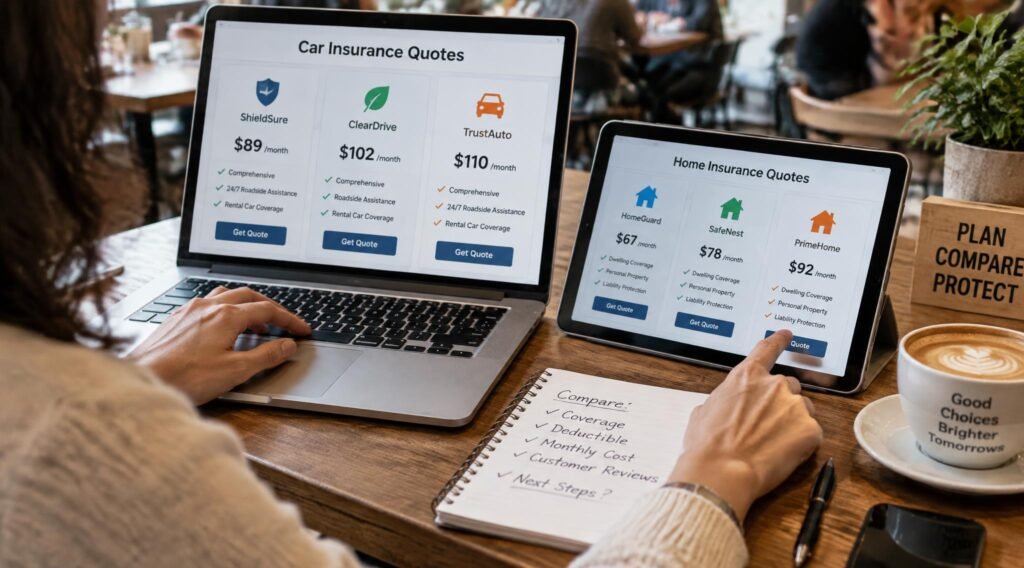
Request at least three quotes using the same limits and deductibles so you’re comparing like with like. Mix one fast online insurer with one agent or marketplace to see how pricing and advice differ.
Step 4: Review Before You Pay
Read the exclusions, limits, and deductible, not just the premium. For professional liability, ask whether the policy is claims-made, which affects when a claim must be reported. Confirm you can get certificates of insurance quickly.
Step 5: Bind, Store, and Review
Save the full policy, declarations page, and certificates somewhere you can find them fast. Put the renewal date on your calendar, and update your insurer whenever you hire, move, add equipment, or launch a new service. Budgeting is easier with the right accounting software.
Common Mistakes to Avoid
Waiting until a client asks. Scrambling for coverage with a deadline looming means accepting whatever is available. Buy before you need it, and keep your contracts organized with e-signature software so insurance clauses don’t get missed.
Buying on price alone. The cheapest policy can come with low limits, narrow coverage, or slow claims handling. Compare exclusions and financial strength alongside premium, and revisit your business license and legal document requirements so nothing falls through the cracks.
Forgetting your equipment. Your laptop and gear may be your most expensive assets, and standard liability policies don’t cover theft or damage to them. Check equipment or property coverage, especially if you’re shopping for the best business laptops for entrepreneurs.
Expert Tips
Bundle where it makes sense. A BOP often costs less than buying general liability and property separately, and some carriers discount bundled policies. Just make sure the bundle includes the coverage you actually need.
Revisit coverage every year. Revenue, headcount, and services change. An annual review keeps limits aligned with reality and can surface savings. If you’re planning an eventual exit, keep records organized with help from our overview of legal documents needed to sell a business.
Ask about claims before you buy. Ask how claims are filed, how fast adjusters respond, and what’s excluded. The claims experience is the product you’re really buying, and it’s the area reviewers most often flag.

Final Verdict
There’s no single winner, but there is a right fit for each owner. For the best small business insurance overall, ERGO NEXT is the easiest starting point for straightforward risks. Hiscox is best for professionals, The Hartford for businesses with employees, Thimble for short-term and gig work, and Insureon for complex risks or side-by-side comparisons.
Whichever you choose, protect the rest of your setup too: review our legal basics for new business owners, keep your books in order with the best accounting software for small business, and revisit your LLC setup as you grow.
Frequently Asked Questions
What is the best small business insurance for a new LLC?
Most new LLCs start with general liability or a BOP, then add professional liability if they sell services, and workers’ compensation once they hire. The best small business insurance for your LLC depends on your trade, contracts, and state rules. Compare at least three quotes using identical limits before choosing.
Do I need business insurance if I work from home?
Usually yes, because homeowners and renters policies often limit or exclude business activity, especially client injuries and business equipment. A home-based business policy or BOP can fill that gap. Check your existing policy wording and ask your insurer directly rather than assuming you’re covered.
How much does small business insurance cost?
It varies widely by industry, location, revenue, payroll, and limits. Some providers advertise general liability from about $19 to $30 a month, while one industry guide cites typical annual costs of roughly $700 to $3,800. Higher-risk trades and employers pay more. Only a real quote gives your actual price.
What’s the difference between general liability and a BOP?
General liability covers third-party injury and property damage claims. A business owner’s policy bundles general liability with commercial property and business income coverage, typically at a lower combined price. A BOP suits many small businesses, but specialized risks may still need separate policies.
Is professional liability the same as general liability?
No. General liability handles injuries and property damage. Professional liability, also called errors and omissions, covers claims that your advice or services were negligent or cost a client money. Consultants, designers, and agencies often need both.
Does my LLC mean I don’t need insurance?
No. An LLC can help separate personal and business liabilities in some situations, but it doesn’t pay for accidents, lawsuits, property damage, or lost income. Insurance and legal structure work together. Many landlords and clients also require proof of coverage regardless of your structure.
How fast can I get a certificate of insurance?
Digital insurers and platforms such as Thimble and ERGO NEXT can often issue certificates quickly after purchase, sometimes the same day. Agents and marketplaces may take longer if underwriting review is needed. If you have a deadline, confirm timing before you pay.
Do I need workers’ compensation for part-time or contract help?
Rules vary by state and depend on how workers are classified and how many people you employ. Misclassifying employees as contractors can create costly problems. Check your state’s workers’ compensation agency or ask a licensed agent before assuming you’re exempt.
What should I do if my claim is denied?
Read the denial letter and your policy wording, then ask the insurer for a written explanation. Gather supporting documents and file an appeal if you believe the loss is covered. You can also contact your state’s department of insurance if you think the denial was improper.
Do mobile businesses need commercial auto insurance?
Often yes. Personal auto policies commonly exclude vehicles used for business, which can leave you exposed after an accident. If you drive to job sites, haul equipment, or deliver goods, ask about commercial auto. Our guide on business licensing for roadside assistance shows how vehicle-based services handle licensing and insurance questions.
Author: Morne Winston
Last Updated: October 2026